
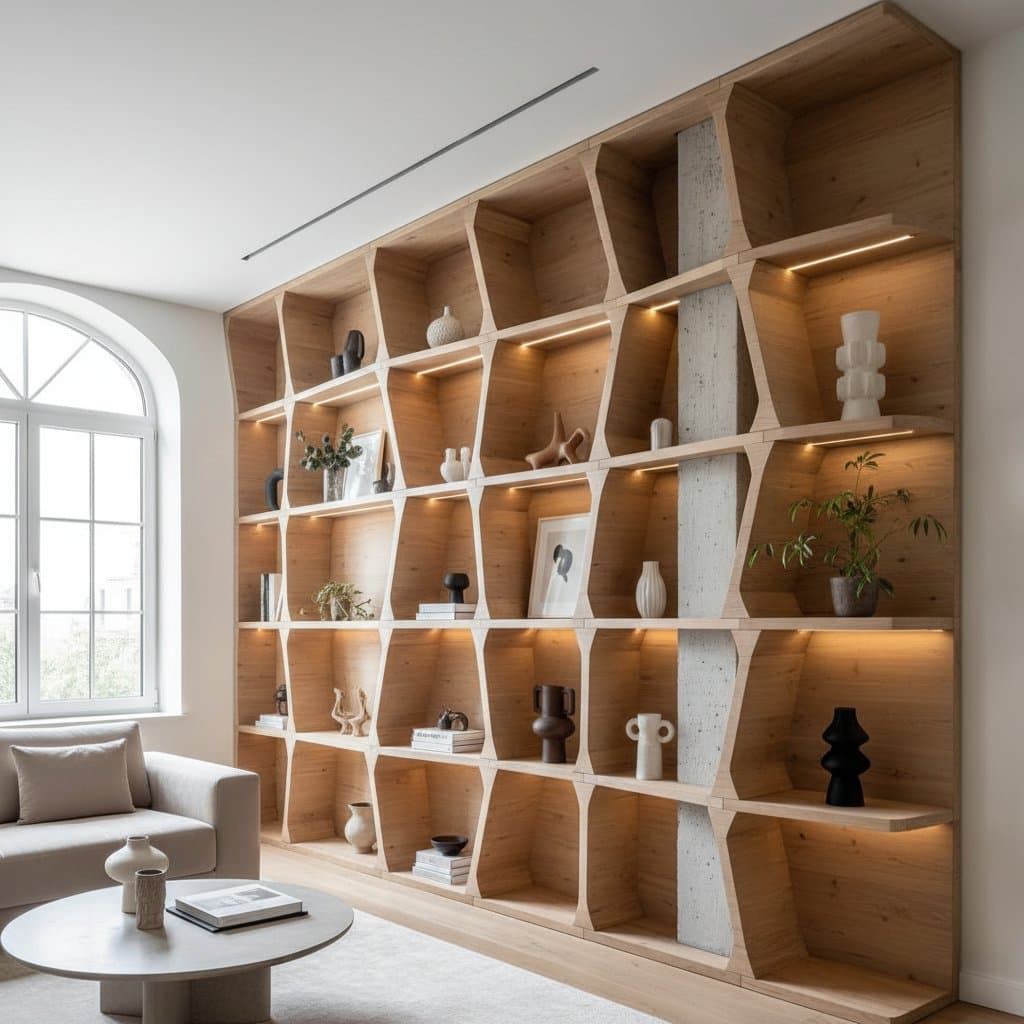
Why Parametric Shelves Are Revolutionizing Home Storage
Parametric shelves transform home organization by combining computational precision with traditional woodworking techniques. These systems allow furniture to conform to the contours of a space rather than requiring modifications to the environment. Homeowners gain the ability to customize every element, from curves to proportions, without manual drafting or extensive prototyping.
At a Glance
Target Audience: Design-conscious families and residents of compact urban dwellings
Ideal Settings: City apartments and modest homes with non-standard layouts
Fabrication Partners: Regional woodshops employing parametric software for modeling
Visual Documentation: Professional studio photography capturing fabrication stages and final installations
Dimensions Available: Wall-mounted units starting at 6 feet (1.83 meters) in length, extending to comprehensive 14-foot (4.27-meter) room systems
Before: The Limitations of Traditional Shelving
Conventional shelving systems featured rigid dimensions and straight lines with minimal flexibility. Fabricators depended on unchanging plans suited only to uniform wall measurements. Homeowners often encountered ill-fitting units that left unused spaces, overlooked corners, or incompatible surface treatments.
"We used to build shelves around the room's imperfections," noted cabinetmaker Julia Rehn, who shifted from standard methods to parametric techniques. "Now the shelves correct those imperfections."
The core issue lay in the reliance on manual calculations for predictability. Any deviation, such as a curved wall or slanted ceiling, demanded a complete redesign from the beginning.
After: The Precision of Parametric Design
Parametric shelves establish a new foundation through rule-based algorithms that govern measurement relationships instead of absolute values. An alteration to one parameter, like shelf depth or overall height, triggers automatic updates across the entire model.
This method yields cabinetry that aligns with intricate room geometries to within millimeters. Fabricators create units that navigate arches, encircle openings, or span irregular surfaces. Visual records highlight flawless connections, embedded illumination channels, and flowing wood grains that span multiple components.
Architect and fabricator Leo Martinez stated, "Parametric design converts geometry into programmable logic. With the logic established, software manages all variations. This liberation allows focus on tactile qualities, balanced forms, and the shelf's presence within the living area."
For residents, this results in integrated storage that maintains adaptability. Systems support future expansions, such as incorporating additional compartments or illumination, without necessitating a full overhaul.
Design Details
- Materials: Sustainable birch plywood cores, premium walnut veneers, and matte-lacquered MDF for modular accents
- Joinery Techniques: Precision CNC-machined finger joints achieving 0.02-inch (0.5-millimeter) tolerances
- Illumination Integration: Concealed LED strips positioned at 18-inch (45.7-centimeter) intervals to provide uniform lighting
- Storage Configurations: Customizable compartments with widths ranging from 9 to 14 inches (22.9 to 35.6 centimeters)
- Surface Treatments: Eco-friendly natural oils that accentuate grain patterns while minimizing reflections in bright conditions
- Functional Enhancements: Integrated cable management channels and magnetic attachment points for effortless panel removal
These elements promote seamless integration into routines. Variable depths accommodate displayed artwork or media collections. Built-in lighting eliminates reliance on separate lamps. The shelves function as architectural extensions rather than mere additions.
Why Parametric Shelves Matter
Parametric tools connect bespoke woodworking with computational efficiency, enabling small-scale operations to rival industrial production. Automation handles routine computations, preserving artistic oversight throughout the process.
Homeowners receive tailored solutions that respond to specific spatial challenges, from wall angles to storage requirements. Algorithms convert these inputs into fabrication-ready instructions, streamlining production.
Material efficiency improves significantly, with optimized layouts reducing scraps by up to 30 percent. Efficient part nesting conserves resources and accelerates timelines for woodworkers.
Steps to Incorporate Parametric Shelving
Homeowners can explore parametric options through modular kits from specialized woodshops, without committing to extensive installations.
- Define Core Needs: Identify items for storage and their designated locations.
- Gather Accurate Measurements: Employ a laser measurer to capture dimensions reliably, as models depend on precise data.
- Explore Parameter Interactions: Consult with fabricators on how changes in one dimension influence others; request real-time visualizations of adjustments.
- Choose Compatible Materials: Select options with matching thermal expansion properties to maintain joint integrity over time.
- Incorporate Lighting from the Outset: Specify fixture placements early, as channels must be routed prior to final assembly.
This process delivers algorithmic benefits without requiring technical expertise in software or programming.
Key Takeaways
- Seamless Spatial Adaptation: Algorithmic parameters guarantee alignment in non-standard environments.
- Material Conservation: Intelligent layouts decrease waste and associated expenses.
- Scalable Customization: Modify sizes or configurations without recreating designs.
- Enduring Quality: Exact joinery and harmonious proportions convey stability and versatility.
Installed units serve dual roles as artistic elements and practical storage. They direct visual flow, stabilize room compositions, and establish rhythmic patterns along surfaces. The overall impression conveys purpose and serenity, free from clutter or haste.
Evolving with Your Parametric System
The enduring benefit of parametric shelving emerges through ongoing use. As lifestyles shift, the framework accommodates updates like dedicated workspaces, replacement modules, or revised lighting setups. The foundational structure persists unchanged.
Designer Julia Rehn observed, "We engineer the system's responsiveness, not merely its form. Your shelf anticipates evolution."
For those who prioritize skilled construction alongside versatility, parametric shelving advances custom furniture design. It preserves wood's inherent warmth and the artisan's touch while incorporating computational foresight.