
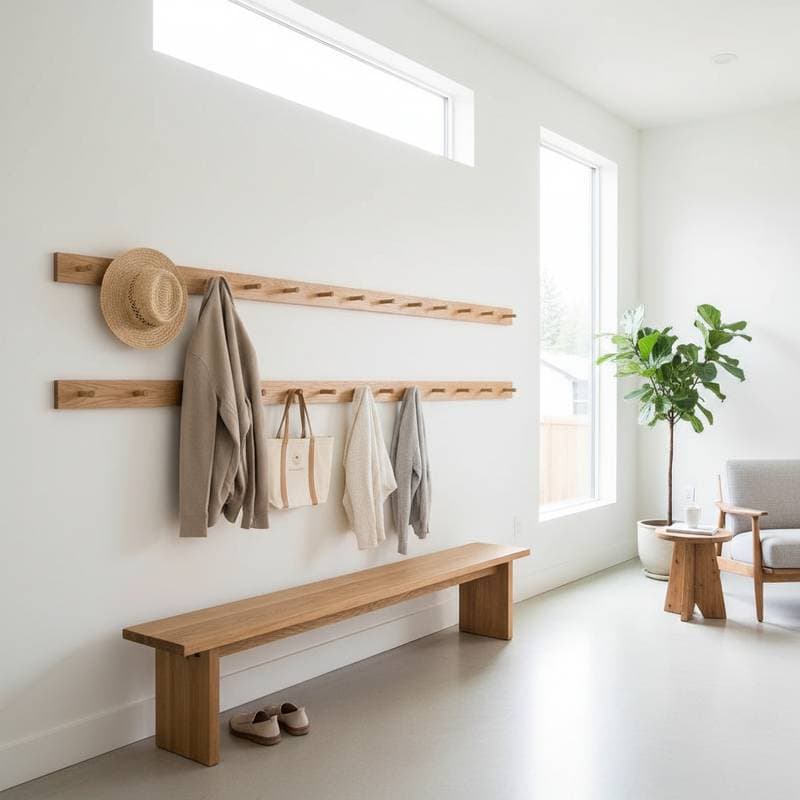
Minimalist Homes: Swap Closets for Shaker Peg Rails
Minimalist homes prioritize clarity and calm. Every surface serves a purpose, and each object must justify its presence. Traditional closets, with their swinging doors and cluttered shelves, frequently disrupt this balance. Designers increasingly turn to the Shaker peg rail, a centuries-old solution that restores order, flexibility, and craftsmanship to everyday spaces.
At a Glance
Who lives here: A couple who work from home and embrace simple living
Location: Portland, Oregon
Size: 1,200 square feet (111 square meters)
Design Team: Fieldline Studio
Photographer: Eva Lark
Before
The small cottage featured standard reach-in closets that encroached on floor space. Heavy doors obstructed natural light and complicated furniture arrangements. Hanging rods saw limited use, while bulky drawers occupied corners unnecessarily.
"We felt like the closets took more than they gave," said homeowner Jenna Wells. "They were dark, deep, and full of things we never touched."
After
The design team dismantled most closet enclosures and fitted continuous Shaker peg rails along strategic walls. In the bedroom, a twelve-foot (3.6 meter) maple rail extends above a low bench. Hooks support daily clothing, woven baskets, and select framed prints. The entryway now includes a matching rail alongside a narrow shoe shelf.
This transformation opened sightlines and permitted light to penetrate every corner. Morning routines streamlined as well. Jenna and her partner select items at a glance rather than rummaging through enclosed spaces.
"We wanted furniture to float and walls to breathe," said designer Marcus Field. "The peg rail provided both structure and softness."
Design Details
- Material: Solid maple with an oiled matte finish for subtle natural sheen
- Peg Spacing: Every six inches (15 centimeters) to create balanced rhythm
- Mounting Height: 66 inches (168 centimeters) from the floor for easy reach and clean visual lines
- Wall Color: Warm white in a satin finish to distribute daylight evenly
- Storage Add-ons: Cotton bags, felt baskets, and hanging planters for varied textures
- Lighting: Two warm white sconces positioned above the rail to accentuate wood grain and create silhouettes
Each rail features a subtle bevel that softens its profile. Pegs taper gently at the tips to secure hangers without exposed hardware. The team employed concealed screws and filled voids with matching plugs for a flawless appearance.
Why the Shift Works
The Shaker peg rail eliminates the divide between storage and living areas. Rather than concealing possessions, it displays them in an orderly rotation. This visible arrangement prompts regular editing. Items that do not fit naturally stand out right away.
In compact homes, the benefits prove tangible. One wall rail can substitute for up to eight linear feet (2.4 meters) of closet rod and shelving. Without deep enclosures, rooms appear one to two feet (0.3 to 0.6 meters) wider. Cleaning simplifies, as fewer crevices collect dust.
The design also promotes airflow. Garments hung on the rail dry swiftly, minimizing odors and upkeep. When combined with under-bench drawers or low chests, the system addresses both display and hidden storage requirements effectively.
Applying the Idea at Home
Begin with a modest installation to test the concept. A four-foot (1.2 meter) section behind a door or along a bathroom wall accommodates towels, robes, or bags. Select hardwood or painted pine with a clear finish to coordinate with existing trim.
Maintain uniform peg spacing and align the rail's top edge with adjacent moldings for a polished finish. Renters can opt for rails with keyhole hangers that detach easily, leaving minimal wall damage.
Achieve visual equilibrium by restricting each peg to one or two items. Incorporate diverse textures such as linen, wicker, and metal to add interest without overcrowding.
Key Takeaways
- Reclaim wall space: Peg rails eliminate bulky closet structures and expand usable surfaces.
- Enhance light and flow: Open storage maintains brightness and connectivity across rooms.
- Encourage mindful living: Visible items foster deliberate selections and reduced clutter.
- Adapt easily: Peg rails fit entryways, kitchens, bedrooms, or studios seamlessly.
- Build affordably: Expect material costs of 8 to 12 dollars per linear foot, varying by wood type.
Evolving with the Design
As time passes, the peg rail serves as a subtle chronicle of routines. Coats change with seasons, baskets hold ongoing projects, and the wood develops a richer patina. This simplicity demands gentle maintenance.
Fieldline Studio crafted bespoke rails for several rooms, including a kitchen wall where aprons and cutting boards suspend near a compact spice shelf. "It keeps tasks visible and honest," said Marcus Field. "You see what you need, and that shapes how you live."
For those pursuing minimalism, this method delivers liberation without starkness. Exchange a fixed enclosure for an adaptable plane that grows alongside your needs. Storage functions as integral architecture rather than mere furniture, harmonizing the space's innate dimensions.
Executed thoughtfully, a Shaker peg rail unites artisanal skill with everyday utility. It links historical handcraft to contemporary preferences for ease and organization. Each peg underscores a fundamental truth: elegance frequently emerges from restraint.