
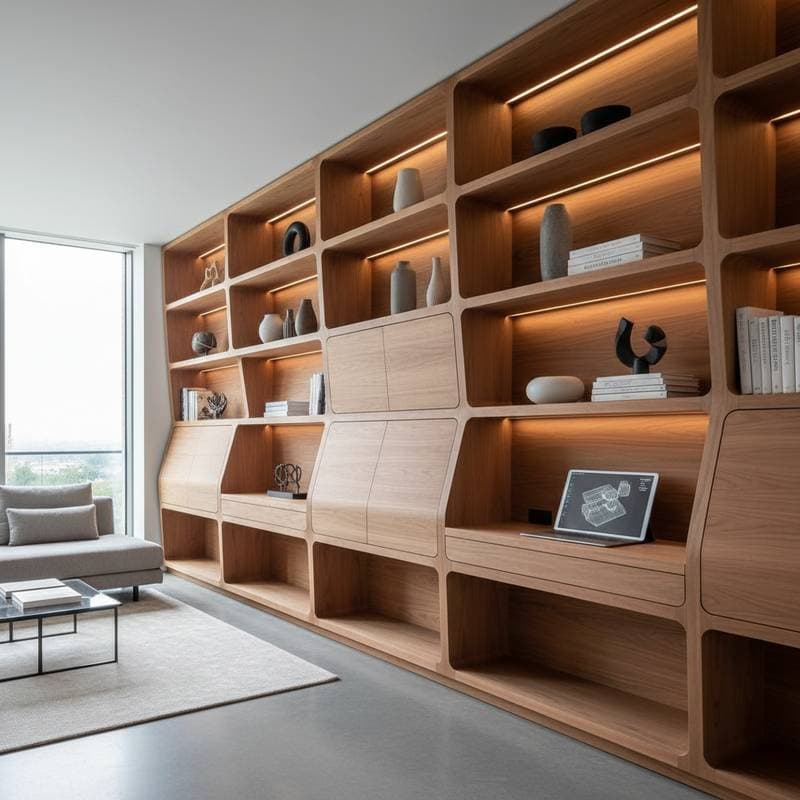
Parametric Algorithms Redefine Built-In Shelving Innovations
Algorithmic design transitions from conceptual digital environments into practical woodworking applications. Professionals and enthusiasts employ computational methods to develop shelving units that conform to irregular wall surfaces, individual usage patterns, and specific illumination requirements. This approach yields innovative built-in storage solutions that appear organically sculpted while maintaining full functionality. The fundamental shift involves replacing fixed blueprints with dynamic algorithms that govern proportions and spatial rhythms.
At a Glance
Who: Homeowners seeking versatile storage options
Where: Remodeling projects in urban and suburban settings throughout North America
Size: Installations typically span 120 to 240 square feet (11 to 22 square meters)
Design Teams: Parametric Studio, FormCraft Woodworks, and freelance computational specialists
Photography: Courtesy of FormCraft Visuals and Studio Luma
Traditional Challenges
Built-in shelving traditionally adhered to uniform grid systems. Carpenters measured spaces, cut components, and assembled repetitive elements. Such consistency produced straightforward aesthetics but offered limited adaptability. When walls presented irregularities or clients required diverse compartment sizes, workers often applied filler pieces or improvised connections that compromised the overall design.
"Clients wanted custom shapes but within tight budgets," said Marco Ellison, a carpenter who now develops prototypes using algorithmic templates. "We used to spend hours adjusting one side, only to find the opposite end off by half an inch."
Storage systems appeared inflexible, and any adjustments registered as imperfections rather than intentional variations.
Modern Transformations
Parametric software alters the entire design process. Designers establish parameters instead of sketching individual shelves. Shelf depths, lengths, and support elements adjust in real time based on inputted wall dimensions. After processing the algorithm, the output emerges as a virtual model prepared for CNC machining or laser fabrication.
Images from contemporary installations illustrate shelving that seamlessly integrates across full wall surfaces. Vertical partitions narrow or expand to match ceiling inclines. Horizontal shelves modulate gently to accommodate artwork, electronics, or books of varying dimensions. Integrated lighting traces along contoured edges, forming uninterrupted illumination paths instead of discrete points.
"The code lets the wood tell us what fits," said interior designer Nina Park of Parametric Studio. "We feed the wall scan into the program, and it generates a pattern that feels alive but still grounded."
Beyond aesthetics, this method enables the generation of exact fabrication files, which cut down on material overuse and preparation duration. Homeowners receive shelving tailored precisely to their spaces, blending analytical inputs with skilled artisanal execution.
Technical Specifications
- Materials: Baltic birch plywood finished with clear matte lacquer, complemented by white oak veneer and walnut edge banding.
- Joinery: Precision CNC-cut finger joints paired with concealed cam locks for on-site assembly.
- Lighting: Recessed LED channels positioned 3 inches (7.6 centimeters) from the back panel to produce depth-enhancing shadow effects.
- Hardware: Magnetic panels that hide fasteners yet permit straightforward maintenance access.
- Organization: Adjustable cubbies ranging from 8 to 14 inches (20 to 36 centimeters) in height to suit diverse storage needs.
- Finish Strategy: Layered matte and satin textures that accentuate the fluid linespatterns.
These selections balance durability with visual appeal. Algorithms outline the foundational framework, while material choices and dimensional refinements infuse character and harmony.
Key Influences
Parametric Tools for Everyday Use
Previously reserved for large architectural firms, parametric modeling software now operates on standard laptops. Free plug-ins for applications such as Rhino or Fusion 360 empower small workshops to iterate designs rapidly. Users alter a single parameter, like interval between shelves or structural load thresholds, and observe instantaneous updates across the model.
This iterative process fosters creative exploration. Woodworkers modify underlying rules rather than manually revising drawings. For instance, a parameter could specify maximum shelf lengths of 30 inches (76 centimeters) for plywood constructions or 36 inches (91 centimeters) for solid hardwoods, with the system enforcing compliance automatically during generation.
To expand on this, consider integrating user-specific variables: input average book heights or device widths to auto-scale compartments, ensuring ergonomic access without manual recalculations.
Online Dissemination
Algorithmic shelving designs proliferated via social media video content. Captivating time-lapse sequences depicting code evolving into physical installations garnered widespread attention. The fascination stems from observing abstract parameters materialize as tangible wood structures.
Professionals share foundational scripts openly, encouraging community adaptations. An amateur in one region downloads a core model from a distant creator and customizes it for regional material standards or preferred finishes. This collaborative network disseminates concepts more swiftly than conventional industry events, accelerating trend evolution.
Efficiency and Sustainability
Advanced nesting algorithms optimize part layouts on sheet materials, achieving minimal waste. For a conventional 4-by-8-foot (1.2-by-2.4-meter) plywood sheet, these methods reclaim up to 15 percent more usable area than hand-planned arrangements. In space-constrained urban workshops, where scrap storage poses challenges, such savings prove essential.
Furthermore, simulations assess load dynamics to refine material thickness. Designs employ slimmer profiles that convey lightness without sacrificing integrity, as the software identifies and reinforces critical stress zones prior to production.
Implementing Algorithmic Shelving in Your Space
- Capture the Space. Employ a smartphone lidar application or portable scanner to document wall contours accurately.
- Identify Core Needs. Determine primary storage items, such as books, decorative pieces, or electronics, to guide parameter settings.
- Select User-Friendly Software. Platforms like Grasshopper or Shapr3D offer introductory templates tailored to shelving configurations.
- Test with Prototypes. Output reduced-scale patterns on cardboard to evaluate ergonomics, including reach distances and visual alignment, before committing to wood.
- Collaborate with Fabricators. Local CNC services often process uploaded files directly; inquire about precision tolerances, stock thicknesses, and post-processing options like edge treatments.
This workflow demands precise measurements yet accommodates entry-level digital skills, making advanced customization accessible.
Essential Insights
- Rule-Based Adaptation: Algorithmic shelving employs defined parameters to harmonize structures with unique spatial constraints.
- Streamlined Processes: Digital pipelines enhance material efficiency, fabrication accuracy, and aesthetic possibilities previously uneconomical for bespoke projects.
- Community Momentum: Digital sharing propels these techniques from experimental stages to standard homeowner expectations.
Woodworkers who master parametric principles broaden their project scopes. Homeowners benefit from storage that aligns seamlessly with architectural features and personal habits.
As computational tools integrate deeper into woodworking practices, distinctions between automated generation and manual artistry blur. The result combines analytical rigor with expressive craftsmanship, elevating everyday storage into sophisticated, site-specific installations.