
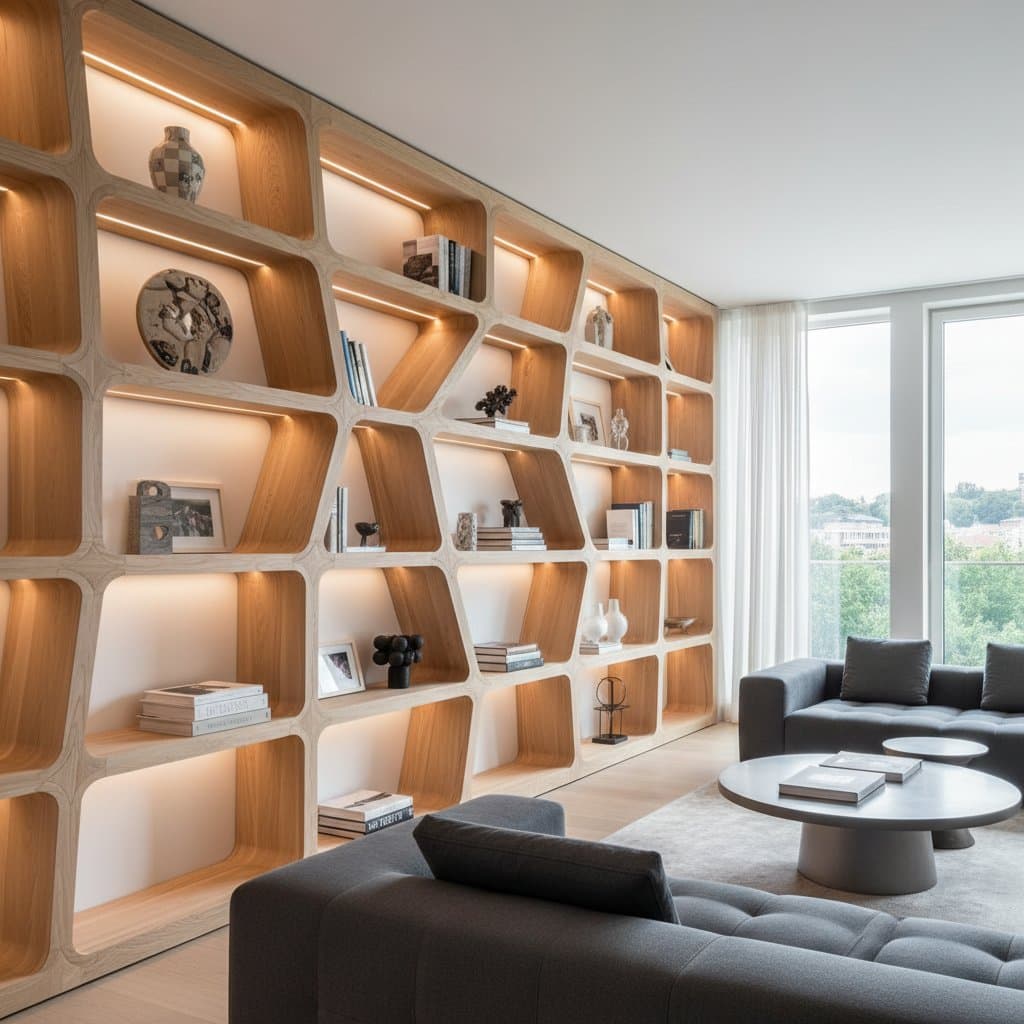
- Support Elements: Concealed steel brackets paired with soft-close sliding panels
- Connection Method: CNC-routed interlocking joints for seamless integration
- Storage Options: Modular adjustments for media, literature, and niche displays
- Added Functionality: Integrated charging station hidden within lower panels
The completed installation balances artistry and utility. Shelf depths align with intended applications: lower tiers accommodate vinyl collections and containers up to 18 inches (45.7 centimeters) deep for ergonomic access, mid-levels showcase glass items, and upper platforms support lightweight ornaments. The model guarantees structural integrity across all segments.
Algorithmic Design in Furniture Making
Parametric approaches, previously limited to large-scale architecture and engineering, now influence small-scale workshops. Designers establish geometric relationships tied to variables rather than absolute sizes. Altering a single factor, such as wall height or object dimensions, prompts automatic reconfiguration. AI integration streamlines this workflow, enhancing speed and accessibility.
The strength of this methodology extends beyond accuracy to customization. Systems process data on possessions, movement flows, and natural light to inform configurations. Wood artisans gain a hybrid practice that fuses manual skill with digital insight.
In a Vermont workshop experiment, parametric tools designed a reconfigurable lumber storage rack. The program assessed weight distribution and recommended brace orientations to prevent deflection under maximum loads. Material efficiency improved by 12 percent, with the fabricator concentrating on surface treatment and final assembly.
Parametric Process Explained
Parametric shelving development starts with established guidelines. Parameters include spatial limits, material selections, and operational objectives. Software generates compliant forms meeting practical and stylistic criteria.
- Data Entry: Specify area measurements, required storage types, and stylistic preferences.
- Computational Generation: Execute numerous simulations varying intervals, profiles, and motifs.
- Performance Assessment: AI evaluates outputs for equilibrium, accessibility, and durability.
- Production Preparation: Export the selected design for CNC or laser processing.
This method fosters collaborative exploration. Designers refine data-informed proposals efficiently, retaining creative oversight while leveraging automated variation.
Broader Implications
Shelving influences spatial organization in nearly every interior. Parametric innovation democratizes bespoke customization without excessive expense. Digital tools enable efficient one-of-a-kind production, minimizing inaccuracies and accelerating construction.
Sustainability benefits emerge through simulated resource allocation. Optimized cutting patterns align with standard sheet dimensions, reducing scraps and timelines. Homeowners enjoy adaptable setups; modules rearrange as lifestyles change, with algorithms facilitating updates for new contexts while preserving design cohesion.
Case Studies from Residences
Seattle Loft
Firm: Forma Studio
Photography: Carla Liu
An open-layout loft demanded subtle partitioning to preserve illumination. The parametric system produced a freestanding, gently curved divider between culinary and lounge areas. Shelf distribution maintained visual permeability and acoustic control. Walnut-veneered construction served dual roles in separation and exhibition. The resident observed, "It feels alive, like it breathes with the room."
Austin Bungalow
Firm: Grain Collective
Photography: Milo Perez
A confined foyer required lightweight storage. The AI-directed grid mounted to the wall, densifying at base level and narrowing above to elongate perceived verticality. Sub-shelf LED spots illuminated entry items like footwear and accessories. Reclaimed maple construction underscored environmental priorities.
Brooklyn Apartment
Firm: Atelier Kiro
Photography: Lina Torres
A slim corridor transformed into a compact reading nook. The model factored in pathway clearance and door arcs, yielding a graduated profile that expands toward light sources. Accessible depths housed volumes, with extended bays for artifacts and foliage. CNC milling followed by manual smoothing achieved a refined texture. The carpenter remarked, "It’s parametric, but it still feels crafted."
Essential Implementation Steps
- Capture Exact Dimensions: Parametric systems demand precise wall widths, heights, and fixture locations.
- Categorize Storage Needs: Sort belongings by scale and purpose to inform algorithmic inputs effectively.
- Incorporate Illumination Early: Model wiring routes for LEDs to prevent post-installation modifications.
- Select Compatible Materials: Plywood, MDF, and veneered woods interact uniquely with machining processes.
- Prototype Components: Fabricate reduced-scale versions to verify ratios and connections.
These practices adapt professional techniques for personal endeavors. Accessible software options allow initial trials in parametric principles prior to production commitments.
Sustaining Parametric Installations
Installed units require minimal upkeep. Protective finishes guard against daily use. Digital documentation of components simplifies part replication without repeated surveys. Users input revised data to modify or augment setups, ensuring longevity.
Daily interaction reveals thoughtful calibration: depths suit handling, intervals promote flow, and contours echo collection rhythms. Illuminated shadows follow predicted geometries, evoking organic warmth.
Credits
Design Firms: Studio Lume, Forma Studio, Grain Collective, Atelier Kiro
Photographers: Jason Kwan, Carla Liu, Milo Perez, Lina Torres
Parametric shelving bridges traditional woodworking and digital precision. It honors material textures while applying analytical rigor, advancing design that integrates intelligence into everyday forms.