
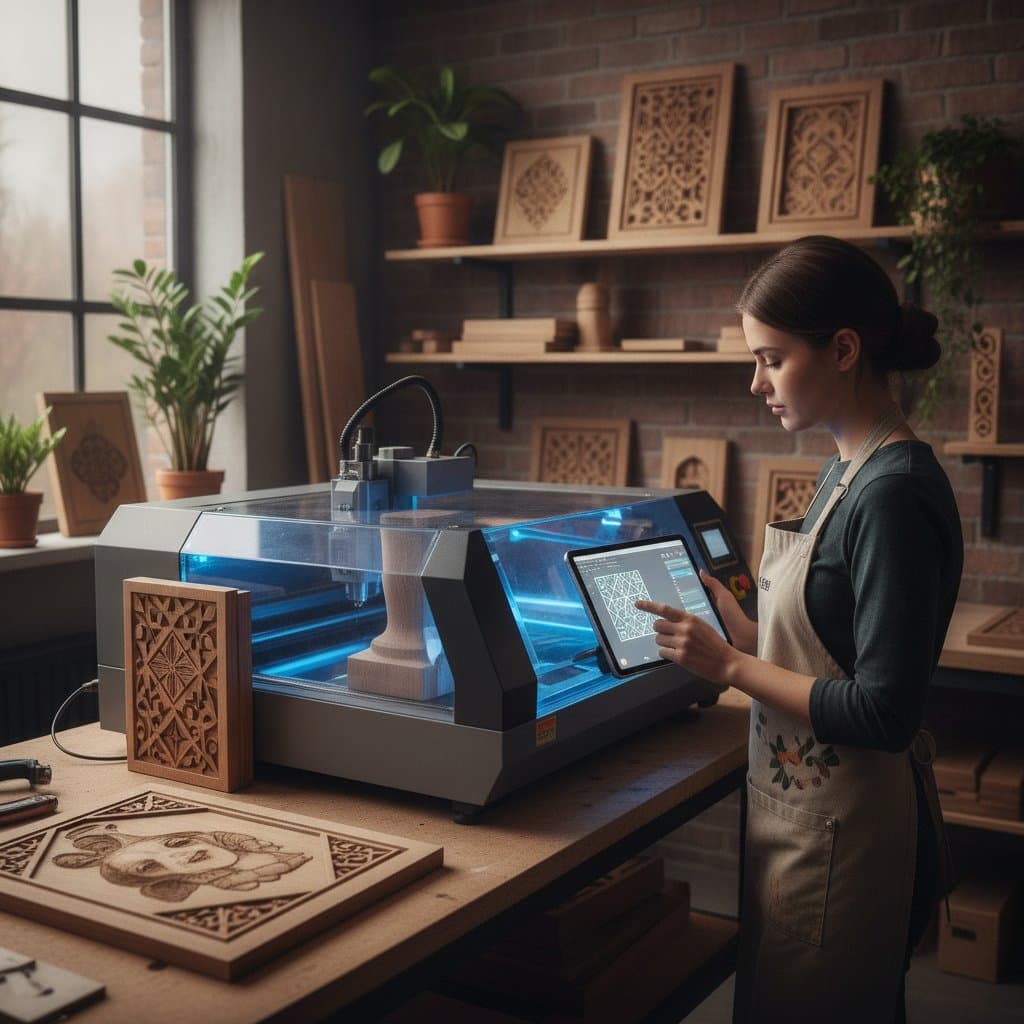
AI-Powered Engravers Make Personalized Furniture Easy
A custom coffee table with a family crest. A chair etched with a child's handwritten note. These projects once required hours of setup and significant labor costs. Today, AI-powered engraving tools guide makers through the process in minutes and deliver precision once limited to industrial equipment.
The change appears straightforward at first. Upload a design, allow the software to refine it, and let the laser engraver complete the work. In practice, the technology represents a fundamental shift in how furniture makers add meaning and market value.
Projects Made Possible
AI engraving supports personalization beyond basic monograms. Makers can incorporate photorealistic scenes, signature inlays, or custom joinery patterns that reflect a client's individual story.
Common applications include dining tables engraved with maps of family hometowns, headboards featuring geometric motifs, cabinet doors with burned botanical illustrations, and cutting boards etched with recipes in a loved one's handwriting. The software scales and mirrors designs automatically to maintain symmetry across multiple panels.
Personalized engravings raise selling prices by 20 to 40 percent while creating emotional connections that mass-produced items cannot match. Small shops gain a practical method to differentiate from larger manufacturers.
Installation Choices
Most AI-powered engravers allow self-installation and calibration, though the level of effort varies with system complexity.
Users comfortable with basic electronics and mirror alignment can complete setup in two to four hours. The included software runs a guided routine that verifies focus height and beam strength. This approach saves 200 to 400 dollars in service fees for single operators or small shops.
Professional installation becomes advisable when the engraver integrates with a larger CNC system or when heavy furniture parts require engraving. Technicians manage grounding, cooling, and safety certification for a fee of 350 to 600 dollars.
Before hiring, verify that the technician holds certification for the specific laser type and maintains liability insurance. Request references from other woodshops and require a test engraving to confirm calibration accuracy.
Safety Requirements
Laser engraving produces heat, smoke, and fine particles. Follow standard shop safety practices at all times.
- Wear eye protection rated for the laser wavelength in use.
- Install an exhaust duct that vents outdoors.
- Keep a CO2 fire extinguisher within reach.
- Verify local code requirements for electrical load and exhaust placement.
Some areas require a permit for equipment above certain wattage thresholds. Consult the building inspector prior to installation.
Practical Habits That Improve Results
Test settings on wood species that match the final material. Birch and maple accept light engraving, while walnut and cherry yield stronger contrast. Maintain a record of speed, power, and resolution values for each wood type. Apply painter's tape before engraving to avoid soot marks, then remove it afterward. Perform engraving before applying oils or varnishes, because finishes alter laser absorption.
Business and Creative Applications
Clients often touch the engraved detail first. This response builds attachment that frequently leads to repeat orders. The same equipment supports business branding through subtle logos on chair undersides or serial numbers on limited-edition pieces.
Home users apply the tools to gifts, signage, and cabinetry with equal effectiveness. A single compact unit serves both creative and functional needs.
Selecting Equipment for Your Shop
Identify surfaces where personalization adds the most value, such as drawer fronts, tabletops, or cabinet doors. Match machine capacity to material size and expected production volume. Consistent testing and documentation of settings will produce reliable, professional outcomes across projects.