
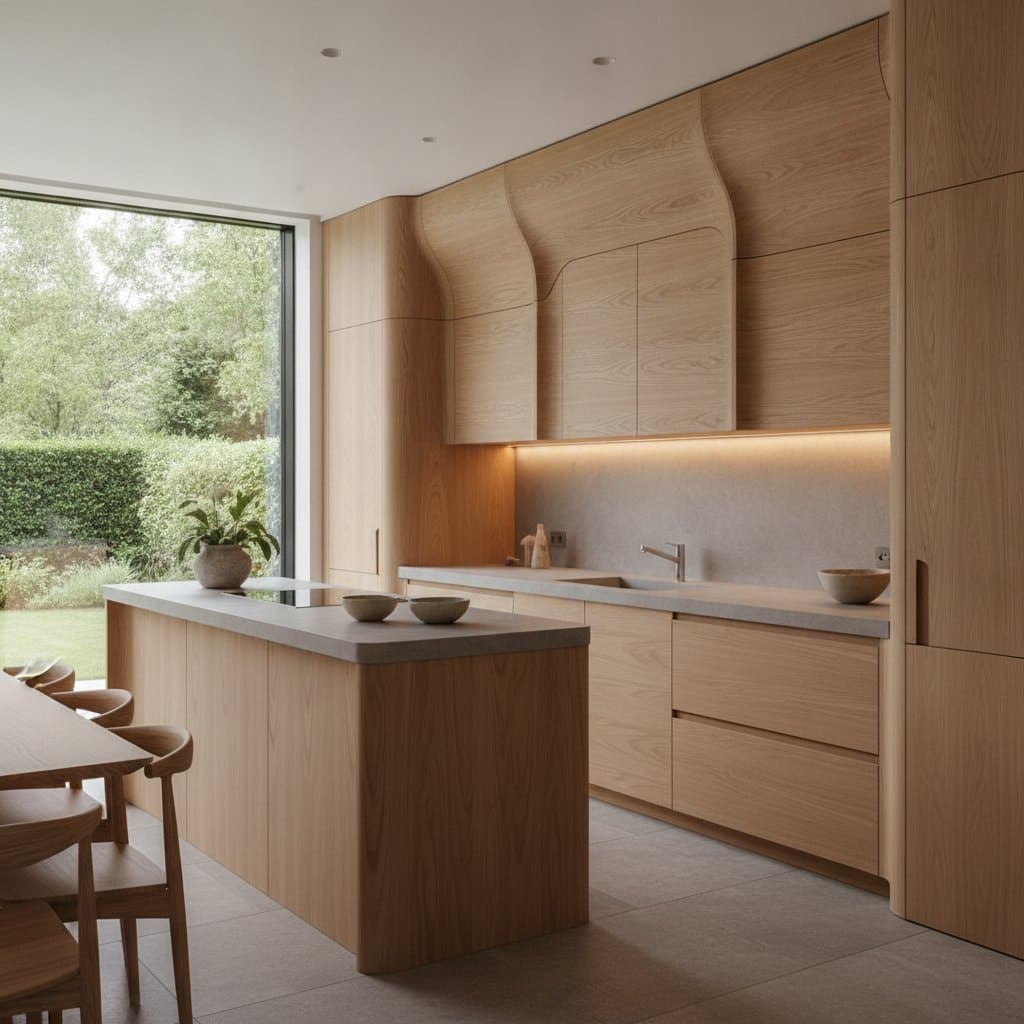
Steam-Bent Curves Replace Straight Cabinet Lines
Cabinet lines once followed rigid grids across kitchens and studios. Now they sweep and bend to soften corners and guide movement. Steam-bent wood, long used in boat building and chair making, has entered cabinetry. The result is furniture that feels fluid, sculptural, and shaped by hand.
Designers and woodworkers now rethink panel construction, door profiles, and toe kicks. What was once a box becomes a contour. This change alters how light moves across surfaces and how people navigate rooms. It also requires new shop skills, from jig construction to steam cycle timing.
Traditional Grid Layouts
Cabinet design once relied on straight lines for speed and consistency. Shaker and slab doors aligned in neat rows. Corners met at precise right angles. Builders used flat panels cut on table saws and predictable dimensions.
Many homeowners found this geometry stiff. Jenna Lowe, who worked with Hatchwood Design on her remodel, noted that her kitchen functioned well yet resembled a set of boxes. She sought a result that felt more like furniture than fixed fixtures. Flat doors also created uneven shadows. Light struck edges sharply instead of spreading evenly.
Material and Construction Choices
- Quarter-sawn white oak, walnut, and ash provide straight grain that bends without tear-out.
- Steam chambers made from six-inch PVC pipe and wallpaper steamers supply consistent heat.
- Bends typically range from ten to fourteen inches for cabinet corners.
- Mortise and tenon frames receive dowel reinforcement at points of stress.
- Low-sheen catalyzed lacquer highlights fiber compression marks.
- Under-cabinet LED strips at 2700K warm the curved surfaces.
- Curved lazy Susans, arc-shaped pull-out trays, and matching vertical dividers maintain storage function.
Each choice supports visual continuity. Curves now connect areas that straight edges once separated.
Shop Process for Bending Components
Steam bending demands careful preparation. Select straight-grained boards with twelve percent moisture content. Build forms from MDF or laminated plywood, adding ten percent extra radius to account for springback.
Heat each piece for one hour per inch of thickness. Remove it from the chamber and clamp it at once, keeping pressure uniform to avoid twist. Allow the form to rest for forty-eight hours so the wood cools and stabilizes. After release, trim ends square and integrate panels into frames. Reinforce joints near bends with splines or dowels.
This method often reduces waste. A single one-inch board can replace multiple glued layers needed for a laminated curve.
Lighting That Follows Curved Surfaces
Curved cabinetry changes light behavior. Continuous surfaces remove abrupt shadow lines. Task lighting uses linear LED strips beneath upper cabinets to emphasize grain. Ambient cove fixtures wash panels from above and produce soft gradients. Small recessed spots at toe kicks trace the base arcs.
The layered approach increases perceived depth. Homeowners note that rooms appear larger because light travels smoothly rather than stopping at edges.
Practical Benefits in Daily Use
Rounded corners ease circulation and reduce sharp contact points. Steam bending revives hand skills within cabinet production. Curves spread illumination evenly and create a steady visual rhythm. Properly dried components hold shape as well as laminated parts. Each radius can match specific room dimensions, from narrow galleys to open plans.
Daily Care and Long-Term Performance
Steam-bent cabinets develop a subtle patina as compressed fibers relax over time. This gentle movement adds character without affecting function. Clean surfaces with mild soap and water. Avoid standing moisture. Apply a compatible oil once a year. Keep room humidity between thirty-five and fifty-five percent. Inspect joints near curves annually and adjust hinges or add thin shims if minor movement occurs.
Homeowner Jenna Lowe observed that the shapes encourage a slower pace. Light slides along the grain during cooking, and the room seems to respond to daily rhythms.