
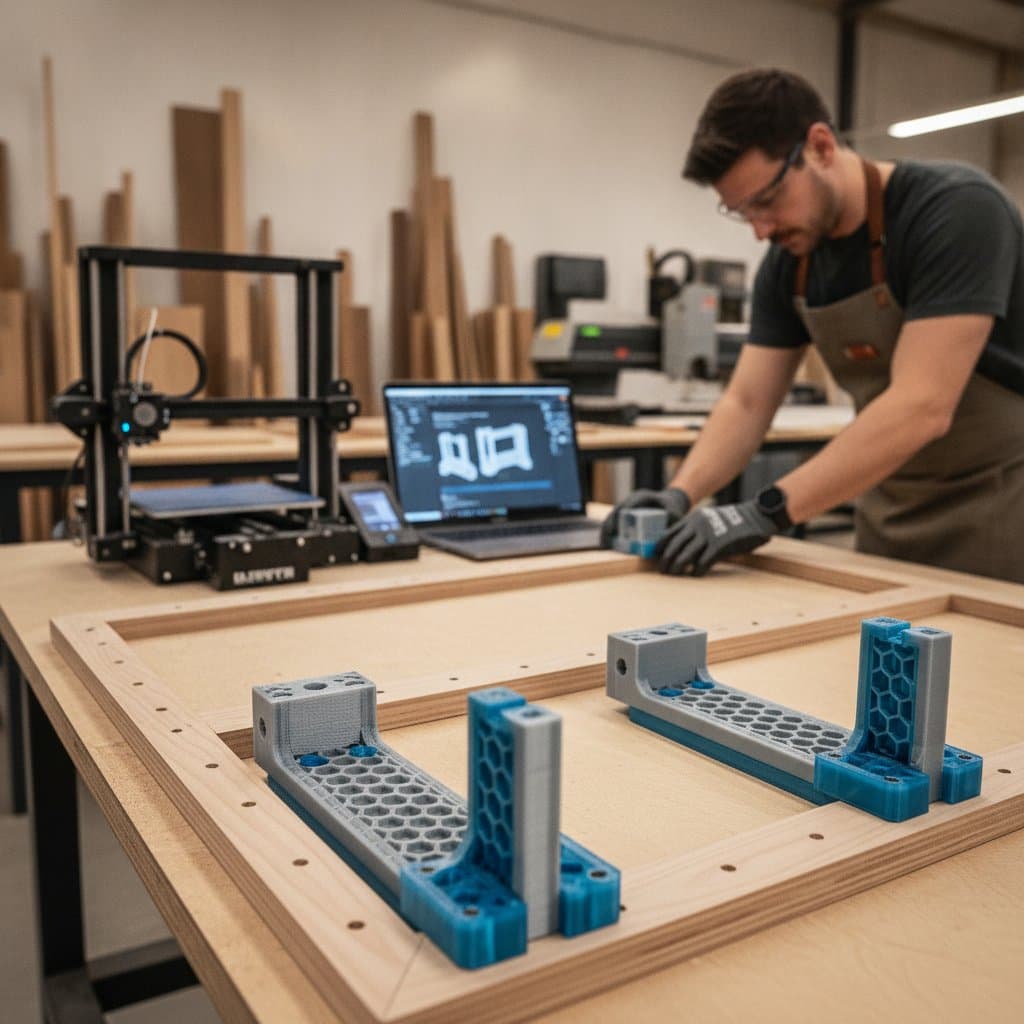
3D-Printed Jigs Revolutionize Custom Cabinet Making
Custom cabinet makers have always relied on precision. Every hinge plate, drawer glide, and shelf pin depends on exact placement. The challenge has been building jigs that guarantee accuracy without slowing production.
Now, 3D printing technology is changing that equation. By merging digital modeling with rapid fabrication, makers can create specialized jigs faster, cheaper, and with near-perfect repeatability. The defining move is the shift from fixed templates to parametric, 3D-printed tools that adapt to any cabinet design.
At a Glance
- Who: Independent cabinet shops and design-build studios
- Where: Across residential and commercial projects
- Size: Shops ranging from 400 to 5,000 square feet (37 to 465 square meters)
- Design Teams: Custom fabricators and digital modelers collaborating through shared CAD platforms
- Photography: Courtesy of workshop documentation and product teams
Traditional Limitations
Traditional jigs took hours to make and often only fit one configuration. When a client wanted a slightly different drawer width or door overlay, fabricators had to modify or rebuild the jig. Luis Romero, a cabinet maker in Portland, noted the time sink. We used to spend half a day cutting and aligning plywood templates. They worked, but they were hard to store and even harder to adjust later.
Conventional materials like MDF or acrylic limited the precision of small openings or complex angles. Over time, drill bushings loosened, and alignment marks wore off. In high-volume custom shops, that meant lost accuracy and wasted time.
Modern Workflow with Printed Jigs
Now, with 3D-printed jigs, the process is digital from start to finish. Makers input hardware dimensions into a parametric model, adjust a few variables for overlay or spacing, and print a ready-to-use jig in under two hours. The result is a lightweight, durable tool that fits the exact hardware and cabinet dimensions every time.
Photos from fabrication floors show rows of bright orange and gray printed jigs hanging neatly on pegboards. Each one is labeled with embedded text and magnetized inserts for secure positioning. The printed pieces have smooth reference edges, chamfered corners, and built-in guides for clamps or pins.
The big win is repeatability, said industrial designer Cara Nguyen, who develops 3D printable jig libraries for small shops. You can tweak one parameter in the file and have a perfect fit for the next project. No sawdust, no hand measuring.
The 3D prints are often made from PETG or nylon composites that resist warping and handle repeated drilling. Many shops now print modular systems, such as dowel drilling grids or adjustable hinge plates, that snap together for different cabinet widths.
Design Details
- Materials: PETG, nylon, or carbon fiber-reinforced filament for strength and stability
- Printing Time: Roughly 60 to 120 minutes per jig, depending on complexity
- Accuracy: Tolerances within 0.008 inch (0.2 millimeter) using midrange printers
- Storage: Wall-mounted pegboards or drawer bins labeled by hardware type
- Cost: Average material expense of less than 10 dollars per jig
- Customization: Parametric CAD files let users resize openings or shift hole spacing in minutes
These details make the system practical for one-off jobs and small production runs alike. The consistent accuracy also means fewer test fits and re-drills, saving both material and labor.
Workflow Advantages
3D-printed jigs are not just faster to produce. They change how shops think about workflow. Instead of waiting for a prototype jig, designers can iterate digitally while the printer runs in the background. This keeps fabrication moving and reduces downtime between design revisions.
The technology also democratizes precision. Small shops that might not afford CNC fixtures can now achieve comparable results with desktop printers. It levels the field, said Nguyen. You do not need industrial equipment to get industrial accuracy.
Another benefit is sustainability. Printed jigs use exactly the filament required, with almost no waste. When a design changes, the old jig can be recycled or reprinted with updated dimensions. That flexibility fits the needs of modern custom cabinetry, where every project is unique but still demands production efficiency.
Parametric Modeling Benefits
The move toward parametric modeling is reshaping how cabinet components connect. Instead of static blueprints, designers use digital models that adjust automatically when dimensions change. A jig designed from the same model maintains alignment with the updated cabinet layout.
For example, a shop building a custom kitchen can model all hinge positions in software, generate matching drilling jigs automatically, and print them overnight. Each jig corresponds to a specific door type or overlay, labeled directly in the print.
This workflow reduces communication errors between design and production. When the cabinetmaker opens the model, all references match the print. The physical jig becomes an exact translation of the digital plan.
Steps for Shop Integration
To adopt 3D-printed jigs, most shops start with hybrid setups. They print smaller templates first, then expand to full systems. A typical path includes:
- Hardware drilling jigs for hinges, pulls, and shelf pins.
- Assembly guides for drawer boxes or face frames.
- Router templates printed in thicker nylon for flush trimming or pattern shaping.
- Custom stops or spacers for repetitive cuts on table saws or drill presses.
Once the team gains confidence, they build a digital library of models tied to standard cabinet components. Over time, that archive becomes a valuable toolset, reducing setup time on every project.
Printing can run overnight, so jigs are ready each morning. With multiple printers, production teams can generate entire sets for large installations.
Core Advantages
- 3D-printed jigs reduce fabrication time by up to 70 percent compared to traditional templates.
- Parametric modeling ensures perfect alignment between digital design and physical hardware.
- Material costs remain low, making it cost effective even for small shops.
- Digital libraries let teams store, modify, and reprint designs instantly.
- Sustainability improves with minimal waste and recyclable materials.
These advantages compound over time. Each printed jig adds to a growing toolkit that makes every new project faster and more precise.
Daily Shop Impact
The shift to 3D-printed jigs represents more than a technical upgrade. It changes the rhythm of daily work. Makers spend less time cutting templates and more time refining fit and finish. Design revisions happen digitally instead of on the bench.