
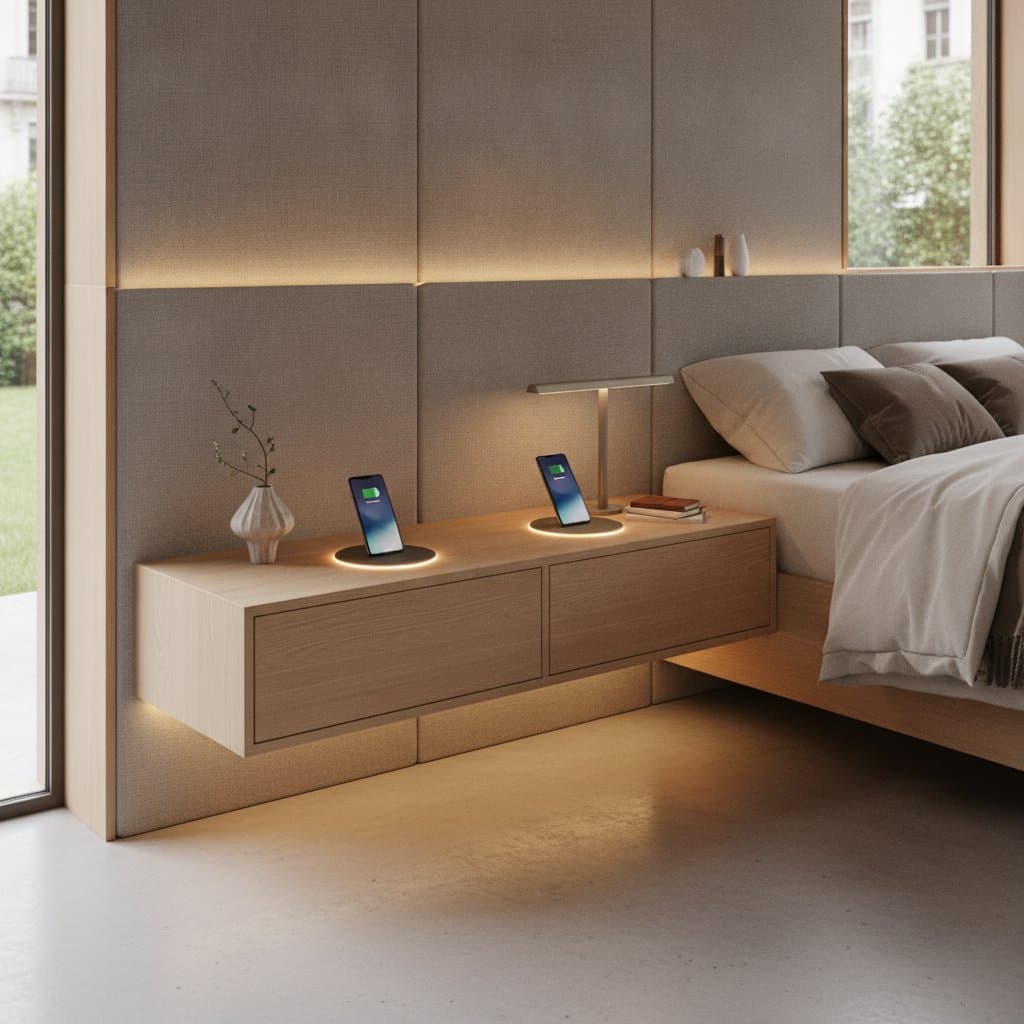
Cable-Free Floating Nightstands Transform Bedrooms
Floating nightstands have become quiet stars in bedroom design. They merge clean lines with hidden function. The newest generation goes beyond minimal surfaces and open space. Built-in wireless charging now removes the visual clutter of cords. These nightstands appear to hover while powering devices invisibly.
At a Glance
- Who lives here: A couple who wanted more surface space and fewer cords near the bed
- Location: Portland, Oregon
- Size: Bedroom, 180 square feet (16.7 square meters)
- Design team: Harper Lowe Studio
- Photographer: Mason Boyd
Before the Update
The original bedroom had two bulky oak tables flanking the bed. Each held a lamp, alarm clock, and a tangle of charging cords. Drawers jammed against the bed frame, and floor space felt tight. The homeowner noted that cables behind the tables created constant tripping hazards. The space looked messy no matter how much they tidied. The couple wanted storage that felt lighter and more integrated with the wall. They also wanted to charge phones and smart watches without cords snaking across the top.
After the Update
The designers replaced both tables with wall-mounted floating boxes. Each box measures 18 inches (45.7 centimeters) wide and 12 inches (30.4 centimeters) deep. The boxes sit eight inches (20.3 centimeters) off the floor. This placement allows light to wash beneath them. Inside the top panel, a concealed wireless charging pad powers devices through the wood surface. The result is a smooth top with no visible hardware or outlets.
A continuous backboard of white oak veneer extends behind the bed. It unifies the wall visually. The wood vertical grain draws the eye upward. Its matte finish softens the light from integrated LED strips hidden along the underside. The couple reading lamps now mount directly to the headboard with slender swing arms that pivot for focused light. Designer Harper Lowe stated that the goal was a mood that feels quiet and grounded. Removing the cords was key. It lets the wood and light take the lead.
The new arrangement frees up nearly two feet (61 centimeters) of walking space on each side. Drawers glide on soft-close slides. Each interior is lined in felt to prevent small items from rattling. The floating form makes the entire wall feel wider and cleaner. It frames the bed as the visual center.
Design Details
- Materials: White oak veneer with clear matte finish, concealed aluminum wall cleats, felt drawer liners
- Lighting: LED strip lighting hidden under each nightstand, swing-arm reading lamps in black powder-coated steel
- Wireless Charging: Inductive charging pads embedded in the top panels, compatible with Qi-enabled devices
- Storage: Single drawer 14 inches (35.5 centimeters) wide and 4 inches (10.1 centimeters) deep, plus open shelf below
- Installation Tip: Mount top surface 24 inches (61 centimeters) above the floor for comfortable reach from bed
- Maintenance: Use a soft cloth and gentle cleaner to protect the finish and maintain wireless charging efficiency
The mix of technology and craft is what makes these nightstands stand out. You touch the surface and your phone begins to charge. Yet nothing interrupts the grain of the wood.
Why the Design Matters
Bedrooms work best when clutter is controlled and movement feels natural. By removing cords and table legs, these floating units clear both sightlines and physical space. The effect is subtle but strong, especially in smaller rooms. Light now reaches the floor. This change makes corners feel larger and easier to clean.
Homeowners also gain flexibility. With outlets hidden behind the panel, there is no need to align furniture precisely with wall plugs. The design invites variation. Some homeowners pair two matching boxes for symmetry. Others install a single floating drawer for a minimalist look on one side. The approach fits contemporary, Scandinavian, or mid-century interiors with equal ease.
Adapting the Idea for Your Home
You can apply the same principles even without custom fabrication. Prefabricated wall-mounted drawers and wireless charging pads are widely available. Key steps include the following.
- Plan Power Access: Locate an outlet behind or below the mounting area. Use a recessed outlet box to keep cords from pushing the unit away from the wall.
- Choose the Right Height: The typical reach from a standard mattress top is about 8 to 10 inches (20.3 to 25.4 centimeters). Adjust your mounting height so the nightstand surface aligns comfortably with that range.
- Integrate Lighting: Add an LED tape strip under the shelf to create a soft glow. Connect it to a dimmer for adjustable evening light.
- Select Durable Materials: Solid wood or high-quality veneer resists wear and conducts wireless power efficiently when the top panel is no thicker than 0.4 inches (1 centimeter).
- Test Charging Efficiency: Before final installation, verify that your devices charge through the surface. Small variations in wood density can affect performance.
By combining these details, you can achieve a look that feels fully built-in without major renovation.
Three Design Moves That Elevate Floating Nightstands
1. Continuous Headboard Wall
Extending the same material behind the bed and nightstands creates a unified backdrop. It hides wiring for power and lighting while visually widening the room. A continuous panel also provides a clean edge for mounting lamps or art.
2. Layered Lighting
Pair ambient lighting under the nightstands with directed task lighting above. The contrast gives dimension and supports different activities, from reading to winding down. Use warm color temperatures for a restful tone.
3. Hidden Technology
Wireless charging pads, touch-activated lights, and motion sensors all keep surfaces clear. The technology disappears until needed. Lowe noted that convenience should come without seeing the mechanism. That is what makes the space feel calm.
Daily Benefits of Cable-Free Design
Once installed, cable-free nightstands change small habits. You set your phone down and it charges automatically. You can vacuum under the units without moving furniture. The room feels larger because light flows across the floor uninterrupted. The visual calm at bedtime carries through to morning routines.
For a quick refresh, consider adding a second layer of lighting behind the headboard or updating drawer pulls in a contrasting metal. These minor moves keep the design flexible as your technology or style evolves.