
Why Woodworkers Are Ditching Poly for Tung Oil
At a Glance
Who: Professional and hobbyist woodworkers across small shops and custom studios
Where: Across the United States and Canada
Size: Varies from 200 to 2,000 square feet, or 18.5 to 185.8 square meters
Design Team: Finishing specialists, product developers, and restoration experts
Photographer: Courtesy of shop contributors and finish makers
Before
For decades, polyurethane dominated the finishing bench. It offered hardness and shine, but also fumes, long cure times, and a plastic feel that sealed wood under a heavy shell. Many woodworkers accepted it as the default because it was durable and predictable. Still, it left something missing.
“Poly always felt like a layer between me and the wood,” said furniture maker Tom Rivera. “It looked clean, but I wanted to feel the grain, not a coating.”
The demand for safer, more natural finishes started small, often in cutting board and kitchenware circles. As awareness of indoor air quality and sustainable materials grew, so did curiosity about traditional oils.
After
Enter pure tung oil. Once limited to boutique makers, it is now a staple in many modern shops. The shift reflects a larger move toward finishes that highlight natural texture, improve repairability, and reduce chemical exposure.
When applied correctly, tung oil penetrates deep into the fibers, forming a flexible, water-resistant barrier without altering the wood’s tactile warmth. It enhances tone rather than covering it, creating a matte to soft-satin glow that fits today’s preference for natural finishes.
Designer and finisher Amy Leung explained, “Clients love how it feels alive. Tung oil breathes with the wood and ages gracefully. You can spot-repair it without stripping an entire surface.”
Design Details
- Application: Typically three to five coats, thinned for early layers to improve absorption. Each coat dries overnight, then buffs to a gentle sheen.
- Coverage: Roughly 400 square feet, or 37.1 square meters, per gallon depending on species and porosity.
- Durability: Resistant to water and mild solvents once fully cured, suitable for countertops, furniture, and turned bowls.
- Maintenance: Easy touch-ups. A thin recoat restores luster without sanding to raw wood.
- Safety: Food-safe when cured, making it ideal for cutting boards, salad bowls, and kitchen tools.
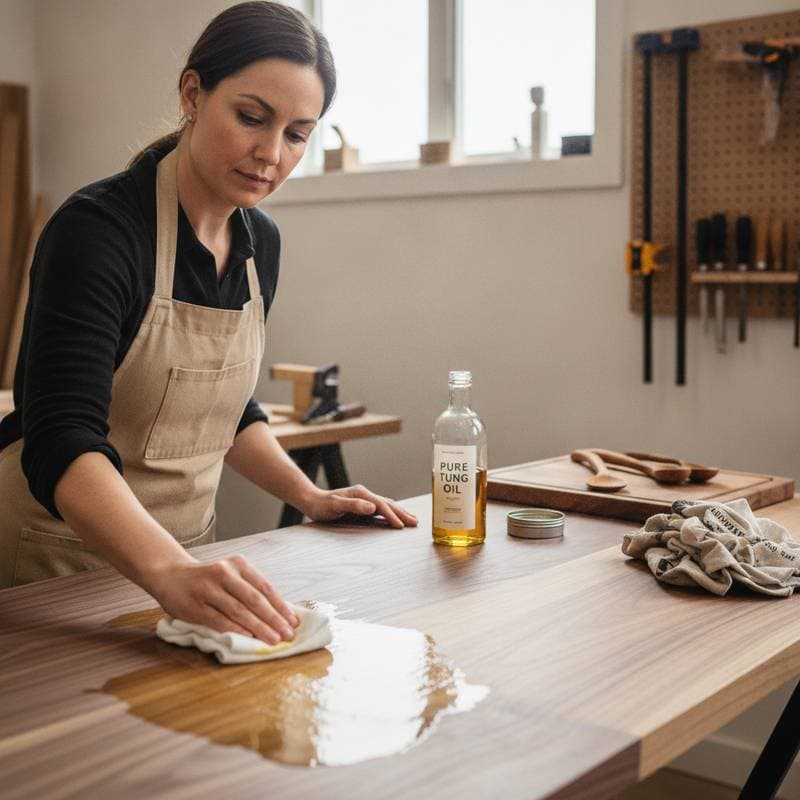
The application process rewards patience. Woodworkers usually sand evenly, remove all dust, and apply a thin coat with a lint-free cloth or brush. Excess oil should be wiped away rather than left in puddles, since heavy layers can remain tacky and cure unevenly. Testing on scrap from the same board is also important because porous species absorb oil differently from dense ones.
Pure tung oil should not be confused with products labeled tung oil finish. Some blends contain varnish, drying agents, or petroleum solvents. Those products can still be useful, but makers seeking the most natural result should read the label carefully and follow the manufacturer’s safety directions.
Why It Matters
Tung oil’s rise connects craft, health, and sustainability. It contains no synthetic resins or harsh solvents when used pure. Many formulations are VOC-free and biodegradable, aligning with a growing preference for environmentally responsible materials.
The tactile difference is also key. Polyurethane builds a film that can appear glassy or thick, while tung oil accentuates natural character. Under workshop lighting, you see grain depth and chatoyance rather than a reflective surface. In photos, the light appears softer, with subtle highlights rather than glare.
Functionally, tung oil finishes move with seasonal wood expansion. This flexibility prevents cracking or peeling, especially on wide panels and solid slab tables. Woodworkers appreciate that it allows easy future maintenance rather than a full refinish cycle.
The finish also supports thoughtful interior design. On dining tables, benches, shelving, and accent furniture, its quiet sheen works with linen, stone, leather, and painted surfaces. It adds warmth without competing with a room’s architecture. In restoration work, tung oil can refresh a worn piece while preserving small marks that contribute to its history.
Key Takeaways
- Natural Look and Feel: Tung oil enhances the wood’s authentic texture and tone.
- Health and Safety: Lower odor and no synthetic sealants create a safer workspace.
- Repair and Longevity: Simple reapplication extends the life of the finish without intensive prep.
- Sustainability: Derived from the seeds of the tung tree, it is a renewable resource supporting eco-conscious production.
- Versatility: Works across species, from maple and walnut to bamboo and reclaimed pine.
For small shops, this switch also improves daily flow. Without the need for heavy ventilation or expensive respirators, finish work can happen alongside other tasks. Cleanup uses mild soap or citrus-based thinner instead of strong solvents.
Woodworker Elena Brooks said, “I can finish boards in the same room where I glue up panels. It changed how I schedule projects. My shop smells like wood again, not chemicals.”
Even with its advantages, tung oil is not a shortcut. It may require more hands-on attention than a single thick film coat, and full curing can take patience. Surfaces exposed to standing water or heavy commercial use may need a different system. Good design begins with matching the finish to the object, its location, and the way it will be used.
Living with a Natural Finish
The resurgence of tung oil signals a deeper respect for material honesty. It reminds makers that finishes can protect while still letting wood be wood. For clients, the result is furniture that invites touch and develops patina gracefully.