
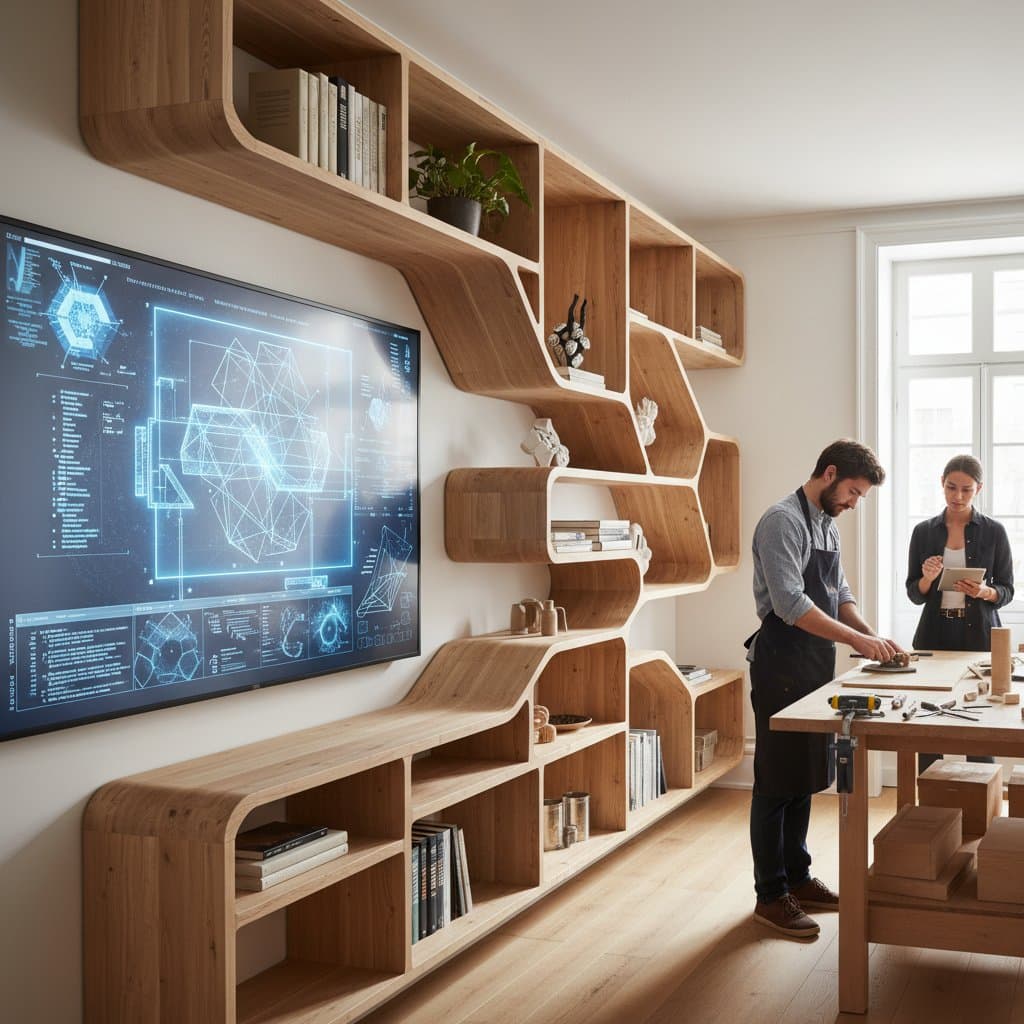
AI Parametric Shelving Moves from Studio Experiments to Workshop Floors
Parametric furniture design has moved from niche studio experiments to widespread interest. Across social platforms, videos of shelving units adjusting in real time through algorithmic software draw large audiences. What once required complex computation now appears approachable. Behind the animations lies a practical method for designing storage that combines craft precision with digital intelligence.
This overview examines how AI and parametric tools change custom shelving, what sets these systems apart from traditional joinery, and how woodworkers can apply them to produce adaptive and visually striking storage.
Current Landscape
Independent fabricators, design studios, and home woodworkers now test AI-assisted workflows. Projects range from small wall niches to full shelving walls that span large surfaces. Teams at Parametric Studio and FormaLab work alongside local woodworkers who adapt open-source scripts. Photographers capture the builds to document the results.
Traditional Limitations
Traditional built-ins rely on static drawings and fixed dimensions. Once a design is cut, adjustments require rework. Many workshops spend time on repetitive layout tasks and handling irregular wall dimensions by hand.
Luis Ramirez, a cabinetmaker, noted that every wall sits slightly off and every ceiling dips somewhere. Before algorithmic modeling, this led to extra filler panels or uneven joints. The main constraints remained time and accuracy, as designers refined CAD files only to encounter fit issues during installation.
How Parametric Design Changes the Process
Parametric design redefines the workflow. Makers set rules that describe relationships between parts instead of drawing each shelf manually. When one dimension changes, the entire system recalculates. AI-assisted platforms extend this capability by learning preferences and optimizing materials during the process.
A wall-length oak shelving system can ripple slightly near the ceiling to follow an uneven plaster surface. Vertical dividers taper as they rise, and each shelf depth adjusts to hold specific objects. Every joint remains precise because CNC equipment follows data from the parameter model. The method reduces material use and shortens design time while allowing variation from a single algorithm.
Practical Specifications
- Material choices include solid oak, birch plywood, or bamboo panels from 0.75 inch stock.
- Finishes such as natural oil or matte lacquer highlight the digital contours.
- LED strips at 3000K sit behind rear reveals for accent illumination.
- Hidden steel brackets and CNC-cut joinery with 0.25 inch dowels support clean assembly.
- Data inputs cover wall width, ceiling height, preferred shelf ratios, and load requirements.
- Output files nest cut sheets to keep waste below 8 percent.
These specifications convert algorithmic output into finished craft. Each measurement transfers directly to the saw or router.
Benefits of Variability
Parametric shelving handles irregular walls by adapting dimensions to keep sightlines level. The model compensates for floor slopes or ceiling dips through adjusted support angles. This flexibility suits modern rooms where storage needs shift over time.
From a visual standpoint, the approach avoids rigid repetition. Subtle shifts in shelf thickness or spacing create rhythm. Light plays across curved or faceted surfaces to add depth in compact spaces.
AI Contributions to Optimization
AI introduces prediction and material optimization. Designers supply data on user habits, and the program analyzes access frequency or object sizes. It then suggests configurations that balance access and appearance.
In one project, AI tracking of console use led to heavier drawers moving toward the center. The revised layout used less material and improved stability. AI rendering tools also preview wood species and finishes under realistic lighting so clients can decide with accurate visuals.
Steps for Adoption in Small Shops
- Start with a rule-based platform such as Grasshopper or Fusion parametric tools to define relationships like shelf spacing.
- Limit early variables to width, height, number of shelves, and material type.
- Export clean 2D profiles that match available fabrication equipment.
- Add tolerance rules for wood movement so seasonal changes do not affect fit.
- Collect client feedback on visual sliders before cutting begins.
Each step reduces later revisions. Once the base logic is in place, new projects scale without starting from blank drawings.
Example Project
A loft renovation required one wall to hold books, art, and a hidden desk. The team set a rule that varied shelf height from 8 inches at the top to 14 inches at the base. Shelves deepened toward the center to form a gentle curve. AI simulation confirmed weight distribution and recommended a concealed steel rod for the central span.
The finished unit measured 12 feet wide by 8 feet tall in birch plywood. Continuous LED lighting and hidden wiring channels kept the surface clean. Assembly took under six hours because every part matched the cut files exactly.
Efficiency Results
Design time drops by 40 to 60 percent after the initial model is complete. Material waste stays under 10 percent through nesting routines. Fabrication for a medium unit requires 5 to 8 hours of machine time. Project budgets range from 1800 to 6500 dollars depending on materials and finish.
Owner Experience
Owners describe the shelving as living art that feels dynamic without excess. Because the structure adapts to actual use, pieces age gracefully. Modules can be added or resized without full reconstruction.
Digital files support long-term maintenance. The original parameter model allows exact replacement parts or minor dimension tweaks when needed. This continuity extends service life beyond conventional built-ins.