
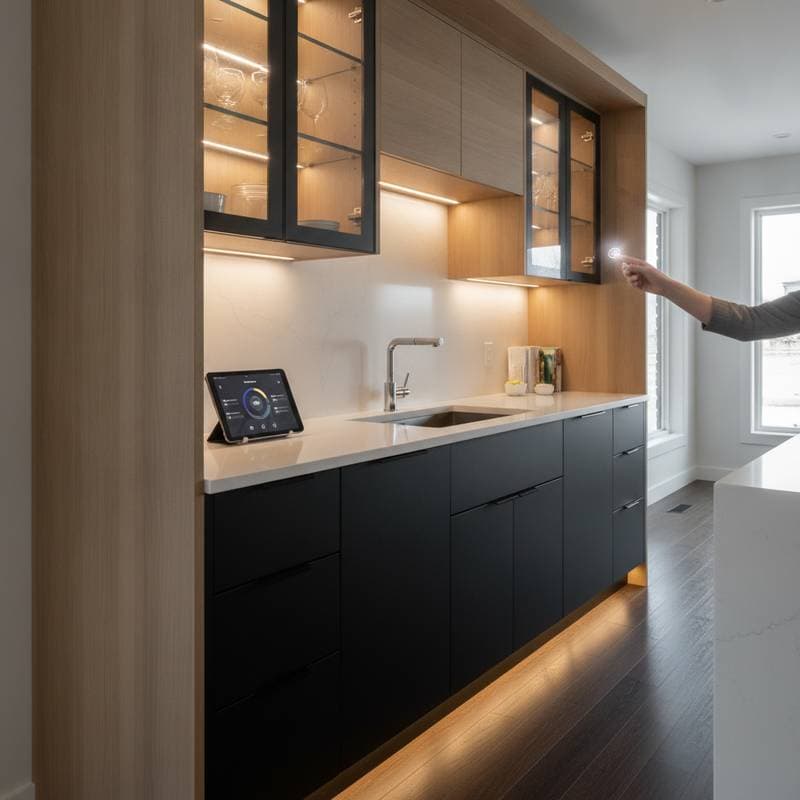
Integrate Smart Lighting into Custom Cabinetry
Smart lighting in cabinetry serves as a practical upgrade. It boosts visibility, streamlines daily tasks, and adds sophistication to kitchens, baths, and built-ins. Sensors, touch controls, and wireless LED strips allow woodworkers and designers to create cabinetry that responds to daily routines.
Benefits of Adaptive Lighting
Cabinet interiors often remain dark despite well-lit rooms. Smart lighting pairs low-profile LEDs with automatic triggers to solve this issue. Opening a drawer or door activates light that reveals contents without glare. This change reduces eye strain and accelerates tasks such as cooking or organizing.
Designer Erin Vance noted that new lighting hardware alters interior finishing. She plans wiring and sensor placement alongside hinge and drawer layouts so the light integrates into the build.
Core Components and Operation
Modern cabinet lighting uses three main elements. LEDs deliver consistent brightness while consuming less energy than older halogen options. Touch sensors or motion detectors control activation timing. Power sources include hardwired low-voltage drivers or rechargeable battery packs mounted inside cabinet bases.
Wireless controls add flexibility. Many systems connect to home networks for remote dimming or scheduling. Plug-in or battery versions suit small shops and retrofit projects where new wiring channels prove difficult.
Planning Layouts for Effective Installation
Successful lighting begins with careful layout planning. Map shadow locations first. In kitchens, position under-cabinet LEDs two inches from the face frame to distribute light evenly across counters. Vertical strips along both sides of tall pantry units illuminate shelves from top to bottom.
Mount slim LED bars beneath the top rail in drawers. Pair them with magnetic or infrared sensors that activate on opening. Place lights at the front edge of shelves in glass-front cabinets to highlight objects without hotspots.
Builder Marcus Laird emphasized preplanning for custom walnut kitchens. His team cuts shallow channels in cabinet sides before finishing to conceal wiring and maintain a clean appearance.
Selecting Materials and Finishes
Color temperature influences wood appearance. Warm white between 2700 and 3000 Kelvin flatters oak, cherry, and walnut. Cooler tones near 4000 Kelvin suit painted or lacquered surfaces. Test samples with chosen LEDs before installation.
Diffusers soften output and protect strips. Frosted covers eliminate visible diodes while aluminum channels with snug lenses manage heat and add durability.
Recommended Smart Features
- Touch sensors for activation on faces or drawer fronts
- Motion sensors for deep pantry or closet units
- Wireless dimmers for mood lighting in living areas
- Rechargeable modules where wiring access is limited
- App integration for remote brightness or temperature adjustments
Features scale easily. A single plug-in strip in a vanity can expand later into a full home network.
Maintenance and Future Adaptability
LEDs last beyond fifty thousand hours, though connectors and sensors may need resets. Modular components simplify replacements. Keep drivers accessible behind removable panels or toe-kick voids.
Run flexible conduit or hollow channels during fabrication when future device additions seem likely. This approach avoids major modifications as technology advances.
Achieving Responsive Storage Solutions
Smart cabinet lighting combines function with refined design. It enhances visibility, minimizes wiring clutter, and enables flexible control. Early integration during construction delivers clean results and lasting adaptability for both woodworkers and homeowners.