
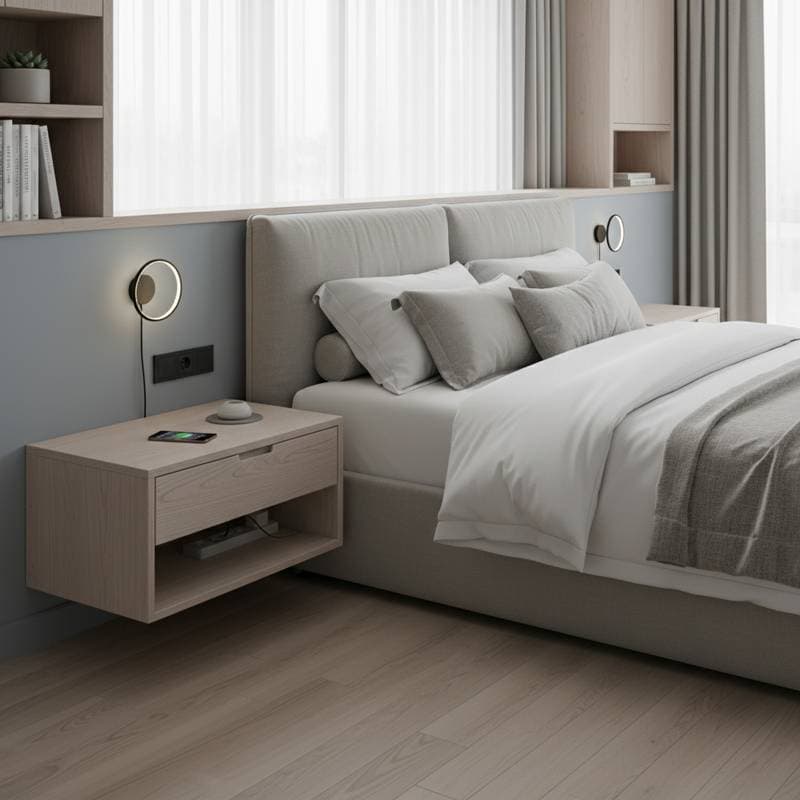
Create Clean Bedrooms with Cable-Hidden Floating Nightstands
Tangled phone cords, lamp wires, and charger cables disrupt bedroom tranquility. Floating nightstands equipped with integrated cable management address this issue and deliver a streamlined, contemporary appearance. Such designs provide additional floor space, simplify cleaning tasks, and offer a bespoke element that appears deliberate. A properly constructed cable-hidden floating nightstand ranges from $180 to $600 per unit, based on material choices and design intricacy. Through careful planning, individuals build or commission pieces that suit specific spaces and maintain cords out of view.
Benefits of Floating Nightstands
Bedrooms thrive with furniture that reduces visual weight. Floating nightstands secure directly to walls, which clears the floor for straightforward cleaning and fosters an impression of openness. This approach also establishes a crisp boundary around the bed, enlarging the perceived room size and enhancing organization.
Another key benefit involves cable management. Conventional nightstands frequently feature power cords dangling behind, accumulating dust and disorder. Floating versions integrate hidden channels, recessed outlets, or grommet holes to route wires through back panels or wall spaces. This setup ensures accessibility while preserving invisibility.
The visual impact of cable concealment proves substantial. One exposed wire captures attention, whereas a managed design allows lighting, wall hues, and textures to dominate. The outcome yields a serene, purposeful environment that conveys luxury.
Action step: Prior to selecting a design, compile a list of all devices requiring power near the bed. Include lamps, alarm clocks, chargers, and air purifiers. Map wire routes in advance to incorporate them seamlessly.
Detailed Construction Guide: Cable-Hidden Floating Nightstand
1. Select and Prepare Materials
Opt for 3/4-inch plywood or solid hardwood to ensure durability and steadiness. Measure and cut panels for the top, bottom, sides, and back to match the intended dimensions. Sand all edges thoroughly to eliminate rough spots and splinters.
For designs incorporating a drawer, prepare corresponding pieces for the drawer box and front panel. In a basic shelf configuration, omit the drawer and concentrate on the primary frame assembly.
2. Form Cable Management Features
Prior to joining components, employ a router or circular saw to carve channels for cables in the back panel. Standard dimensions include a 1-inch width by 1/2-inch depth groove extending from the top surface to the lower rear edge. Position and drill small exit holes at points where wires emerge.
Secure rubber grommets within these holes to shield cords from wear. For integrated power solutions, affix a power strip inside the rear compartment and create access points for plug insertion.
3. Construct the Main Frame
Connect panels with pocket screws reinforced by wood glue. Verify squareness using a carpenter's square at each joint. After forming the box, fasten the back panel with countersunk screws for a flush fit.
Progressively sand all surfaces, starting with 120-grit paper and finishing with 220-grit for optimal smoothness. Remove dust particles completely before proceeding to finishing.
4. Finish the Surfaces
Select a finish aligned with bedroom aesthetics. Clear polyurethane accentuates natural wood grains, whereas matte paint imparts a sleek modernity. Apply two to three coats, allowing full drying time between each layer.
5. Install the Nightstand Securely
Identify wall studs with a stud finder. Indicate two level attachment points per nightstand. Employ heavy-duty floating shelf brackets or a French cleat system capable of supporting at least 50 pounds. Secure the bracket to the wall, then position the nightstand by sliding or locking it into place.
Route cables through designated rear openings prior to permanent fixation. Upon installation, connect devices to the concealed outlet or power strip.
Action step: Verify functionality of each cord prior to enclosing the back panel. Confirm illumination, charging capabilities, and power availability before completion.
Choosing Between DIY and Professional Services
Ideal Scenarios for DIY Projects
Individuals with intermediate woodworking experience and essential tools find floating nightstands a fulfilling endeavor. Joinery techniques remain straightforward, and surface treatments prove accessible. This method grants complete oversight of dimensions and aesthetics.
DIY suits situations where:
- Basic equipment such as a drill, sander, and saw exists.
- Proficiency with stud finders and levels is present.
- Surface-mounted cable routing suffices, without internal wall modifications.
Anticipate 6 to 10 hours for construction and mounting per unit. The primary difficulty lies in aligning both nightstands perfectly level across the bed.
Circumstances for Professional Assistance
Engage a carpenter or electrician for projects involving in-wall wiring, embedded lighting, or robust hardwood builds. Experts guarantee adherence to electrical regulations and execute concealed wiring without compromising wall integrity.
Professional fees generally include:
- $150 to $250 for nightstand fabrication per piece.
- $75 to $150 for electrical work or outlet adjustments.
Action step: When outsourcing, obtain a detailed written proposal specifying cable routes, attachment methods, and weight tolerances. This prevents unexpected issues during execution.
Versatile Design Ideas for Every Bedroom Style
Floating nightstands adapt to diverse interior themes. Consider these favored options:
- Minimalist shelf: An unadorned open platform with clean lines and a solitary rear cable port.
- Mid-century drawer unit: Angled profiles clad in walnut veneer, accented by subtle brass hardware.
- Illuminated variant: Built-in LED strips beneath the base for ambient underlighting.
- Extended console: A spanning floating ledge across the bed's rear, with integrated power conduits serving both flanks.
In compact bedrooms, select models measuring 12 inches in depth to accommodate necessities without encroaching on space. Larger areas accommodate broader units up to 30 inches, featuring storage drawers and centralized power modules.
Action step: Coordinate stains or paints with headboard and trim elements for unified harmony. Prefer matte sheens for a subdued, contemporary vibe.
Preserve and Protect Your Floating Nightstands
Floating nightstands demand minimal upkeep, yet regular attention sustains their appeal. Clean surfaces weekly using a soft cloth dampened with mild solution. Prevent excess moisture near joints from devices like humidifiers.
Annually examine mounting brackets for secure fastening. Monitor cables for signs of damage or excessive heat near electrical elements. For painted surfaces, address scratches immediately to avert water infiltration at edges.
To extend service life, distribute weight evenly and avoid concentrating heavy items like lamps at outer edges. Centered loads optimize bracket performance and structural integrity.