
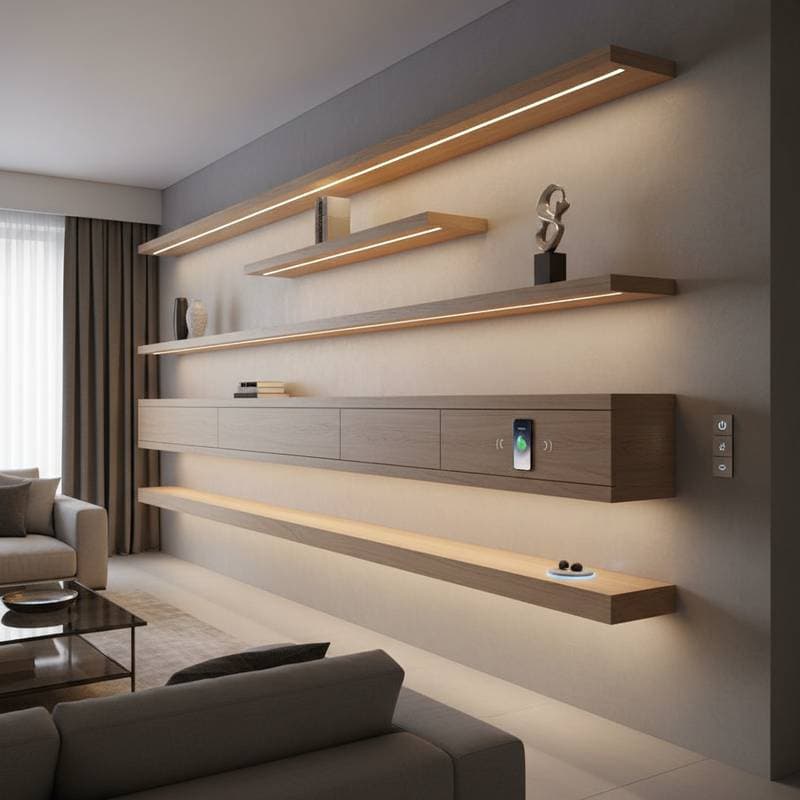
Why Smart LED Shelves Are Replacing Traditional Built-Ins
Smart LED shelves transition from novelty to essential elements in built-in cabinetry. These innovations integrate lighting, power, and storage into a single seamless surface. Homeowners benefit from enhanced visuals and practicality, as shelves illuminate display areas, charge devices, and eliminate visible cords. Woodworkers and designers view them as the evolution of integrated craftsmanship.
This transformation appears in both remodels and new constructions. Living spaces increasingly combine work, leisure, and display functions, making lighting a structural component. A shelf evolves beyond a simple plank into an active surface that supports, illuminates, and connects.
At a Glance
Typical Setups: Living rooms, kitchens, home offices, and dressing areas.
Size Range: From compact 24-inch (61-centimeter) nooks to full-wall 12-foot (3.6-meter) installations.
Design Teams Leading the Trend: Studio Plinth, Oakline Interiors, and Form Collective.
Photography: Courtesy of each firm's in-house team.
Core Materials: Solid oak, walnut veneer, powder-coated steel, and matte acrylic diffusers.
Average Installed Cost: $250 to $400 per linear foot (305 millimeters), including lighting drivers and smart modules.
The Core Challenge and Defining Solution
Built-ins traditionally emphasize storage and symmetry. The current challenge involves incorporating light and power without exposed wiring or added bulk. The key solution fuses LED strips directly into the shelf profile, powered by low-voltage drivers hidden in back panels. Paired with wireless charging pads and app-controlled dimmers, each shelf functions as a versatile zone rather than a mere display ledge.
"People want technology that disappears," states interior designer Leah Moran of Form Collective. "When the shelf glows evenly and you can drop your phone there to charge, that is when design and function truly meet."
Before: Limitations of Traditional Approaches
Conventional built-ins often falter with lighting integration. Puck lights produce hot spots and shadows, while cables route awkwardly through cabinet backs or walls. Post-installation LED tape creates visible lines or glare. Storage areas remain partially illuminated, rendering some sections dim or underutilized.
Homeowners contend with scattered cords and chargers as devices proliferate. This clutter disrupts the serene appearance of custom wall units, with power bricks and cables undermining visual harmony.
After: Seamless Integration of Light and Power
Smart LED shelves address lighting and power issues simultaneously. A continuous LED ribbon hides behind a frosted diffuser on each shelf. Channels milled into the underside cap with a seamless lens for even light distribution across objects. Power feeds route through concealed metal brackets or cavities in vertical supports.
Wireless charging pads embed flush into the surface, indicated by a subtle ring or grain shift. A hidden transformer in the cabinet base supplies power, managed via a smart hub or touch sensor.
Finished installations reveal dramatic improvements. Books receive soft underlighting. Art glass gains depth. Laptops charge beneath warm, uniform illumination. The result combines sculptural appeal with everyday utility.
Design Details
- Shelf Thickness: Minimum 1.5 inches (38 millimeters) to accommodate LED channels and wiring.
- Lighting Temperature: 2700K to 3000K for living areas; 4000K for work zones.
- Dimming: App-based or motion-activated via built-in sensors.
- Power Management: Low-voltage 24V DC systems with concealed drivers.
- Charging Pads: Qi-standard modules recessed 0.1 inch (2.5 millimeters) below the surface.
- Mounting: Concealed steel brackets rated for 50 pounds (22.6 kilograms) per shelf.
- Finish Options: Natural oiled wood, matte lacquer, or powder-coated metal.
Implications for Builders and Designers
Woodworkers face new joinery demands with lighting integration, requiring precise channels, tight tolerances, and early wiring coordination. The rewards include elevated project value and clients drawn to the polished outcome.
"Once you have installed one, clients start asking for them everywhere," notes cabinetmaker Jonas Pike of Oakline Interiors. "They want the same glow in a bar, in the hallway, even under bathroom niches."
Designers regard smart shelves as connectors between cabinetry, lighting, and technology. This multifunctionality aligns with trends toward efficient, adaptable interiors that maintain a quiet elegance.
How the Technology Operates
Smart LED shelves depend on three primary components: a linear LED strip, a diffuser, and a driver. The 10mm-wide LED strip delivers approximately 400 lumens per foot (305 millimeters). The diffuser lens softens output to resemble natural daylight. The driver converts standard current to low voltage, supporting multiple shelves on one circuit.
Control systems integrate Wi-Fi or Bluetooth modules. Users adjust brightness scenes, connect shelves across rooms, or automate via voice assistants. Low power draw minimizes heat, safeguarding finishes and displayed items.
Installation simplifies with plug-and-play options. Shelves link to a hub using low-voltage plugs, with wiring accessible behind removable panels for straightforward maintenance or upgrades.
Aesthetic and Functional Benefits
Smart LED shelves alter room atmospheres through continuous horizontal lighting, fostering calm and expanding perceived space in compact areas like narrow living rooms or galley kitchens. Reflected light softens edges and adds depth to walls and ceilings.
Homeowner Rachel Kim shares her experience after upgrading her display case: "It feels like daylight even at night. I can see every book and vase clearly, but the light never feels harsh."
Even illumination enables darker finishes, such as deep walnut or charcoal lacquer, to appear rich without heaviness when combined with warm integrated light.
Room-Specific Applications
Living Rooms
Floating LED shelves frame televisions or artwork while serving as accent lighting to minimize overhead glare. Configurations typically feature three to five shelves spaced 12 inches (30 centimeters) apart, equipped with dimmable warm white LEDs.
Kitchens
Open shelving with built-in light replaces under-cabinet strips, keeping items visible and enhancing backsplash textures. Wireless charging pads near preparation areas maintain clear counters.
Home Offices
LED shelves boost productivity with cooler light for focus and wireless charging for devices. Concealed cable paths ensure a tidy background for video conferences.
Bedrooms and Dressing Areas
Soft shelf lighting provides ambient glow without relying on bedside lamps. Built-ins near mirrors gain shadow-free illumination, with some systems using motion sensors for nighttime navigation.
Bathrooms
Moisture-rated LED shelves backlight toiletries or artwork in niches. Frosted panels ensure even diffusion, preventing mirror glare, while drivers locate in adjacent dry areas for safety.
Material and Craftsmanship Essentials
Optimal smart shelves use stable, seasoned wood or composites like solid oak, maple, or walnut to resist warping from routed LED channels. In humid environments, marine-grade plywood or powder-coated aluminum proves more suitable.
Routing leaves at least 0.5 inch (12 millimeters) of material below channels for structural integrity. Diffusers install flush or slightly recessed to deter dust accumulation. Sanding and finishing follow channel cutting but precede final assembly for seamless results.
Preplan cable paths relative to studs and anchors during wiring. Builders drill vertical chases behind panels and route low-voltage wires before shelf attachment, yielding a serviceable yet wireless appearance.
Emerging Innovations
-
Tunable White LEDs: Adjust from warm to cool tones to align with circadian rhythms, accentuating materials variably throughout the day.
-
Embedded Sensors: Motion and proximity detectors activate illumination on approach, perfect for hallways or low-light scenarios.
-
Voice and App Integration: Compatibility with major platforms enables commands like setting display shelves to 60 percent brightness.
-
Modular Power Rails: Conductive brackets transfer power without visible connections between shelves.
-
Expanded Finishes: Options include matte acrylics, back-painted glass, and sustainable veneers, each altering light diffusion for unique effects.
Cost Considerations and Planning Strategies
A basic three-shelf system with LEDs, drivers, and wireless charging costs $1,200 to $2,400 installed. Extensive feature walls with intricate wiring may exceed $4,000. Factors influencing price encompass materials, lighting quality, and control features.
Builders reduce time through early coordination: Install low-voltage wiring before wall finishes, provide access panels for drivers, and align shelf spacing with art or appliance dimensions. These measures halve installation duration compared to retrofits.
Practical Implementation Tips
- Pair adjustable shelf heights with fixed lighting channels for uniform illumination.
- Conceal drivers in vented toe-kick drawers for accessibility.
- Apply magnetic cover plates over connection points.
- Separate power and data lines in distinct chases to avoid interference.
- Select warm white LEDs for wood or fabric displays; neutral white for glass or ceramics.
Ideal Scenarios and Performance Highlights
Smart LED shelves thrive in areas blending light and display, suiting collectors, readers, and tech-oriented homeowners who prioritize uncluttered surfaces. In compact apartments, they maximize multifunctional space.
Hospitality and retail applications amplify branding: Cafés employ glowing shelves behind counters, while boutiques use them for backlit merchandise without additional fixtures.
Architects appreciate their adaptability, as embedded light sources keep ceilings clear. Shelves function dually as architectural elements and illumination.
Essential Insights
- Smart LED shelves unify storage, light, and power into cohesive units.
- Meticulous planning and routing ensure safety and visual appeal.
- Wireless charging and app controls enhance everyday usability.
- Proficiency in this area allows builders to command premium pricing for expert craftsmanship.
- These features promote minimalist designs that retain warmth and vitality.
Enhancing Daily Living Through Integrated Design
Homeowners experience transformed routines with smart LED shelves. Daily tasks gain efficiency, from effortless device charging to illuminated organization. The subtle glow fosters inviting spaces that adapt to evolving needs, blending timeless craftsmanship with modern convenience.