
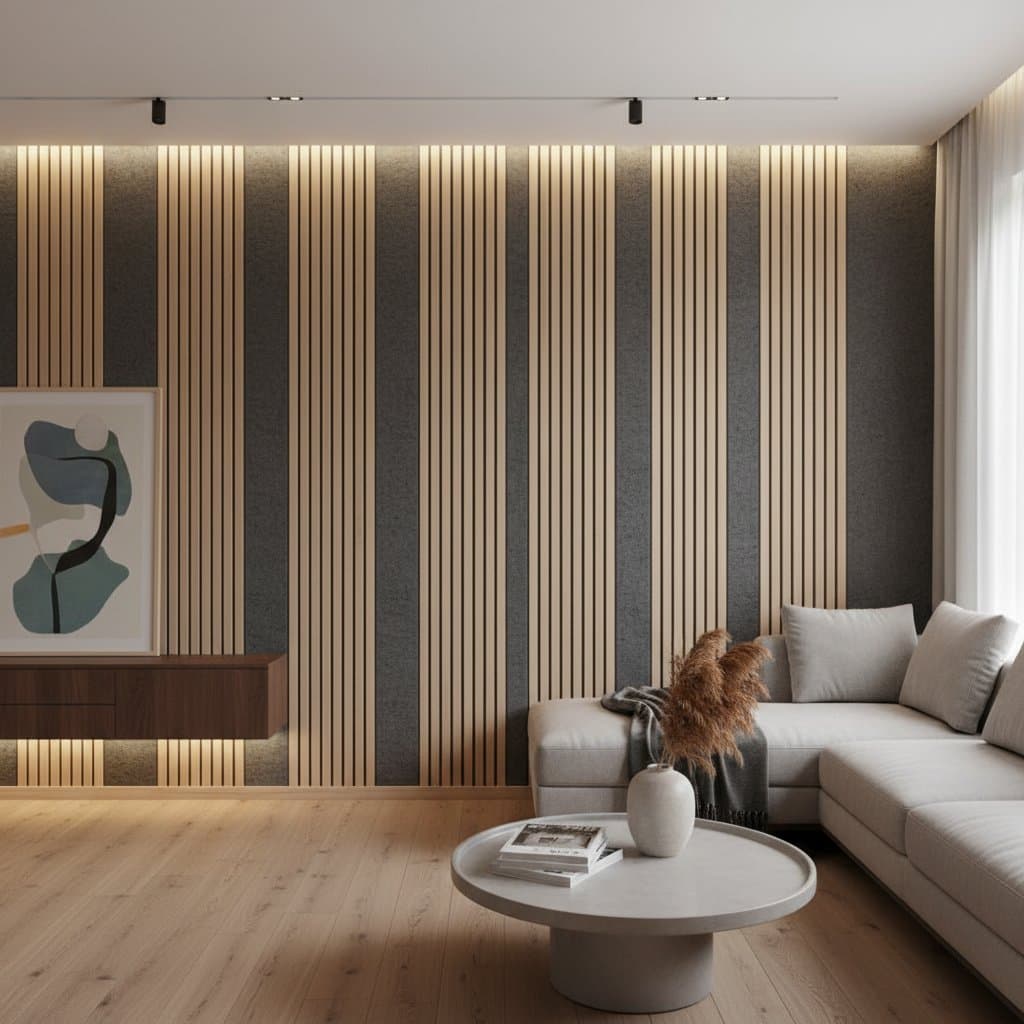
The DIY Solution for Eliminating Room Echoes
A hollow-sounding room undermines even the finest furniture and lighting arrangements. The emerging remedy in workshops and homes involves a straightforward, hands-on approach. Vertical acoustic battens combined with felt wall panels convert ordinary walls into effective sound-dampening features that resemble bespoke woodworking. This method proves cost-effective, requires only fundamental tools, and alters the sensory experience of a space.
This guide explains the acoustic batten wall concept, its effectiveness, and construction process. Readers learn about optimal materials for superior performance, layout planning strategies, and surface finishing techniques to achieve a seamless, purposeful appearance rather than a makeshift repair.
Assessing the Problem
Hard surfaces dominate most interiors and cause sound to rebound. Drywall, windows, and hardwood floors generate echoes that intensify footsteps and voices. Such conditions lead to listener fatigue and distorted audio quality. One homeowner noted, "We enjoyed the open layout until conversations became indistinct."
Rugs and drapes offer partial relief, yet they fall short against bare walls. Sound persists upon impact with smooth surfaces. Effective treatment demands depth and irregularity to capture vibrations. The objective involves reducing noise without imparting a padded or institutional aesthetic.
Principles of Sound Absorption
Sound propagates as waves. Rigid materials redirect these waves, whereas absorbent substances capture them. The felt component targets midrange and high-frequency sounds. Vertical battens introduce subtle diffusions through their spacing, scattering reflections. This pairing establishes a comprehensive acoustic treatment without bulky fillers or concealed structures.
The approach adapts studio-grade methods for residential use. A typical panel measures about 94 inches (239 cm) in height and 24 inches (61 cm) in width. Install panels adjacent to one another for complete coverage, or apply a few as focal points behind seating or workstations.
Essential Materials and Budget
Pre-fabricated panels exist, but custom construction saves money and allows personalization. For an 8-foot (2.44 m) high by 10-foot (3.05 m) wide wall, costs range from 180 to 500 dollars, varying by lumber selection and fabric quality.
Required materials:
- 1/2-inch (13 mm) MDF or plywood sheets for backing
- 3/8-inch (10 mm) thick acoustic felt or recycled polyester panels
- 1-inch (2.5 cm) thick by 1.5-inch (3.8 cm) wide solid wood battens
- Construction adhesive and brad nails for assembly
- Level, miter saw, and measuring tape for precision
Select felt in neutral shades such as charcoal, gray, or beige to serve as a versatile foundation. Pale colors illuminate compact areas, while deeper hues provide contrast under light-toned woods. Opt for oak, walnut, or ash battens to introduce natural warmth. Pine suits tighter budgets, though staining enhances its appearance.
Integrating Lighting for Enhanced Effect
Acoustic improvements pair ideally with strategic illumination. The battens' linear pattern generates dynamic shadows that interact with light sources. Position linear LED strips along the ceiling edge or employ wall-mounted fixtures to skim the surface. Choose warm tones between 2700 and 3000 Kelvin to harmonize with wood finishes.
In work areas, incorporate adjustable task lighting that reflects off the treated wall. The felt minimizes harsh reflections, yielding a diffused backdrop suitable for displays and reading.
Avoiding Installation Errors
- Excessive gaps: Spaces exceeding 2 inches (5 cm) compromise sound control.
- Omit the absorbent layer: Attaching battens straight to drywall skips the felt and fails to dampen noise.
- Misaligned elements: Employ a laser level for plumb verticals; minor offsets become noticeable.
- Excessive sheen: Glossy varnishes rebound sound and light; opt for matte sealants instead.
Tailoring to Specific Spaces
Home Office Setup
Position panels behind the desk to minimize feedback during virtual meetings. A 4-foot (1.22 m) wide section typically suffices for targeted treatment.
Living Room Application
Apply to the wall facing the television or audio system. The absorption prevents return echoes, allowing clearer playback at reduced volumes.
Bedroom Enhancement
Pair soft gray felt with white oak battens. This configuration introduces subtle texture above the headboard, fostering tranquility.
Studio or Workshop Adaptation
Select darker felt to conceal particles from use. Integrate with overhead absorbers for comprehensive noise management.
Core Principles for Success
- Acoustic batten walls address reverberation while infusing visual interest.
- Assembly demands basic tools and intermediate woodworking skills.
- A 3/8-inch (10 mm) felt depth suits typical residential acoustics.
- Uniform batten intervals ensure both auditory and aesthetic balance.
- Thoughtful lighting accentuates texture and ambiance.
- Installation yields measurable reductions in ambient noise and improved concentration.
Precision defines the outcome. Accurate measurements and flush connections integrate the feature seamlessly. Pre-treat wood elements prior to attachment for efficiency.
Experiencing the Results
Installation delivers prompt improvements. Dialogue sharpens, and spaces acquire a subdued resonance. Users often lower media volumes as audio distributes more uniformly. The surface encourages interaction, providing a sensory depth absent in flat finishes.
Reports highlight enhanced rest and extended productivity without strain. The synergy of structured visuals and sonic clarity promotes sustained attention and ease.