
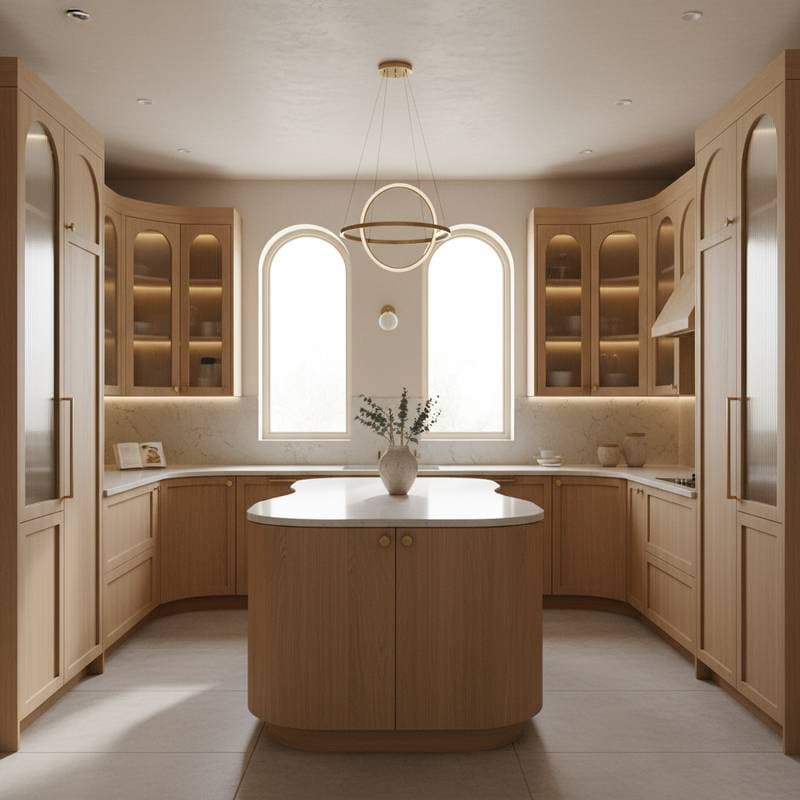
Why Arched Cabinet Doors Will Dominate 2026 Kitchens
Soft curves transition from architectural elements into cabinetry, transforming standard kitchen fronts into sculptural focal points. Arched cabinet doors, traditionally associated with classical or Mediterranean aesthetics, now integrate seamlessly into sleek, modern kitchens. This evolution unfolds gradually yet decisively. Designers seek methods to infuse warmth and texture following an era of stark minimalism, and the arch delivers structure alongside subtlety.
The appeal stems from both emotional and visual dimensions. Curved lines render a kitchen more approachable and less industrial. They disrupt the uniformity of rectangular forms and provide visual respite. Whether sculpted from solid oak, formed in painted medium-density fiberboard, or fitted with glass panels, the arched door signifies artisanal quality and serenity.
At a Glance
Who lives here: Families and homeowners with a keen eye for design, seeking warmth without excess
Location: Coastal residences, suburban homes, and urban apartments nationwide
Size: Standard kitchens ranging from 180 to 300 square feet (17 to 28 square meters)
Design teams: Studios such as Studio Den, Willow & Clay Interiors, and The Cabinet Collective
Photography: Images provided by Tim Laird, Minna Grove, and Rae Studios
Before
Flat-panel cabinets prevailed for an extended period. Their ease of maintenance, affordability, and alignment with minimalist trends suited many new constructions. Homeowners appreciated the straightforward appearance, yet some perceived it as overly clinical.
Designer Lena Morris observed, “Every kitchen started to look the same. Clients were craving something that felt built, not just installed.” Lacking intricate details or embellishments, the space often appeared chilly, particularly alongside unyielding materials like quartz countertops and stainless steel appliances. Sharp angles intensified the effect, with light reflecting abruptly and transitions between walls and cabinets feeling abrupt.
Storage solutions prioritized efficiency over expression. The lack of fluid forms limited opportunities for individuality. As Morris noted, “We had function, but we lost feeling.”
After
Incorporating arches reversed this trend. Curving the upper edge of each cabinet door introduces immediate depth. The form directs light upward and outward, generating subtle shadows that enhance the perceived volume of the cabinetry. It also lightens the appearance of towering pantry units and appliance enclosures.
Contemporary installations frequently pair curved panels with glass inserts, fluted timber accents, or woven cane inserts. These elements interact with light in unique ways, introducing layers of texture and subtle translucency. The overall impression conveys meticulous handwork combined with current sensibilities.
Visual documentation captures kitchens where an arched glass cabinet radiates against textured plaster walls. Another view highlights a white oak island featuring dual rounded edges that echo the cabinet motifs. Aerial perspectives reveal layouts that flow more organically, with pathways bending smoothly rather than intersecting rigidly.
Designer Jordan Pike of The Cabinet Collective explained, “We are not returning to old-world ornament. We are editing the idea of the arch down to its pure geometry.”
This adjustment proves understated yet profound. It alters light distribution throughout the space and influences navigation within it.
Design Details
- Materials: White oak, walnut, rift-cut ash, and painted medium-density fiberboard finished in semi-matte sheens. Natural oils or low-luster lacquers provide a touchable quality.
- Edge profiles: Rounded stiles and rails, typically with a 1-inch (2.5-centimeter) radius. Integral handles sometimes trace the curve for cohesion.
- Glazing: Clear or reeded glass embedded in arched frames, forming dedicated areas for showcasing dishware or stemware.
- Hardware: Brass or bronze in brushed finishes. Handles mimic the arch through flowing contours.
- Lighting: Concealed LED strips within arches to emphasize dimension and emit a soft luminescence after dark.
- Organization: Tailored inserts optimize storage space behind curved faces. Extending shelves incorporate divided sections to accommodate the shape.
These elements tie aesthetic choices to everyday functionality. The cabinetry invites interaction, and the smooth lines minimize perceived disarray, even alongside exposed shelving.
Why Arches Work Now
Curves align with a desire to restore emotion in contemporary design. Following prolonged exposure to rigid lines, observers appreciate a form that yields. The arch evokes historical resonance, yet precise execution ensures compatibility with restrained environments.
From a psychological standpoint, rounded shapes evoke security and gentleness. In kitchens, hubs of activity and assembly, such signals foster ease. The curved upper portions of doors diminish the imposing nature of overhead storage, which might otherwise dominate.
Arched doors also reflect growing appreciation for skilled workmanship. As mass-produced options proliferate, discerning clients recognize bespoke quality. Fabricating a curved door demands expertise. It conveys intentionality and refinement.
Designer Kari Velasquez stated, “An arch is not a sticker or a mold. It is built. That honesty appeals to clients who want lasting beauty.”
The Fabrication Shift
Cabinet fabricators adjust equipment and processes to accommodate rising requests. Computer numerical control routers enable accurate shaping of curved edges, though manual sanding refines the contours. Applying veneers over curved bases serves as an alternative, particularly for dense-grained woods like ash or maple.
Painted arches benefit from medium-density fiberboard, which resists dimensional changes. Radii vary from subtle, approximately 18 inches (46 centimeters), to more defined, nearing 9 inches (23 centimeters).
Glass-fronted versions demand careful construction. Frames maintain the arch without distortion, and glass undergoes tempering post-cutting. Fabricators collaborate with specialized suppliers to achieve precise curvatures.
The outcome blends technical accuracy with artisanal traces. The curve emerges as the defining characteristic.
Variations on the Theme
Designers explore the arch through diverse applications:
- Single arch per door: A rectangular base with a curved top rail, suited to transitional interiors.
- Full radius doors: Complete frame curvature for enhanced sculptural impact.
- Double arch compositions: Twin curves converging at a central divider, common in showcase units.
- Arched niches within flat cabinetry: Subtle integrations that introduce cadence without wholesale alteration.
Each variation alters the kitchen's ambiance. A single arch tempers uniformity. A full radius elevates cabinets to furniture-like status. A niche creates recessed interest.
Practical Benefits
Beyond aesthetics, arches offer tangible advantages.
- Enhanced light diffusion: Curves scatter illumination to illuminate edges and temper harsh reflections.
- Improved circulation: Rounded terminations at cabinet ends facilitate fluid passage, beneficial in compact configurations.
- Durability: The arched form reinforces panel integrity, minimizing distortion in extended-height doors.
- Design continuity: Arches harmonize with window arches or structural openings, unifying interior and exterior.
These attributes elevate curved cabinetry beyond mere ornamentation. They optimize the kitchen's operational efficiency.
How to Bring the Look Home
Incorporate arches incrementally, avoiding comprehensive overhauls. Install an arched open shelf over a beverage area or add a curved glass enclosure. Repaint existing uppers and swap doors for arched alternatives.
For fresh installations, evaluate scale initially. A 30-inch (76-centimeter) upper cabinet pairs ideally with an 18-inch (46-centimeter) radius. Wider arches suit taller pantry doors to preserve elegance.
Select materials thoughtfully. White oak accentuates natural patterns, whereas painted medium-density fiberboard yields crisp outlines. Opt for matte finishes to underscore curves via shadow play rather than shine.
Strategic lighting amplifies the design. Position LED strips along arch crests to delineate forms. Light at 2700 Kelvin warms wood hues effectively.
Key Takeaways
- Balance geometry with warmth. Arches temper cabinet grids while preserving modern exactitude.
- Scale the curve to the space. Subtle bends promote tranquility; sharper ones inject energy.
- Link materials and light. Grainy woods, transparent glass, and diffused glows collaborate to elevate contours.
- Prioritize craftsmanship. Curved elements necessitate proficiency in assembly and polishing.
- Think flow, not just form. Arches guide movement and perception, rendering spaces more navigable and welcoming.
Living with the Design
Residents embracing arches describe kitchens as more serene. The forms guide attention skyward and ease junctions between vertical planes. Rounded island extremities simplify child navigation, while arched-framed shelves encourage curated displays without chaos.
One resident shared, “I did not realize how harsh straight lines had become until we replaced them. The arches make the room breathe.”
Professionals observe strong compatibility with diverse substrates. In sleek contexts, oak arches contrast concrete or aggregate floors. In established dwellings, painted versions honor period details with updated tones.
Renovation and Maintaining Your Investment
Arched cabinetry endures as a worthwhile commitment when constructed with sound joints and protective coatings. Consider these maintenance strategies:
- Dust surfaces weekly with a soft cloth to preserve finish integrity.
- Avoid abrasive cleaners; use mild soap solutions for painted elements.
- Inspect hinges and pulls quarterly to ensure smooth operation.
- For wood, apply conditioning oil annually to counteract drying.
- Address moisture exposure promptly to prevent warping in humid climates.
Proper care extends the lifespan, keeping the curves crisp and the warmth enduring.
Sources or Credits
Insights drawn from interviews with designers Lena Morris, Jordan Pike, and Kari Velasquez. Project examples courtesy of Studio Den, Willow & Clay Interiors, and The Cabinet Collective. Photography by Tim Laird, Minna Grove, and Rae Studios.