
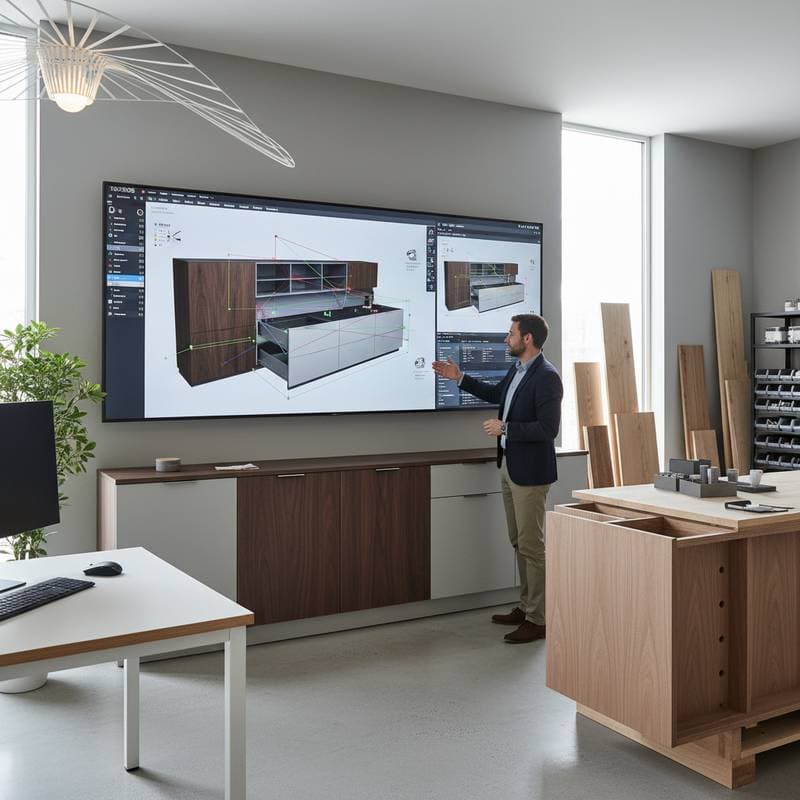
Parametric Software Revolutionizes Custom Cabinets
Modern cabinetmaking demands speed alongside unwavering precision. Woodshops seek flexibility and consistent quality, even as clients demand unique dimensions and finishes. Parametric software addresses these needs by creating dynamic models where adjustments propagate automatically. A single dimension change updates the entire design in seconds, generating accurate joinery and cut lists for immediate production.
At a Glance
Primary users: Custom cabinet shops, furniture makers, and design-build studios
Geographic reach: Strong adoption in North America and Europe
Project scale: Ranges from compact 120-square-foot (11.15-square-meter) kitchens to comprehensive 2,000-square-foot (185.8-square-meter) home millwork installations
Team structures: Solo woodshops, digital fabrication labs, and integrated software operations
Visuals: Images provided courtesy of featured shops
Traditional Design Challenges
Before parametric tools, cabinet design depended on static sketches or basic CAD files. Any alteration meant recalculating dimensions, rechecking joints, and repositioning hardware manually. These repetitive tasks disrupted workflows in high-volume shops.
Jason Mills, owner of Mills Custom Woodworks, recalls the frustration. "Each client request for a one-inch adjustment forced a full redraw of elevations," he explains. "The process functioned, but it consumed hours and invited mistakes."
Storage configurations often stuck to rigid templates, limiting options for lighting or concealed features. Separate drawings for these elements increased the chance of discrepancies between plans and CNC machining results, delaying projects.
The Parametric Advantage
Parametric software shifts the focus to relational rules rather than fixed measurements. Cabinet door widths tie to frame sizes, which in turn link to total run lengths. Alter the run, and all connected elements realign instantly.
Recent project images illustrate this fluidity: tall pantry units blend smoothly with floating shelves and appliance panels. Edge profiles remain uniform, drawer heights synchronize, and corners join perfectly. Algorithms enforce these connections while respecting material constraints and geometric principles.
Mills notes the impact on scalability. "After developing our parametric templates, we adapted designs from modest kitchenettes to expansive chef's kitchens without starting over," he says. "This approach reshaped our quoting, fabrication, and installation processes."
Lighting integration simplifies dramatically. Embed LED channels, puck lights, and switch openings directly into the model. Shift a shelf, and the lighting adjusts accordingly. Ventilation slots, wire routes, and hinge spaces follow the same adaptive logic.
Material use becomes more efficient with built-in nesting functions. These tools monitor grain orientation and waste ratios. A door width tweak triggers fresh sheet utilization calculations, yielding precise reports that streamline purchasing.
Core Design Elements
Materials and Finishes
- Baltic birch plywood forms the carcasses, paired with maple veneer on fronts
- Neutral-toned matte lacquer provides a durable, low-sheen surface
- Solid brass pulls blend seamlessly into door profiles
Software Options
- Rhino paired with Grasshopper enables algorithmic design exploration
- Autodesk Fusion handles mechanical connections and hardware placement
- Cabinet Vision and SketchUp extensions produce CNC-compatible outputs
Lighting and Hardware Specifications
- LED strips fit into 0.5-inch (12.7-millimeter) recessed channels
- Soft-close undermount slides support up to 100 pounds (45.36 kilograms)
- Concealed European hinges offer a 110-degree swing range
Storage Solutions
- Pull-out spice towers and double-tier utensil drawers maximize accessibility
- Adjustable shelf pin systems use parametric grids for customizable spacing
- Wire management integrates behind appliance panels for clean routing
Standard Measurements
- Base cabinets measure 34.5 inches (87.63 centimeters) in height
- Counter depth sets at 25 inches (63.5 centimeters)
- Toe kick recesses provide 4 inches (10.16 centimeters) of clearance
These specifications integrate into the parametric framework, upholding ergonomics while permitting tailored modifications.
Broader Implications
Parametric modeling elevates cabinetry beyond aesthetics to enhance functionality in living spaces. Adaptive geometry guarantees precise fits, accommodating irregular room shapes. Link material properties to rendering tools for realistic previews of light interactions on various surfaces.
Last-minute client changes update all related components swiftly, conserving time and resources. Homeowners experience cohesive installations where sightlines align, corners transition sharply, and storage optimizes space usage. Simulations of drawer clearances and door swings minimize on-site adjustments.
Shops gain from standardized records. Each element, from side panels to drawer fronts, receives a unique identifier tied to its digital twin, facilitating tracking and replication.
Streamlined Workflow
Start by establishing core parameters: base dimensions, material thicknesses, and joint preferences. The software then builds a rule-driven model. Increase the overall width from 96 inches (243.84 centimeters) to 108 inches (274.32 centimeters), and it recalibrates shelf intervals, door quantities, and hardware positions proportionally.
The underlying logic maintains balance across features. Drawer volumes scale, rail locations adapt, and cut lists refresh automatically. Export to CNC routers produces updated g-code without additional drafting.
Collaboration improves through cloud platforms. Designers and fabricators access the identical live model. Direct annotations on elements propagate changes instantly, cutting email exchanges and aligning visions before production.
Real-World Applications
In a compact galley kitchen project, storage demanded efficiency. The designer tied cabinet depths to laser-scanned wall contours. The model offset a 1.25-inch (3.18-centimeter) wall deviation, ensuring face frames aligned perfectly. Installers achieved a seamless fit immediately.
Another installation featured a hidden coffee station behind pocket doors. Parametric rules activated an interior light via sensor upon opening. The software predefined wiring routes, avoiding conflicts with slides or brackets.
Such integrations deliver practical enhancements. Pull-outs operate fluidly, outlets match backsplash patterns, and designs eliminate unnecessary fillers.
Essential Outcomes
- Efficiency gains: Design iterations drop by up to 70 percent, allowing more focus on client engagement and refinements
- Resource savings: Nesting automation reduces waste by 10 to 15 percent through optimized layouts
- Scalable personalization: Established rules adapt to diverse room dimensions and appliance setups
- Fewer discrepancies: Interconnected elements prevent dimension conflicts between drawings and machine outputs
- Seamless integrations: Fixtures and hardware dynamically align with model evolutions
Implementing Parametric Design
Entry-level adoption requires no advanced setup. Develop parametric versions of standard cabinet modules using CAD plug-ins. Prioritize foundational links: total width, door intervals, and hardware positioning. Gradually incorporate drawers, shelves, and accents.
Incorporate clearance checks via basic constraints. Allocate 42 inches (106.68 centimeters) for cooking zones and 36 inches (91.44 centimeters) for passages. Set counter overhangs at 1.25 inches (3.18 centimeters) and test door trajectories.
For illumination, correlate LED lengths to cabinet dimensions. Size adjustments update fixture inventories. On cloud systems, distribute models to electricians and contractors early to accelerate installations and refine finishes.
This methodology extends to upkeep. For door replacements, regenerate matches from archived parameters, bypassing measurements and estimates.
Sustaining Parametric Practices
Initial adoption involves training and template creation. Assemble libraries of joints, hardware, and rules methodically. Established assets yield long-term returns, with updates to new materials or components applying project-wide.
Organize data meticulously. Assign descriptive labels to parameters and standardize nomenclature. Perform regular backups and record rule documentation for team continuity. A solid digital base supports ongoing innovation and service growth.
Sources
Images and quotes courtesy of Mills Custom Woodworks and participating shops.