
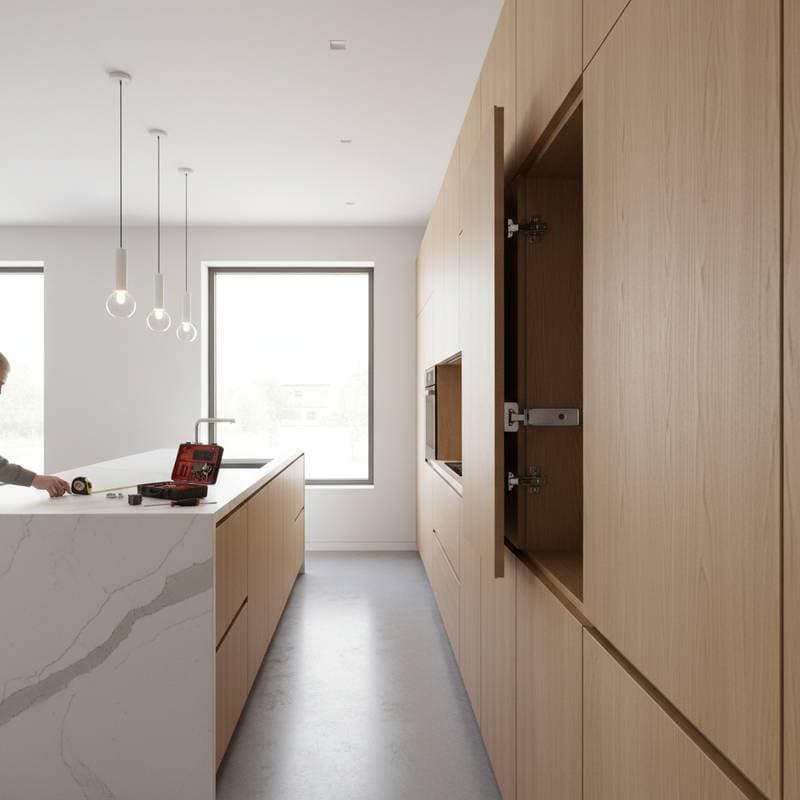
Invisible Hinges: Transforming Cabinet Design for Modern Spaces
Cabinet hardware evolves rapidly, with invisible hinges at the forefront of this transformation. In environments that prioritize sleek profiles and efficient functionality, these concealed elements redefine approaches to cabinet construction among woodworkers, interior designers, and homeowners. Individuals who seek doors that operate effortlessly without exposing any metallic components will find value in examining these hinges prior to undertaking subsequent projects.
Understanding Invisible Hinges and Their Significance
Invisible hinges, also known as European or concealed hinges, consist of hardware elements installed within the cabinet frame and door structure. Upon closure, the hinge remains entirely out of sight, preserving the uninterrupted surface of the cabinet. This configuration aligns seamlessly with minimalist design principles while addressing key practical concerns. Visible hinges tend to accumulate dust, exhibit signs of wear, and disrupt the natural flow of wood grain across door panels.
The mechanism employs a cup-and-arm system that facilitates complete door articulation from within a discreet recess. Advanced variants incorporate three-dimensional adjustment capabilities for vertical, horizontal, and depth positioning. Such features simplify post-installation refinements, particularly for inset doors or bespoke frameless assemblies.
Beyond aesthetics, invisible hinges promote a tidier appearance, minimize upkeep requirements, and bolster structural integrity. Manufacturers engineer these components to withstand extensive use, frequently certifying them for over 100,000 cycles while bearing substantial weight. In high-traffic areas such as kitchens, workshops, or professional offices, this endurance yields considerable long-term economic advantages.
Professionals often select specific models based on overlay types, including full overlay for frameless cabinets or half overlay for face-frame constructions. Compatibility with various door thicknesses, from 3/4 inch to 1-1/4 inches, ensures versatility across projects. Integration with soft-close dampers further elevates user experience by preventing slams and reducing noise.
Action Step: Prior to commencing a cabinetry endeavor, allocate dedicated time to review the precise boring specifications outlined by the chosen hinge manufacturer. Investing a short period in familiarizing oneself with the appropriate Forstner bit and alignment jig prevents extensive corrections during assembly.
Evaluating Costs and Developing a Budget
Invisible hinges vary widely in quality and capability, influencing overall project expenditures. Entry-level pairs begin at approximately $12, while mid-tier selections equipped with soft-close mechanisms range from $25 to $35 per pair. High-end options crafted from stainless steel or solid brass surpass $45 per pair, offering superior corrosion resistance and refined finishes.
For a standard kitchen featuring 30 cabinet doors, the aggregate cost for hinges alone spans $360 to $1,350. Comprehensive budgeting must account for supplementary items and services:
- Boring tools: Allocate $40 to $120 for a durable hinge template and matching Forstner bit set.
- Professional labor: Installation by specialists typically costs $7 to $15 per hinge, depending on regional rates and complexity.
- Post-installation adjustments: Reserve additional hours for aligning doors to achieve uniform gaps and level operation.
Opting for higher-quality hinges frequently results in enhanced performance and extended lifespan, offsetting initial outlays. Inferior alternatives may develop play or misalignment when subjected to repeated stress, necessitating premature replacements.
Comparisons with traditional exposed hinges reveal that invisible models command a premium of 10 to 20 percent in hardware budgets. However, the elevated visual and functional outcomes often align with client expectations for upscale renovations.
Action Step: During the estimation phase of a remodeling initiative, conduct a side-by-side analysis of expenses for conventional versus concealed hinges. This evaluation highlights how the aesthetic enhancements can warrant the modest incremental investment.
Avoiding Pitfalls in Installation
Precision forms the cornerstone of successful invisible hinge implementation. Errors frequently arise from inaccuracies in boring or alignment, yet proactive measures mitigate these risks. The following outlines prevalent challenges alongside preventive strategies:
-
Excessive boring depth: Such mistakes compromise door integrity. Employ a depth stop or utilize a drill press with calibrated settings to maintain exact measurements.
-
Improper hole spacing: Position hinge cups precisely 3 inches from the door's top and bottom edges to distribute load evenly and prevent warping.
-
Neglecting preliminary fittings: Install hinges on a single door prototype prior to scaling the process across the entire set.
-
Overzealous screw tightening: This action risks damaging wood fibers. Select a screwdriver equipped with torque limitation for controlled fastening.
-
Overlooking load capacities: Each hinge specifies a maximum door weight. Surpassing this threshold leads to gradual sagging and operational failure.
Additional considerations include verifying cabinet frame squareness and selecting hinges compatible with door materials like solid wood or engineered panels. For overlay applications, confirm the hinge's projection to avoid interference with adjacent surfaces.
Action Step: Construct a practice jig using scrap lumber to simulate the installation environment. Rehearse the boring and mounting of at least two hinges on this mockup before proceeding to production pieces, thereby averting costly rework.
Maximizing Longevity and Enjoyment
Following installation, invisible hinges elevate the daily interaction with cabinets in profound ways. The lack of protruding hardware accentuates the inherent beauty and workmanship of the wood selections. Maintenance simplifies, as smooth surfaces eliminate crevices where debris might accumulate. The integrated soft-close functionality dampens motion, fostering quieter environments suitable for open-concept residences or collaborative workspaces.
Property owners frequently observe heightened market value after incorporating these hinges, particularly in contemporary kitchen designs. Construction professionals note that clients regard concealed hardware as an indicator of sophisticated execution, even when the relative cost remains a fraction of the total budget.
To sustain optimal performance over time:
- Clean the hinge mechanisms annually using a soft cloth to dislodge any accumulated particles.
- Inspect and readjust positioning screws biannually to counteract settling or environmental shifts.
- Apply a minimal amount of silicone-based lubricant if operational resistance develops, ensuring fluid articulation without excess buildup.
In summary, invisible hinges not only refine the visual harmony of cabinetry but also deliver enduring practicality. Woodworkers and homeowners who integrate these components into their designs position themselves for spaces that blend form, function, and future-proof reliability.