
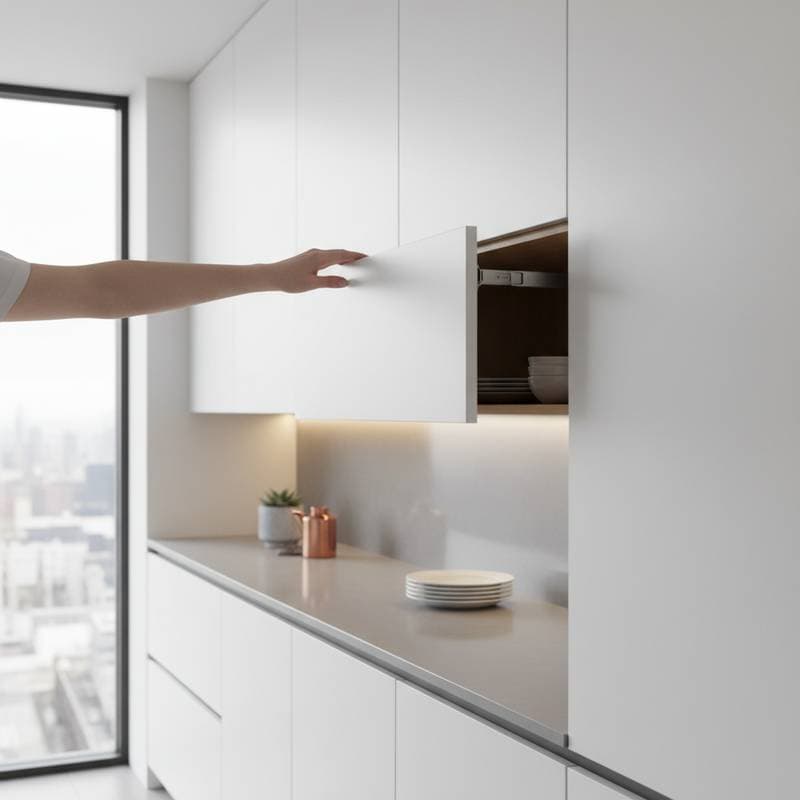
Invisible Touch Latches: Achieving Seamless Cabinetry Without Hardware
Contemporary cabinetry emphasizes smooth surfaces and minimal visual distractions. Handle-free designs, once reserved for luxury installations, now appear in everyday woodworking projects. Invisible touch latches make this possible through a concealed spring mechanism that opens doors or drawers with a firm press.
These latches go beyond aesthetics. They alter user interaction with storage solutions, guide spatial planning, and suit constrained environments or streamlined styles. Builders of custom pieces or those updating older setups benefit from mastering latch operation and fitting techniques to produce a refined, functional outcome.
Functions of Invisible Touch Latches
Invisible touch latches substitute traditional pulls or knobs with an internal mechanical or magnetic system. A press on the door or drawer front disengages the latch, extending the panel slightly, typically half an inch or 12 millimeters. Users then grasp and open it fully. Closing involves another press to engage the catch.
This tension-based system maintains an unbroken cabinet face, ideal for showcasing wood patterns, color contrasts, or uniform panels. Professionals apply them in kitchen setups, bathroom vanities, freestanding furniture, and integrated storage where appearance and usability align.
"Removing hardware lets the material speak," said designer Carla Nguyen of Studio CN. "It changes the rhythm of the space. Suddenly you see the joinery and finish instead of a line of metal handles."
Significance in Contemporary Cabinetry
Handleless approaches align with trends favoring uncluttered, airy interiors. Such designs promote tranquility and facilitate cleaning, as protruding elements collect less residue. In smaller areas, they prevent snags on fabrics and maintain unobstructed pathways.
For artisans and fabricators, touch latches provide versatility. Panels align evenly with appliances or adjacent walls, free from handle interference. In versatile areas like studio apartments or secondary units, this creates a unified, furniture-integrated appearance that expands perceived space.
The push activation enhances usability for those with reduced hand strength or mobility, requiring only light pressure instead of tugging. Combine them with soft-close hardware for effortless, hushed performance.
Varieties of Touch Latches
Mechanisms differ in operation and suitability, impacting required space, holding power, and user sensation.
Mechanical Push Latches
Spring-driven plungers extend doors upon activation. These prove durable, budget-friendly, and straightforward for upgrades. Pair them with concealed hinges for lighter panels on cabinets or drawers.
Magnetic Push Latches
Magnets secure and disengage the panel. Alignment precision proves essential, though fewer components mean less wear. They excel with moderate-weight, inset doors demanding uniform spacing.
Integrated Push-to-Open Drawer Slides
Full-extension runners incorporate release triggers directly. No additional latch required, they handle substantial loads while ensuring steady movement.
Electronic Servo Latches
Compact motors respond to slight pressure for automated opening. Wired to electricity and detectors, they suit upscale or adaptive environments.
Accuracy remains crucial across types. Minor misalignments lead to jams or irregular openings. Optimal setups deliver crisp, quiet responses; flawed ones result in awkward ejections or unreliable secures.
Essential Installation Steps
Proper fitting of invisible touch latches hinges on precise positioning, suitable hinges, and panel mass considerations. Follow these steps for reliable results.
-
Determine Clearances
Plan for a minimum 1/16-inch or 1.5-millimeter gap around doors or fronts. This allows the mechanism to function without interference. -
Select Appropriate Hinges
Opt for non-self-closing or free-swing varieties. Closing hinges resist the release force and hinder operation. -
Locate the Latch Components
Secure the main unit inside the cabinet frame, on side, top, or bottom surfaces. Affix the strike or magnet to the door's rear. Ensure contact occurs in the closed position. -
Calibrate Projection
Utilize adjustable threads or screws on most units. Set the extension so panels rest flush and extend evenly by half an inch or 12 millimeters. -
Verify Functionality Pre-Finish
Operate each assembly repeatedly prior to coatings. Account for potential shifts from wood expansion or added layers. -
Incorporate Dampening as Required
For gradual closing, integrate soft-close hinges or dampers. Balance spring forces to avoid opposition.
"Precision matters more than power," said cabinetmaker Leo Ortiz. "A millimeter too deep and the door will rattle. A millimeter too proud and it will never catch."
Integrating Design Elements
Touch latches shape more than assembly; they define a space's overall feel and appearance.
- Grain Continuity: Uninterrupted patterns allow bookmatching across surfaces or horizontal flows over doors.
- Surface Emphasis: Finishes on painted, layered, or solid materials gain prominence without metallic distractions.
- Lighting Synergy: Pair with concealed illumination under cabinets or at base levels to accentuate textures over fixtures.
- Seamless Connections: Align panels with countertops or walls for an embedded, structural quality.
- Concealed Entries: Employ latches for hidden utility or equipment panels.
Practical Daily Use
Initial appeal lies in visuals, yet enduring value emerges in handling. The press action feels natural. Full hands permit activation via elbow or knee. Cleaning streamlines to broad sweeps across planes, bypassing protrusions.
Kitchens gain reduced distractions and quicker upkeep. Bathrooms evoke calm retreats. Office or living storage merges into surroundings, directing attention to surroundings or displays.
This adaptability supports evolving layouts. As boundaries dissolve in open plans, cabinets function as extensions of architecture. Handleless forms reinforce this by serving dual roles as units and surfaces.
Resolving Typical Challenges
Challenges arise even for seasoned builders. Address these effectively.
- Excessive Extension: Lessen projection or spring force if panels spring out too far.
- Non-Engagement: Verify plunger-strike alignment. Reposition hinges if necessary.
- Inconsistent Spacing: Use shims on hinges or tweak latch depth for uniform reveals.
- Drawer Drag: Inspect slide alignment or load capacity. Select reinforced push slides for bulky contents.
- Audible Operation: Install silicone pads to mute impacts without impeding the mechanism.
Budget and Material Factors
Pricing spans from basic mechanical units at a few dollars each to advanced magnetic or powered models costing multiples more. Integrated drawer systems boost ease at higher initial outlay but minimize components.
Select based on substrates. For solid woods, position strikes on stable zones to counter humidity shifts. Pre-drill painted composites to prevent cracks. For thin overlays, site latches post-application to safeguard integrity.
Core Insights
-
Precision Drives Success: Seamless results stem from exact alignments and even gaps.
-
Usability Meets Style: Latches blend accessibility with contemporary appeal, clearing sightlines while easing reach.
-
Upkeep Simplifies: Smooth planes resist buildup, accelerating routines.
-
Styles Adapt Easily: Incorporate into minimal modern or classic wood schemes.
-
Retrofit Viable: Update legacy setups with compatible hinges and adjusted spaces.
Sustaining Your Installation
Handleless systems demand minimal ongoing care. Tighten fasteners occasionally and brush clean the activation points. Steer clear of forceful strikes on fronts, as mechanisms depend on subtle motions. If securing fails, inspect alignments before applying pressure.