
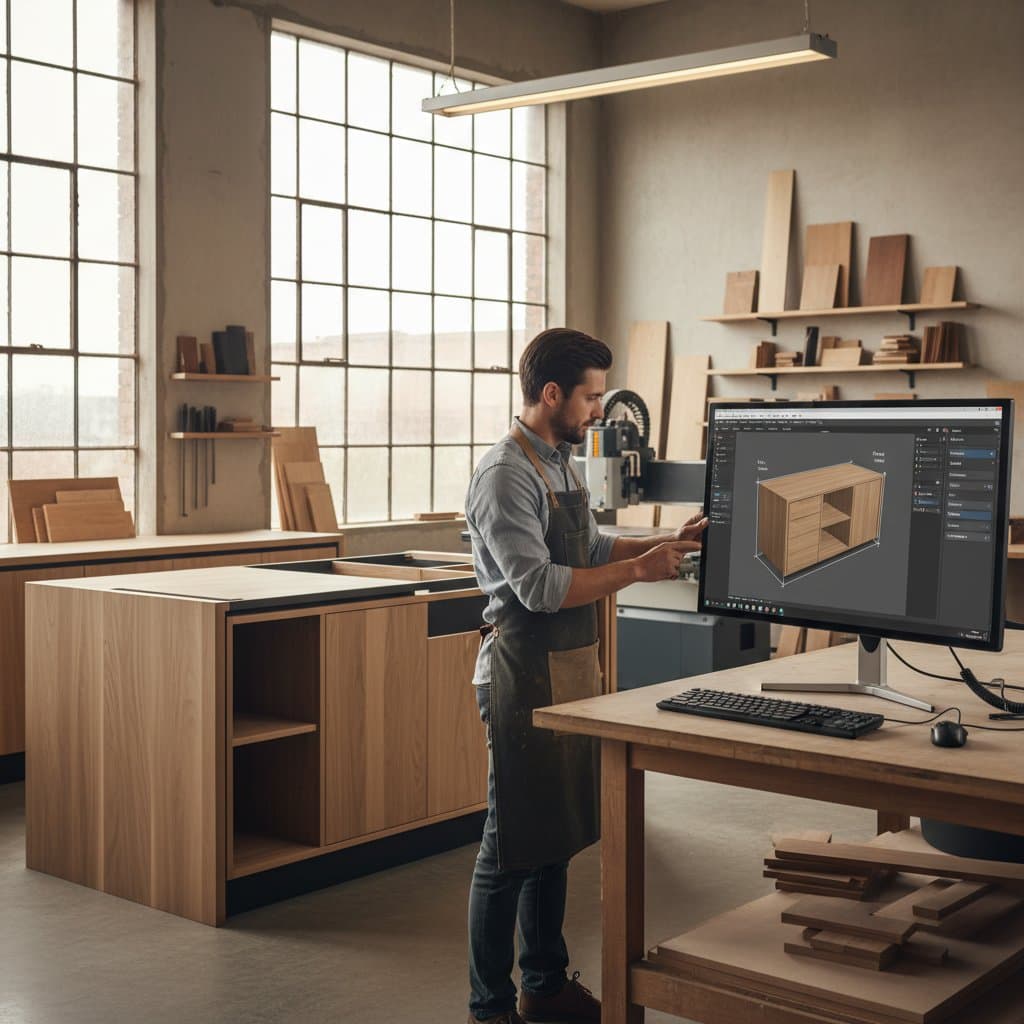
Parametric Tools Revolutionize Custom Cabinetry
Parametric modeling changes the approach to designing, building, and refining custom cabinetry. Tasks that once demanded hours of manual drafting now occur in minutes through adaptable digital models. Woodworkers in workshops of all sizes employ software such as Fusion 360 to create cabinets that adjust automatically to new dimensions, materials, and joinery details. This method yields faster workflows, fewer errors, and more efficient use of time and lumber.
At a Glance
Who: Custom cabinetmakers integrating digital workflows
Where: Across small fabrication shops and design studios
Size: Projects range from compact kitchens of 120 square feet (11 square meters) to full wall systems over 400 square feet (37 square meters)
Design Tools: Fusion 360, Grasshopper, Rhino, and proprietary plug-ins
Photography: Courtesy of shop teams and in-house fabricators
Before
Traditional cabinetmaking depended on static drawings. Any alteration in width, door overlay, or hardware placement required manual revisions across multiple views. A single misalignment could affect the entire shop, leading to rework or discarded panels.
"Adjusting one cabinet dimension often meant starting from scratch," said designer Alex Ramirez of Studio Frame. "It slowed everything from client approvals to cut lists."
Workshops maintained binders of 2D templates for standard sizes, yet customization created challenges. Even experienced teams encountered extended lead times for requests involving new proportions or material changes.
After
Parametric tools eliminate this rigidity. In Fusion 360, for instance, a cabinet functions as a live system where variables control every component. Parameters such as height, depth, face-frame thickness, hardware type, and edge banding allow changes in seconds. When one input modifies, the full assembly updates without delay.
In a recent kitchen project by Brightline Woodworks, the team developed a modular base cabinet model featuring adjustable toe-kick height and drawer spacing. Upon the homeowner's request for an integrated recycling pull-out, the design team adjusted a single variable. The revised parts list and CNC-ready files generated immediately.
"Parametric design frees us from repetitive drafting," said shop lead Maria Chen. "We focus on proportion and material detail instead of redrawing rectangles."
Project photos reveal tight grain-matched walnut fronts, uniform reveals, and smooth integration with stone countertops. This precision stems from variable-driven geometry that maintains exact tolerances throughout.
Design Details
- Materials: Walnut veneer plywood, maple interiors, powder-coated steel pulls
- Joinery: Dado and confirmat screw construction optimized for CNC cutting
- Finishes: Low-VOC matte lacquer with hand-rubbed feel
- Hardware: Undermount soft-close slides, concealed hinges, integrated LEDs
- Lighting: Linear LED strips under wall cabinets and warm white task lighting above the island
- Storage Moves: Adjustable tray dividers, hidden charging drawer, and vertical pan pull-out
- Software Setup: Fusion 360 with parameter tables controlling cabinet width, height, and hardware offsets
This project illustrates how digital parameters ensure physical precision. Each drawer front aligns precisely because the model establishes defined relationships between components. When the wall length extended by two inches (5 centimeters), the system applied that adjustment across the entire run without manual intervention.
How Parametric Thinking Works
Parametric modeling constructs geometry through rules rather than fixed dimensions. Each rule connects one element to another. For example, the face-frame width may equal one-twentieth of the cabinet width. If the cabinet width alters, the frame scales accordingly to adhere to the rule.
In Fusion 360, users establish a parameter list with named, editable values. A shop might define "base_height" as 34.5 inches (88 centimeters) and "toe_kick" as 4 inches (10 centimeters). These values adjust per project, instantly refreshing the 3D model, drawings, and toolpaths.
This method removes human error from repeated resizing tasks. It also enables libraries of evolving parts. Designers begin with a core cabinet family, then replicate and modify it for various projects or clients.
Parametric thinking promotes consistency. It establishes a shared digital framework for design and fabrication teams. Once in place, this framework extends to CNC machines, nesting software, and on-site installation.
Real Workshop Applications
1. Rapid Kitchen Layouts
Cabinetmakers test diverse kitchen configurations by expanding or contracting base modules. In Fusion 360, parametric constraints maintain door and drawer alignment despite footprint variations. This capability accelerates visualization and client approvals.
2. Custom Closet Systems
Designers at TimberForm Studio apply parametric templates to closet sections that accommodate different ceiling heights. Simple sliders control adjustable shelf spacing and hanging rods. The software then recalculates shelf quantities and material cut lists.
3. Commercial Millwork
Parametric systems manage repetitive yet varied cabinetry in hospitality and office settings. Elements like reception desks, feature walls, and built-ins adhere to brand standards while adapting to site specifics. This uniformity enhances quality control and minimizes installation issues.
Why It Matters
For small shops, adopting parametric tools extends beyond software acquisition. It transforms the complete workflow. Teams shift from sketching individual parts to defining interconnected systems.
"Once you think in relationships, you stop redrawing and start refining," said industrial designer Paul Nguyen. "You can price faster, respond faster, and deliver better fit."
Flexible models advance sustainability objectives. Reduced rework and material waste decrease scrap amounts. Late-stage dimension changes produce updated cut sheets that avoid expensive offcuts.
Parametric data integrates directly with CNC routers. Toolpaths adapt to new dimensions, preserving clearances and joinery accuracy. This connection strengthens the alignment between design vision and final production.
Key Takeaways
- Speed: Established libraries halve the time from concept to fabrication.
- Accuracy: Linked dimensions prevent errors such as misaligned drawer fronts.
- Flexibility: Variable-driven models handle client changes with ease.
- Consistency: A shared digital standard applies across all projects.
- Sustainability: Design revisions generate less waste, with improved nesting efficiency.
Parametric systems enhance collaboration as well. Designers, engineers, and fabricators reference the same live model, bridging communication gaps. The outcome includes smoother interactions and reliable on-site results.
Getting Started with Parametric Cabinetry
New shops begin with a single cabinet type. Define parameters for width, height, depth, and material thickness. Observe how these drive component creation. With growing confidence, extend the library to encompass drawers, doors, and accessories.
Fusion 360's parameter table and user parameters offer an accessible starting point. Grasshopper in Rhino provides advanced options for intricate geometries or algorithmic arrangements. Fabricators often combine these with CNC or laser systems for seamless output.
Tips for Implementation:
- Begin modestly with one cabinet family and iterate on it.
- Assign clear names to parameters, like "door_gap" or "drawer_spacing."
- Employ reference sketches to outline relationships prior to modeling.
- Record each rule to aid team comprehension.
- Refresh the library periodically to incorporate shop standards and hardware updates.
A collection of dependable templates delivers repeatable precision. In time, these digital resources prove as essential as physical jigs or fixtures.
Living with Your Design System
An established parametric library evolves as a dynamic resource. Designers experiment with new materials or layouts absent redrawing efforts. Shops extend customization choices to clients without additional drafting demands.
Parametric modeling complements craftsmanship rather than supplanting it. It equips woodworkers with greater command over proportion, fit, and material application.