
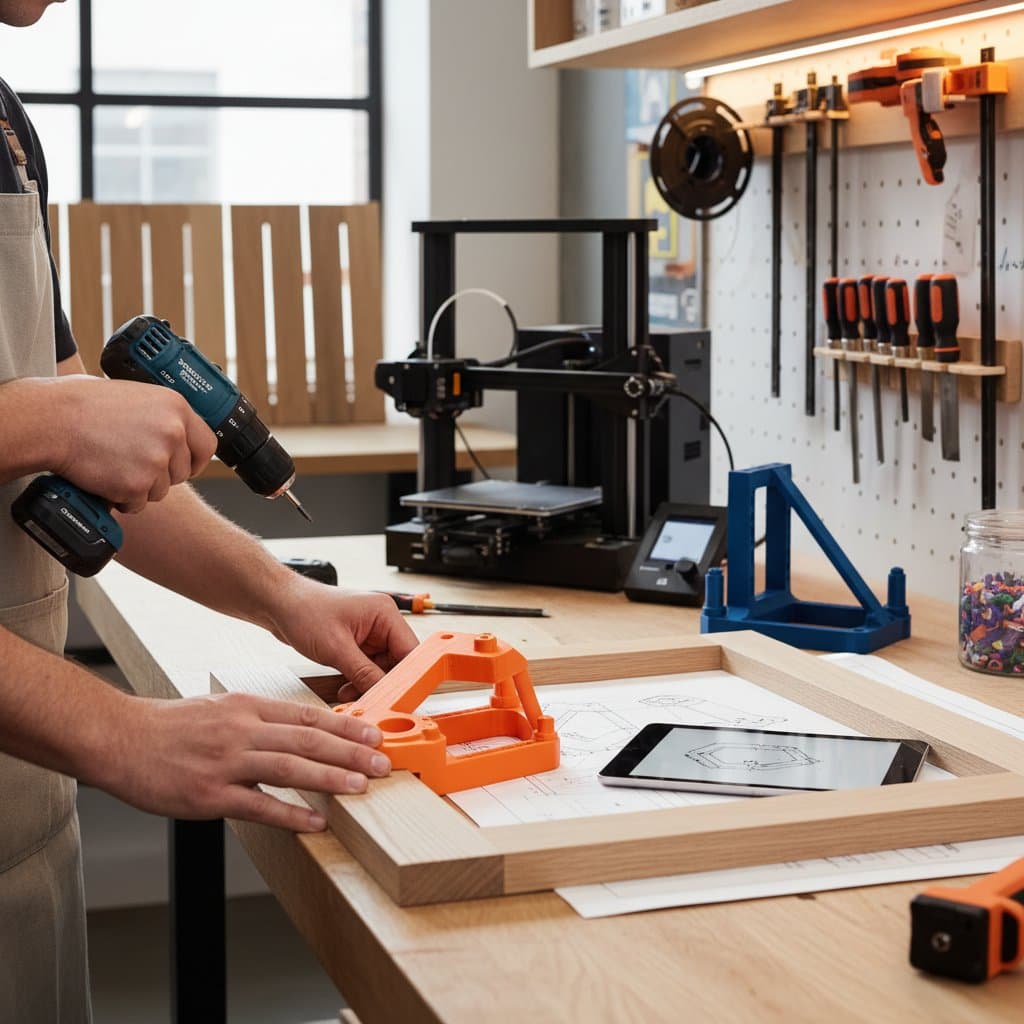
3D-Printed Jigs: Achieve Professional Accuracy for Just $25
A cabinet door misaligned by mere fractions of an inch disrupts the entire appearance of a kitchen. Home woodworkers often encounter irritation when drill holes fail to align or surfaces protrude unevenly. These minor discrepancies escalate rapidly during the construction of several cabinets. The emergence of 3D-printed jigs alters this narrative. Equipped with a 3D printer and digital files, woodworkers produce tailored guides that eliminate uncertainty and provide precision comparable to professional standards at minimal expense.
At a Glance
| Feature | DIY 3D-Printed Jig | Store-Bought Jig | Custom Shop Jig |
|---|---|---|---|
| Cost | $5 to $25 in filament | $40 to $120 | $150 to $300 |
| Lead Time | 2 to 6 hours print time | 3 to 5 days shipping | 1 to 2 weeks |
| Precision | ±0.2 mm typical | ±0.5 mm typical | ±0.1 mm typical |
| Custom Fit | Fully adjustable | Fixed template | Custom order |
How 3D-Printed Jigs Enhance Accuracy
The primary function of any jig involves maintaining consistent tool positioning. When fabricated accurately, a 3D-printed plastic jig achieves tolerances around 0.2 millimeters. In cabinetry applications, this level ensures that holes align within a margin narrower than a sheet of paper. Traditional manual methods typically deviate by several multiples of that amount.
3D-printed jigs excel in three key aspects:
- Repeatability: After creating the digital file, woodworkers print identical versions on demand. This capability proves essential for constructing multiple cabinets or replicating guides for future repairs.
- Customization: Designs incorporate features such as text labels, depth stops, or contoured edges directly into the model.
- Cost Efficiency: One roll of PETG filament, priced at approximately $30, yields numerous custom jigs.
This precision arises from the printer's layer-by-layer deposition, guided by software algorithms. The resulting digital fidelity ensures uniform hole spacing and guide alignment when applied to wood or other materials.
Action Step: Incorporate pilot holes for screws or clamps into the jig design. Such secure attachments minimize movement and elevate accuracy during drilling or routing operations.
Selecting Materials and Software for Jig Design
To begin designing jigs, woodworkers select user-friendly CAD software like Tinkercad or Fusion 360, both available in free versions. These tools allow intuitive modeling of guides for tasks such as hinge placement or drawer slide installation. Start with basic shapes: rectangles for flat bases, cylinders for drill bushings, and slots for tool clearance.
Material choice influences durability. PLA suits prototypes due to its ease of printing, but PETG offers superior strength and heat resistance for shop use. For heavy-duty applications, consider ABS, though it requires an enclosed printer to avoid warping.
Layer height settings of 0.2 millimeters balance speed and detail. Infill density at 20 to 40 percent provides rigidity without excessive material use. Test prints on scrap wood verify fit before committing to final production.
Action Step: Download free jig templates from open-source repositories and modify them in CAD software. Adjust dimensions to match specific cabinet hardware, such as European hinges measuring 35 millimeters in diameter.
DIY Printing Versus Professional Services
Many enthusiasts pause before investing in a 3D printer. For those individuals, community maker spaces or online platforms produce jigs from uploaded designs at costs of $20 to $60 per unit. These services provide calibrated equipment and eliminate home maintenance needs. However, they introduce delays and limit rapid design iterations.
Scenarios for DIY Printing
- Ongoing cabinet projects demand multiple jigs over time.
- Experimentation with design tweaks and fit testing appeals to the user.
- Full control over filament types and print parameters is preferred.
Scenarios for Print Services
- Production of only one or two specialized jigs is required.
- Advanced materials, such as carbon fiber-reinforced nylon, are necessary for robustness.
- Limited home space or inadequate ventilation precludes personal printing.
Either approach yields high-quality outcomes. The decision hinges on project frequency and the balance between autonomy and ease.
Action Step: For outsourced prints, specify a tolerance of ±0.15 millimeters and request 100 percent infill in critical areas like drill guides. This configuration maintains structural integrity under operational stress.
Essential Techniques from Seasoned Cabinetmakers
Veteran professionals integrate 3D printing through established practices that maximize reliability.
- Install insert bushings in drill guides using brass or steel to resist wear and preserve hole integrity over repeated uses.
- Embed labels directly into the design with raised or recessed text to denote function and compatible hardware.
- Establish uniform mounting points across all jigs, such as standardized clamp spacings, to facilitate seamless transitions between tools.
- Perform monthly printer calibration, including bed leveling and extrusion rate checks. Even a 0.1-millimeter deviation accumulates into visible door misalignment.
- Store completed jigs flat in a cool environment to avert deformation. Opt for PETG over PLA for its enhanced thermal stability, despite the modest price premium.
Action Step: Organize a digital repository for jig files. Name versions systematically, for example, "DrawerSlide_Jig_v3_PETG," to cultivate an expanding collection tailored to evolving needs.
Examples of Custom Jigs for Cabinet Projects
Consider a hinge jig for overlay doors. Design a base plate with slots matching door thickness, plus adjustable fences for reveal settings. Print in PETG with steel bushings to guide a 35-millimeter Forstner bit precisely.
For drawer slides, create a guide that clamps to the cabinet side and marks mounting holes at exact centers. Include depth stops to prevent over-drilling into adjacent compartments.
Shelf pin jigs simplify repetitive layouts. A modular design with interchangeable pegs accommodates various shelf spacings, from 32 millimeters for standards to custom increments.
These examples demonstrate versatility. Woodworkers adapt designs to specific hardware brands, ensuring compatibility without purchasing proprietary tools.
Action Step: Prototype a simple jig for your next project, such as a pocket hole guide. Print, test on scrap, and refine the model based on real-world performance.
Developing a Personalized Jig Collection
As projects accumulate, a library of 3D-printed jigs becomes invaluable. Start with essentials: hinge, slide, and pin guides. Expand to specialized tools like router templates for dados or scribes for scribe-fit adjustments.
Regular use reveals opportunities for improvement. Update files to incorporate lessons from past builds, such as tighter tolerances for hardwoods.
This approach not only saves money but also builds skills in digital design. Woodworkers gain confidence in achieving seamless cabinetry that rivals commercial installations.
Action Step: Schedule a quarterly review of your jig library. Print updates for worn pieces and archive successful designs for quick access in future endeavors.