
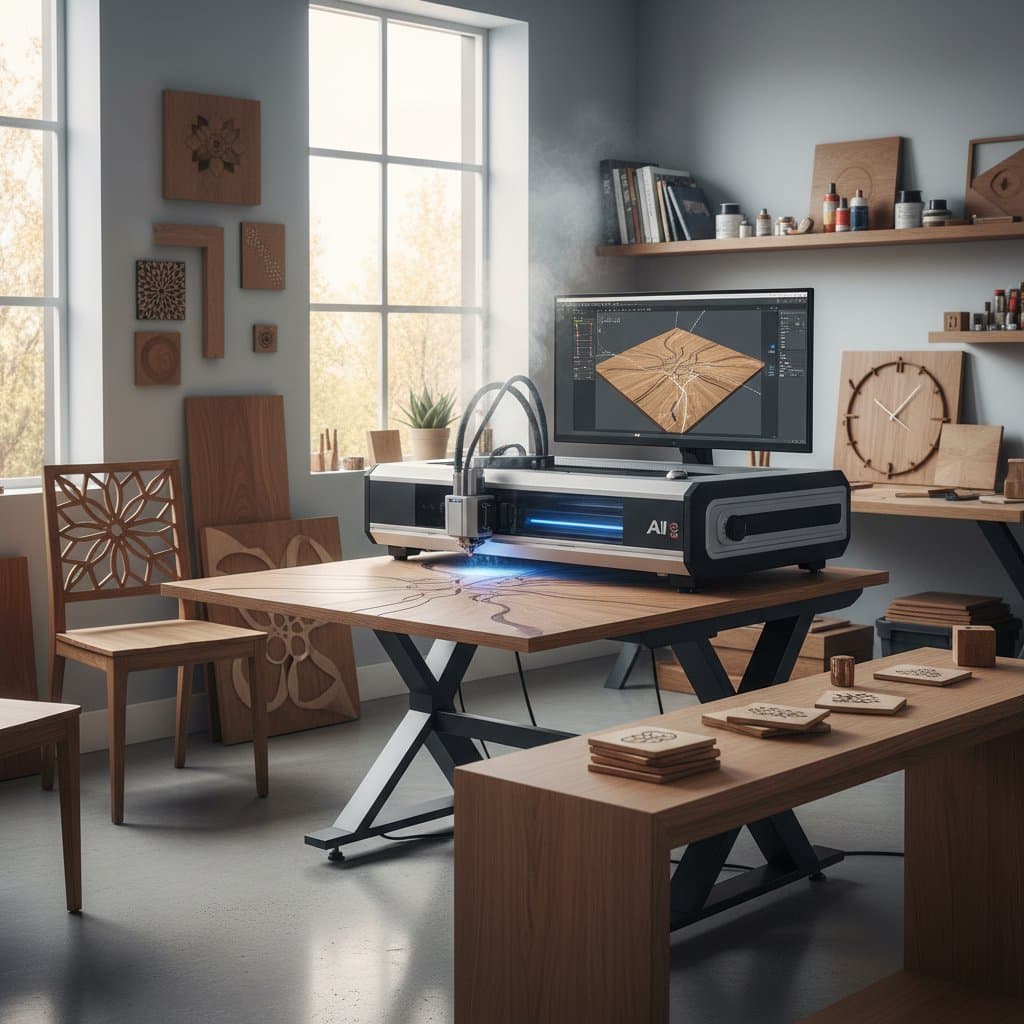
AI Laser Engraving Brings Pro-Level Personalization Home
AI-driven laser engraving transforms DIY woodworking by delivering professional-grade personalization directly to home workshops. Home makers now access tools that interpret wood grain patterns, fine-tune engraving depth, and produce intricate designs with unmatched accuracy. This technology empowers creators to elevate ordinary furniture pieces into unique, custom creations that showcase individual style and skilled craftsmanship.
Woodworkers of all experience levels benefit from these advancements. Traditional engraving methods often demand extensive manual adjustments and trial runs, which can lead to inconsistencies and wasted materials. In contrast, AI integration streamlines the process, allowing focus on creativity rather than technical hurdles.
Understanding AI in Laser Engraving
AI laser engraving combines computer vision and machine learning to analyze materials before and during operation. The system scans the wood surface to map natural variations such as knots or grain direction. Based on this data, it automatically adjusts laser power, speed, and path to achieve optimal results.
This approach differs from standard laser cutters, which require users to input fixed parameters. AI models learn from previous jobs, refining techniques over time to minimize errors. For instance, when engraving on oak versus pine, the software predicts how each wood type responds to heat, preventing burns or shallow cuts.
Home users appreciate the user-friendly interfaces that simplify complex operations. Software platforms often include drag-and-drop design tools integrated with AI suggestions, making it possible for beginners to produce professional outcomes without advanced training.
Key Benefits for DIY Woodworkers
Precision stands out as a primary advantage. AI ensures consistent depth across irregular surfaces, which proves essential for detailed patterns like filigree or text on tabletops. This level of control reduces rework and enhances the final product's durability.
Efficiency gains allow projects to complete in hours rather than days. Automated adjustments eliminate the need for multiple test pieces, saving both time and resources. Woodworkers report up to 50 percent faster production rates when using AI-enhanced systems compared to manual alternatives.
Customization options expand creative possibilities. Users upload personal photos, logos, or sketches, and the AI vectorizes them for clean engraving. Textures such as faux leather or embossed effects become achievable on budget-friendly setups, turning standard shelves into heirloom-quality items.
Selecting the Right AI Laser Engraver for Home Use
Choose equipment based on workspace size and project scale. Compact desktop models suit small home shops, offering engraving areas up to 12 by 8 inches with power outputs around 5 to 10 watts. These units handle softwoods and thin veneers effectively while fitting on standard workbenches.
For larger furniture pieces, consider mid-range machines with 20-watt lasers and expandable beds. Verify compatibility with AI software; reputable brands provide proprietary apps that update via cloud services for ongoing improvements. Budget options start at a few hundred dollars, with premium setups reaching into the thousands for industrial features.
Safety features matter greatly in home environments. Look for enclosures that contain laser light, automatic shutoffs, and ventilation systems to manage fumes. User reviews highlight models with intuitive AI calibration wizards that guide initial setup in under 30 minutes.
Step-by-Step Guide to Engraving Personalized Designs
-
Design Your Pattern: Start in the AI software by importing or creating a vector file. Use built-in libraries for inspiration, such as geometric motifs or nature-inspired borders. The AI analyzes the design for feasibility, suggesting modifications to avoid overly dense areas that could overheat the wood.
-
Prepare the Material: Secure the wood piece on the engraver bed using clamps or adhesive. Clean the surface to remove dust, which might interfere with laser focus. Run a quick AI scan to map the grain; the system generates a preview showing expected depth variations.
-
Configure and Engrave: Input parameters like desired depth, typically 0.5 to 2 millimeters for decorative work. Activate the AI mode, which monitors progress in real-time and pauses if anomalies appear. Engraving sessions last from minutes for small logos to an hour for full tabletops.
-
Post-Process and Finish: Inspect the engraving for clarity, then sand lightly if edges feel rough. Apply sealants like polyurethane to protect the design and enhance wood tones. AI tools often recommend finishing techniques based on the engraving style.
Follow these steps to achieve repeatable results. Practice on scrap wood builds confidence, and save successful profiles in the software for future projects.
Exploring Advanced Techniques
Once comfortable with basics, experiment with multi-pass engraving for deeper reliefs. AI optimizes layering to build dimension gradually, ideal for sculptural elements on chair backs or cabinet doors. Combine engraving with cutting to create inlays, where contrasting woods fit precisely into recessed patterns.
Texture mapping represents another frontier. Upload 3D models, and the AI translates them into varied laser intensities for realistic effects like bark or woven patterns. This technique suits ambitious pieces, such as personalized cutting boards with topographic designs.
Integration with other tools expands versatility. Pair the engraver with CNC routers for hybrid projects, where AI coordinates both machines. Woodworkers share community templates online, adapting them via AI for personal twists without starting from scratch.
Elevate Your Workshop with AI Precision
Adopting AI laser engraving opens doors to professional personalization without leaving home. Creators gain tools that respect material nuances while amplifying imaginative visions. Furniture emerges not just functional, but infused with stories through custom engravings that endure.
This shift redefines DIY woodworking as an accessible art form. Home makers produce items rivaling custom shops, fostering pride in every detail. Invest in this technology to unlock efficiency, precision, and endless creative potential in your projects.