
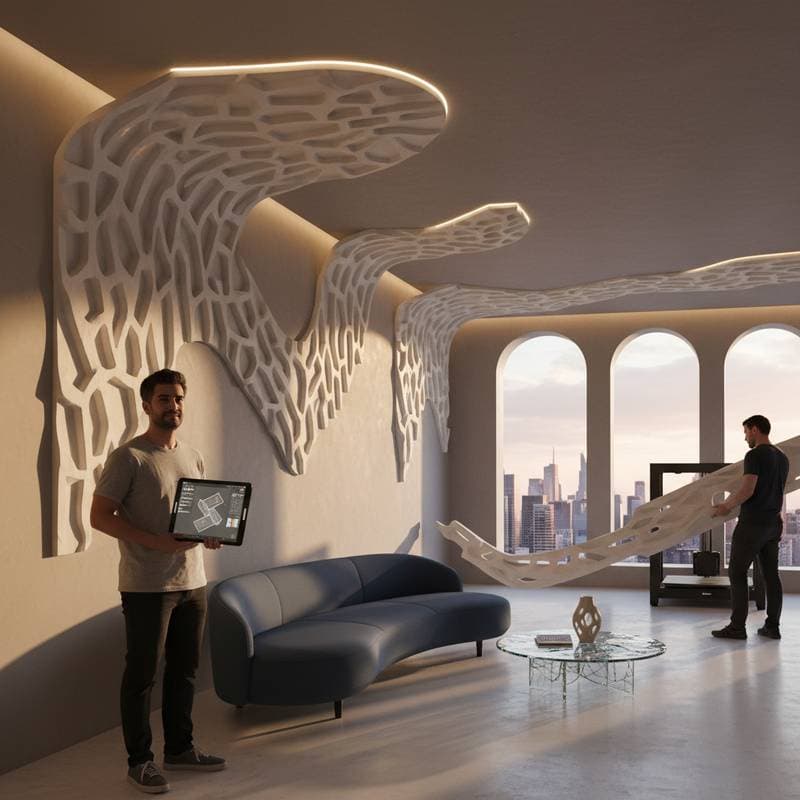
3D-Printed Trim: Revolutionize Your Home Interiors
The transition from hand-carved to digitally printed trim reshapes how designers approach walls, ceilings, and cabinetry. Production that once demanded weeks of labor now occurs overnight through parametric precision. This innovation creates a fresh realm of interior detailing that blends craftsmanship, computational design, and personalization. Builders, designers, and homeowners alike gain access to textures and profiles unattainable through conventional techniques.
At a Glance
- Focus: 3D-printed trim and molding for bespoke interiors
- Applications: Residential homes, boutique commercial spaces, and furniture accents
- Technology: Parametric modeling paired with additive manufacturing
- Materials: Biopolymers, PLA, recycled composites, and flexible resins
- Design Teams: Collaborations between digital fabricators and interior specialists
- Photography: Studio images highlighting layered patterns and light interactions
This guide examines the evolution, its significance, and practical steps for incorporating the technology into projects.
Why 3D-Printed Trim Matters Now
Trim serves as more than a boundary; it structures space, establishes visual cadence, and bridges material shifts. Conventional molding depended on standardized router bits and knives. Digital fabrication enables curves that adapt to light, acoustics, or spatial ratios in real time. Professionals script patterns that extend across walls or adjust seamlessly at corners.
Interior designer Mia Tran notes, “We used to select from catalogs. Now we model the environment in 3D, apply scripts, and the trim aligns with the architecture like a custom garment.” This evolution from choice to creation drives the appeal.
The Core Challenge
Customization has long clashed with affordability. Bespoke millwork requires expert labor and dedicated tools. Even slight modifications necessitate blade recutting or machine reconfiguration. For modest studios or individuals, such expenses proved prohibitive. 3D printing eliminates tooling constraints, allowing variation per piece at fixed printer costs.
Profiles evolve into data rather than physical fixtures. A parametric model scales, rotates, or iterates across sizes without reconfiguration. This adaptability minimizes waste and accelerates timelines.
Before: Static Profiles and Limited Expression
Traditional trim adhered to predefined catalogs of styles like Colonial, Craftsman, or Contemporary. Installation involved precise miters and extended waits. Deviations in wall dimensions or angles prompted field adjustments. Those seeking originality encountered high expenses.
Woodworker Daniel Ross observes, “Hand-carving custom moldings was possible, but only for clients with substantial budgets. Each trial demanded extensive sanding and cutting.” Outcomes favored uniformity over individuality.
After: Parametric Customization and Digital Craft
In a 3D-printed process, the profile originates as code. Designers outline the foundational form, then set parameters for elevation, arc, texture relief, or intervals. Printers produce pieces to exact specifications. Installers handle lightweight sections that secure via clips or adhesives, free from wood's common warping or cracking.
Recent projects showcase the change. Walls display rippling geometric strips. Ceilings incorporate undulating edges that capture illumination. Cabinet fronts feature seamless embossed designs spanning surfaces. Every plane turns into a medium for deliberate intricacy.
Architectural technologist Leila Ortiz explains, “Parametric scripts let us evaluate pattern responses to varied light sources. After finalizing the form, the printer executes details that manual methods would require weeks to achieve.”
Design Details
- Profiles: Derived from models in Rhino, Grasshopper, or Fusion 360 scripts
- Printers: FDM and resin systems with nozzles ranging from 0.4 to 1.2 mm for resolution control
- Materials: PLA for initial tests, ABS for strength, wood-infused filament for organic hues, recycled PET for eco-friendly builds
- Mounting: Adhesive surfaces or dovetail joints for efficient setup
- Finishes: Lightly sanded and painted, stained to emulate oak or walnut, or retained in matte for contemporary appeal
- Lighting Integration: Built-in LED recesses in cornices for subtle radiance
- Maintenance: Modular segments for isolated replacements
These elements ensure expressive yet functional digital trim.
How the Process Works
Step 1: Digital Modeling
Professionals initiate with foundational geometry in CAD or parametric tools. They establish guidelines for breadth, projection, intervals, or motif recurrence. Models incorporate site factors like illumination paths or sound dynamics.
Step 2: Slicing and Printing
Files convert to layer instructions for the printer. Duration varies from hours for short runs to days for extended forms. Larger elements segment for assembly with hidden joins.
Step 3: Finishing and Installation
Post-printing, trim undergoes light sanding, priming, and coating. Attachment uses tape or glue. Precise dimensions guarantee flush connections on uneven substrates.
Step 4: Integration and Lighting
Pairing with illumination is common. Integrated grooves or apertures distribute light uniformly, supplanting prominent fixtures. This method amplifies ambiance and accentuates relief.
Where to Use 3D-Printed Trim
Living Rooms
Apply crown molding with flowing contours to harness natural light. Daily shadow shifts introduce vitality to the area.
Kitchens
Edge cabinets or islands with tailored strips. Wood-filled options harmonize with existing elements while concealing LED runs.
Bedrooms
Incorporate wainscoting on focal walls for subtle dimension. Acoustic variants enhance quietude.
Commercial Spaces
Boutique venues employ branded motifs. Sites derive uniqueness from shared parametric bases.
Cost and Scale
Initial concerns about expense have eased. Entry-level filament printers cost below five hundred dollars; industrial units for broad panels span three to ten thousand dollars. Materials run two to five dollars per linear foot, based on composition and treatment. Comparable custom woodwork surpasses fifteen dollars per foot, excluding labor.
Tooling absence levels the field for unique designs. Small operations match the inventive scope of major firms.
Environmental Impact
Sustainability plays a key role. Filaments often incorporate recycled or biodegradable components. Overuse of material is avoided through precise deposition. On-demand fabrication cuts surplus stock.
Architect Lucas Grant states, “We produce only essentials at the needed time. This redefines inventory; the printer serves as our stockroom.”
The approach aligns with green construction and lowers transport-related emissions from heavy profiles.
How Light Transforms Printed Trim
Illumination elevates digital trim design. Micro-reliefs on printed faces disclose depths invisible in smooth moldings. A modest undulation appears even in ambient light and striking under sidelight.
Modelers preview angles digitally. They assess LED or overhead interactions with the surface. The outcome functions decoratively, directing glow along edges or highlighting displays.
Smart Storage of Digital Assets
Modeled profiles join digital repositories. Firms catalog by dimension, intricacy, and aesthetic. Client requests prompt tweaks to proven codes, bypassing full redesigns. This supplants physical prototypes and streamlines workspaces.
Homeowners access online open-source collections. Desktop printers enable trial pieces before large commitments. The practice fuses amateur experimentation with expert results.
Key Takeaways
- 3D-printed trim translates design files into tangible elements, bypassing custom tools.
- Parametric methods permit boundless adjustments in form, surface, and proportion.
- Expenses now suit modest operations and individuals.
- Illumination turns printed features into evolving architectural highlights.
- Eco-materials and targeted production curb excess and warehousing.
- Asset libraries simplify modifications or fixes.
These aspects underscore the value for experts and casual updaters.
Applying the Idea at Home
Commercial equipment is unnecessary to begin. Makerspaces provide printing by length or time. Supply a basic CAD file or collaborate on creation. Test on minor areas like door surrounds or ledges. Note texture-light interplay, then expand.
Guided options exist through firms with templated sets. Choose a core form, refine measurements, and obtain fitted, install-ready pieces.
Trade-Offs and Maintenance
Advantages come with considerations:
- Lighter weight invites dents from collisions.
- Layer visibility in FDM outputs calls for smoothing or filling.
- Finish grip depends on filament; samples aid selection.
- Proximity to heat sources demands resilient variants.
Planning addresses these. Advancements in materials continue.
Building on the Skill
For carpenters, 3D printing extends rather than supplants tradition. Shops merge printed details with solid wood foundations. Hybrids preserve warmth alongside elaborate additions, linking computation to manual polish.
CNC specialist Jordan Price remarks, “Hand-sanding, staining, and assembly persist. The printer supplies novel contours to refine.” This perspective sustains heritage while broadening expression.
Living with Your Design
Installed trim demands minimal upkeep. Wipe with soft cloths or use light vacuuming. Damage to a part prompts reprinting and targeted swap, sparing surrounding areas. Replaceability stands as a primary strength.