
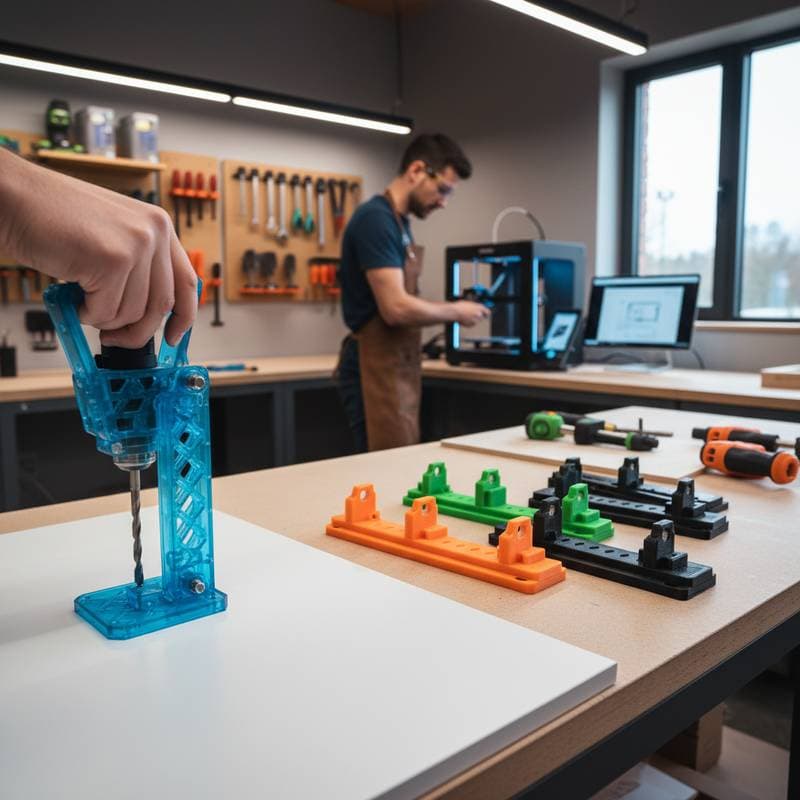
Elevate DIY Cabinetry Precision with Custom 3D Printed Jigs
A misaligned hinge hole disrupts the alignment of an entire cabinet door. Traditional jigs offer some assistance, yet they frequently lack flexibility and degrade with repeated use. Custom 3D printed jigs address these limitations, enabling DIY woodworkers to attain the precision typically found only in professional workshops. Through simple design adjustments and a dependable printer, individuals craft tailored guides that align perfectly with specific projects, thereby conserving time and materials.
The Advantages of 3D Printed Jigs in Cabinetry
Jigs maintain consistency for drills, routers, or saws across various components. 3D printed variants enhance this reliability by incorporating digital precision into their structure. Designers modify spacing, hole diameters, and angles via computer software prior to printing, eliminating trial-and-error measurements and adjustments.
Woodworkers commonly select PLA or PETG filaments, which retain structural integrity under typical workshop conditions involving heat and pressure. For demanding cabinet applications, nylon or carbon fiber-reinforced filaments deliver superior strength. A completed jig facilitates numerous cuts or drillings without compromising accuracy, a feat challenging for conventional plywood or metal templates.
Key advantages encompass:
- Repeatable precision suitable for multiple cabinet assemblies
- Minimal expense for replacements or modifications
- Complete adaptability for elements such as drawer fronts, hinges, and shelf supports
- Digital archiving of designs for effortless future replication
To commence, precisely measure cabinet parts using a caliper. Develop the jig model in accessible software options like Fusion 360 or Tinkercad. Produce a prototype section to verify alignment before generating the full-scale item.
Assessing Costs and Building a Budget
Entry-level desktop printers suitable for detailed jigs range from $300 to $600 in price. Individual jigs require approximately 50 to 100 grams of filament, translating to $2 to $5 in material costs. Accounting for experimental prints and iterative designs, the average outlay per jig falls between $10 and $25.
Commercial jigs for cabinet fittings cost $40 to $120 apiece, and they might not conform to unique configurations. Across five or six undertakings, self-printing yields savings exceeding $200, alongside elevated precision. Consider design duration in financial planning; at a personal valuation of $25 per hour, a jig that eliminates two hours of manual layout recoups its investment immediately.
Options for Printing: DIY Versus Professional Services
Individuals possessing a printer find jig creation a straightforward extension of their capabilities. Essential requirements include foundational CAD proficiency, accurate measuring tools, and tolerance for initial test iterations. Those lacking equipment can utilize community maker spaces, which impose fees of $5 to $10 hourly, or online platforms that fabricate and deliver designs for $15 to $30.
Commercial facilities employ high-end printers compatible with specialized materials, yielding jigs enduring hundreds of applications. Such durability suits large-scale production or business-oriented cabinetry. For residential endeavors, however, standard consumer prints prove sufficiently robust.
Pitfalls to Sidestep in Jig Fabrication
Neglecting printer calibration results in uneven print beds and distorted jigs. Overlook material tolerances at your peril; incorporate 0.2 to 0.3 millimeters of clearance to ensure seamless component insertion. Excessive filament temperatures provoke drooping edges, misaligning critical hole positions.
Disregard signs of degradation, such as surface abrasion or edge fractures, which erode precision over time. Regularly inspect jigs post-use and discard compromised units promptly. These precautions preserve the reliability essential for professional outcomes.
Strategies for Optimal Jig Performance
Verify every dimension within design software prior to printing to avert costly errors. Incorporate engraved labels or utilize distinct filament colors for jig identification and organization. Maintain STL files in secure cloud storage for rapid access and reprints.
Integrate bushings into jig designs for enhanced drill guidance, particularly in high-volume tasks. Experiment with layered reinforcements to bolster high-stress areas. As proficiency grows, these jigs not only streamline workflows but also inspire confidence in tackling intricate cabinet designs.
Realizing Professional Standards in Home Workshops
Custom 3D printed jigs empower DIY enthusiasts to produce cabinets indistinguishable from those in elite shops. The fusion of digital design and affordable fabrication democratizes advanced woodworking techniques. Invest time in mastering these tools, and witness transformations in project efficiency and quality that extend far beyond initial savings.