
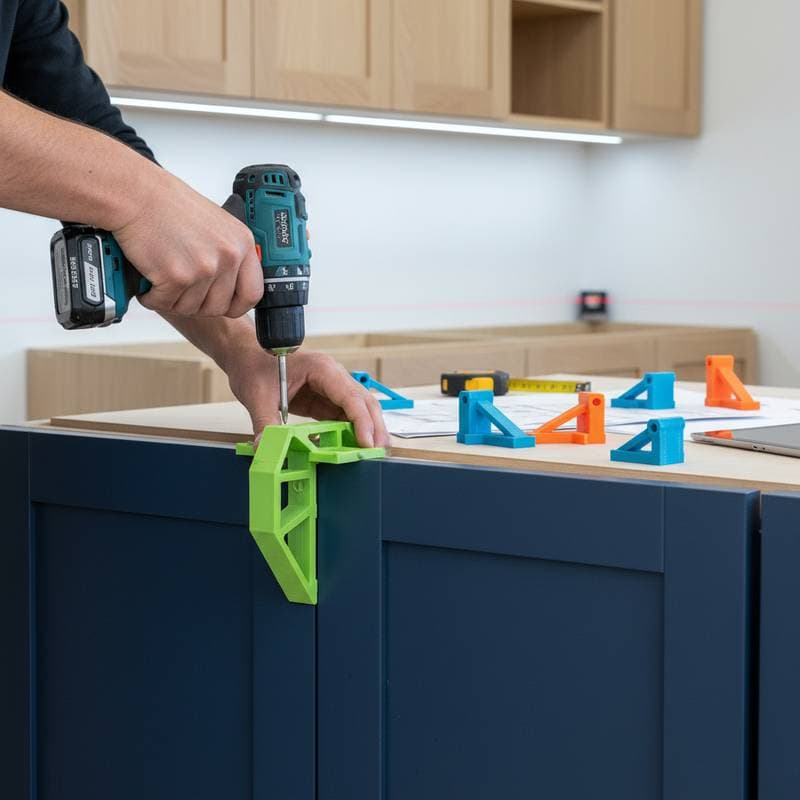
3D Jigs: Unlock Pro DIY Cabinetry Precision Now
The persistent issue of aligning cabinet parts with exact precision has found a reliable solution. 3D printed jigs enable woodworkers and committed DIY enthusiasts to drill, mark, and assemble components with the accuracy previously available only in professional workshops. These custom-printed guides fit specific hardware and layouts precisely, which minimizes setup time and prevents expensive errors.
At a Glance
Who: Committed DIY woodworkers and professionals in small shops
What: Custom 3D printed jigs for cabinetry and furniture assembly
Where: Home workshops and compact fabrication studios
Size: Ranges from 12 square feet (1.1 square meters) bench areas to complete 400 square foot (37 square meter) shops
Design and Engineering Team: Independent creators employing consumer-grade 3D printers and modeling software
Photographer: Studio Woodcraft Images
Before
Traditional cabinetry methods often result in misalignment when even a slight deviation of a fraction of an inch occurs. Reliance on paper templates, purchased jigs, or makeshift blocks frequently leads to repeated drilling or enlarged holes.
One homeowner during a modest kitchen renovation shared, “We tried a metal jig from a hardware store, but the hinge plates never lined up. It felt like guessing with every door.” Such tools, designed for general use, fail to accommodate the precise dimensions of particular hardware or materials.
Professional shops encounter comparable challenges. Frequent reconfiguration slows output, and adapting to new hinge varieties requires recalculating hole positions each time. Without access to CNC routers, precision hinges on manual steadiness and uniform marking techniques.
After
3D printed jigs bridge this accuracy shortfall effectively. Woodworkers employ modeling software to create guides that secure precisely in required positions. These fixtures maintain a drill bit, router, or saw blade in optimal alignment with the workpiece, which eradicates marking fatigue and repetitive inaccuracies while providing professional-grade uniformity at reduced expense compared to commercial alternatives.
Images from contemporary workshops depict vibrant orange and gray printed templates attached to cabinet faces and drawer fronts. Each jig features engraved labels and depth indicators. Certain designs incorporate integrated bushings and adjustable stops, while others embed magnets that attach to steel rulers or fence edges.
Design consultant Maren Ellis noted, “We print a new jig for every hinge and pull type. It takes an hour to model but saves a full day of setup on site.” These printed tools establish a cohesive visual system in the workspace, with each tailored to a unique function yet integrated into an overall process.
Design Details
- Material: PLA or PETG filament, selected for strength and stability under typical workshop temperatures.
- Printing time: Two to four hours per jig, based on design intricacy.
- Accuracy: Hole positions confirmed to within 1/64 inch (0.4 millimeter).
- Finish: Apply light sanding followed by wax to enhance sliding and longevity.
- Organization: Use labeled pegboard racks to store jigs by function, ensuring quick retrieval.
- Integration: Pair jigs with standard clamps or dowel guides to form versatile hybrid systems.
- Cost range: Materials cost between 5 and 25 dollars per jig, influenced by dimensions and infill percentage.
These specifications highlight the ease of achieving precision today. Rather than depending on standardized factory products, individuals craft and produce their own tools. This adaptability converts individual projects into efficient, personalized production lines.
How to Start Printing Jigs
Start with a detailed layout sketch. Measure cabinet components thoroughly and note positions for hinges, handles, and shelf pins. Convert these dimensions into a 3D model via accessible CAD software, which often includes parametric features for simple later adjustments without full redesigns.
Generate an STL file from the model and produce it on a basic FDM printer. Set layer height to 0.2 millimeter for sufficient surface smoothness in guiding operations. For jigs intended for frequent drilling, reinforce with metal bushings or increased wall thickness around critical openings.
Print a prototype jig initially to test against scrap material or a spare cabinet door. Verify alignment before producing the complete series. Label each jig clearly by depth and hardware specifications, for example, “Door Pull 96 mm” or “Shelf Pin 6 mm.”
Real Workshop Examples
Small Kitchen Cabinet Retrofit
In a limited urban apartment, an amateur woodworker applied 3D printed hinge jigs to update existing cabinet doors. These guides ensured proper placement for concealed hinges and halved the installation duration. The homeowner explained, “I used to measure every door twice. Now I snap the jig on and drill. Every hinge cup fits tight and square.”
Custom Closet Build
A suburban workshop team produced extended shelf pin jigs featuring integrated indexing ribs. These ribs maintained uniform spacing on panels reaching 84 inches (2.13 meters). By printing interlocking extensions, they drilled several panels in a single session, yielding straight vertical alignments and accelerated assembly.
Furniture Prototype
Freelance designer Leo Tran developed a corner clamping jig printed in 3D that secures panels at exact 90-degree angles. The design incorporates an adjustable stop and a quick-release mechanism. “It’s like having a third hand that never gets tired,” he observed. This consistent precision allowed him to deliver a polished prototype to clients without purchasing costly metal alternatives.
Key Takeaways
- Precision on demand: Tailored jigs align perfectly with specific hardware, removing uncertainty.
- Cost efficiency: Expenses for materials remain low relative to metal or CNC-based options.
- Time savings: Modeled once, jigs can be reprinted for ongoing use.
- Adaptability: Modify designs per project to incorporate refined measurements or additions.
- Professional results: Small operations attain factory-comparable alignment and spacing.
Beyond functionality, 3D printed jigs foster innovation. Embed custom logos or scale indicators during printing to personalize tools. Assign colors by operation to streamline task transitions and avoid mix-ups.
Integrating Jigs into Daily Workflows
Adopting printed jigs reshapes the construction sequence fundamentally. Allocate less effort to measurements and verifications, freeing time for joining and refinement stages. Workspaces remain tidier, with reduced reliance on disposable templates or debris.
Care for jigs proves simple. Lay them flat or suspend them to avoid distortion. Reprint worn pieces during off-hours. Opt for PETG or nylon filaments in demanding applications for enhanced resilience. Organize digital models in categorized folders by project category to facilitate future access and modifications.
The empowerment from reliable precision tools proves evident. Shelves level perfectly, hinges operate without binding, and drawer fronts meet seamlessly. For casual weekend builders or dedicated small-scale cabinet producers, these jigs deliver the exactness and consistency essential for professional-grade outcomes in any home setting.
Sources or Credits
Design and engineering contributions from Maren Ellis Studio and Leo Tran Design.
Photography by Studio Woodcraft Images.