
Japandi Vanities: DIY Built-Ins That Transform Bathrooms
Japandi vanities emphasize simplicity, warmth, and functionality, redefining the bathroom as a peaceful area for daily tasks. This design merges Japanese restraint with Scandinavian coziness, allowing woodworkers to craft DIY built-ins that balance clean lines and natural textures. Beyond aesthetics, these vanities optimize storage, movement, and illumination in compact rooms.
At a Glance
Who lives here: A couple with two children
Location: Portland, Oregon
Size: 85 square feet (7.9 square meters)
Design team: Studio Hako, cabinetry by local maker Jamie Ruiz
Photographer: Lila Carter
Before the Renovation
The existing bathroom appeared heavy and confined. A dark stone countertop rested on a substantial floor-mounted cabinet that obstructed floor space and diminished natural light. Drawers jammed frequently, plumbing remained visible, and adequate counter space near the sink was absent. Ruiz noted, "Everything functioned, but nothing flowed smoothly." The homeowners sought a lighter appearance, improved organization, and preserved storage capacity.
After the Renovation
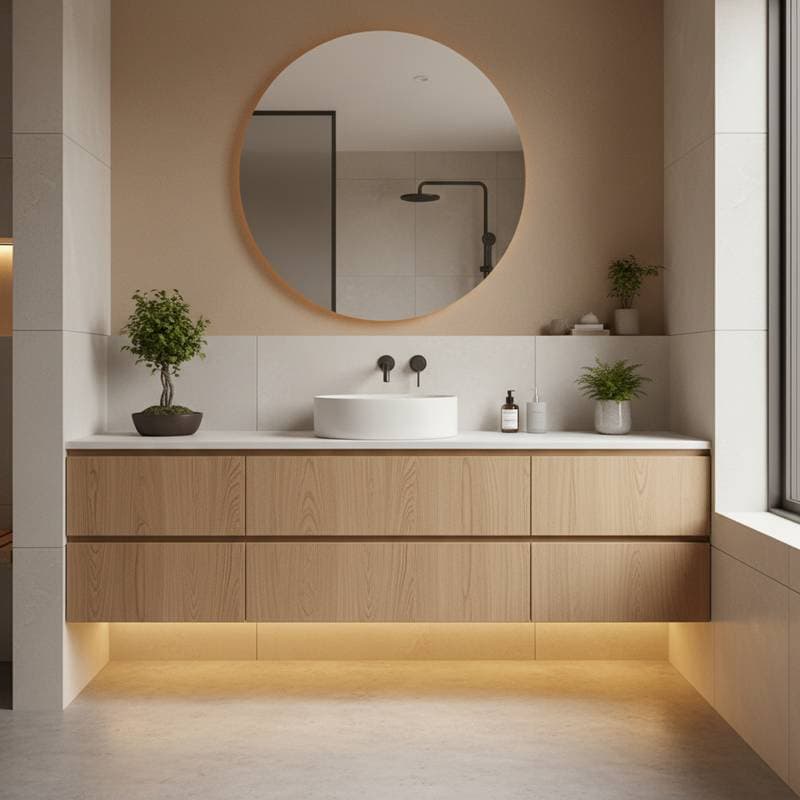
The design team substituted the floor cabinet with a floating oak vanity that extends along one wall, positioned six inches (15 centimeters) above the floor. This installation creates an uninterrupted visual line from the tile flooring to the mirror. Drawers feature shallow finger pulls integrated into the rails, maintaining a seamless surface. A solid maple countertop hovers over the drawers via concealed steel brackets, while plumbing conceals behind a detachable back panel.
Soft LED strips positioned beneath the vanity edge cast warm light across the tile. This illumination enhances the room's perceived height and cleanliness. The couple retained equivalent storage volume, yet gained superior accessibility and a sense of tranquility. Ruiz explained, "The objective was to render the vanity unobtrusive until needed."
Layout and Flow
Eliminating the floor cabinet exposed an additional six inches (15 centimeters) of flooring, expanding the visual width by approximately one-third. Movement near the shower door improved, removing the former bottleneck that snagged towels. The updated mirror, edged in matching oak, captures daylight from the opposing window, forging a cohesive horizontal expanse.
Storage Strategy
Drawers supplant traditional doors for enhanced access. Custom birch dividers organize toothbrushes, hair styling tools, and skincare products within each compartment. A shallow drawer adjacent to the sink conceals a power outlet for charging devices like razors. A deeper drawer below accommodates rolled towels in an upright position. The homeowners report reduced cleaning time, as items now maintain designated spots.
Finishes and Details
Oak veneer receives a matte polyurethane seal, preserving the wood grain while offering protection. The countertop protrudes slightly, forming a one-inch (2.5-centimeter) reveal that generates subtle shadows. The sink integrates as a rounded solid-surface basin. White square tiles, hand-cut for subtle irregularities, adorn the rear wall, diffusing light akin to textured paper. Material simplicity directs attention to balanced proportions and skilled execution.
Design Details
- Cabinetry: Quarter-sawn white oak veneer with clear matte finish
- Counter: Solid maple sealed in food-grade oil
- Hardware: Integrated finger pulls without visible handles
- Lighting: LED strip beneath vanity at 2700K color temperature
- Mirror: Frameless design with oak trim at the base
- Organization: Birch drawer inserts featuring adjustable dividers
- Plumbing access: Removable back panel secured by magnetic catch
Why Japandi Suits DIY Built-Ins
Japandi principles value precision and subtlety, aligning well with dedicated DIY enthusiasts. The aesthetic prioritizes clear joinery and authentic wood expression over embellishments. Floating vanities become feasible using common workshop tools and targeted methods.
- Lightweight Framework with Robust Anchoring. Employ steel angle brackets or a ledger board fastened to wall studs for concealed support, achieving a weightless aesthetic.
- Uniform Grain Patterns. Bookmatch veneer panels or cut drawer fronts from a single board to sustain continuous lines, fostering the serene rhythm essential to Japandi.
- Subtle Shadow Lines. Incorporate narrow gaps of one-eighth inch (3 millimeters) between drawer fronts and the wall to provide visual respite.
- Integrated Illumination. Embed LED tape within aluminum channels under the vanity; the resulting glow delineates the structure and serves as ambient lighting.
These projects integrate cabinetry, furniture elements, and architectural features, emphasizing layout precision and finish quality over decoration.
Broad Appeal and Material Selection
DIY builders favor Japandi for its adaptability across scales. In a compact powder room, birch plywood paired with a modest sink costs under five hundred dollars. For expansive bathrooms, extend the design with coordinating wood panels or an integrated bench. The interplay of expense and artistry remains straightforward, with emphasis on harmonious proportions and genuine surfaces.
Woods like oak, ash, or maple complement light tiles or plaster effectively. Select warm lighting at 2700K to 3000K to avoid a clinical atmosphere. Matte finishes resist fingerprints and minimize glare, ensuring uniform visual harmony.
Key Takeaways
- Floating vanities enhance floor visibility. A six-inch (15-centimeter) clearance beneath the cabinet can double the perceived openness in a small bathroom.
- Integrated lighting boosts practicality. Under-cabinet LEDs deliver gentle task lighting and overall ambiance.
- Organized drawers promote order. Shallow compartments and concealed outlets minimize clutter and streamline routines.
- Durable finishes withstand use. Matte clear coats and solid-surface sinks endure humidity without discoloration.
- DIY projects prove accessible. Construct using plywood bases, veneered fronts, and straightforward wall mounts.
Extending the Japandi Influence
Recent renovations reveal a consistent evolution. Professionals and homeowners alike abandon cumbersome vanities with elaborate hardware in favor of integrated wood elements that blend into the architecture. This movement reflects a broader desire for tranquil, individualized environments that retain warmth through natural materials.
In a Seattle bathroom designed by Aiko Tan and constructed by Sam Nystrom, a walnut floating vanity adjoins lime plaster walls. Drawers frame within a one-inch (2.5-centimeter) reveal, with underlighting evoking a soft glow. Tan stated, "We aimed for the vanity to resemble bespoke furniture rather than a standard fixture." The client highlights simplified maintenance and increased maneuverability.
A compact Austin installation utilized birch plywood with wax-sealed exposed edges. The hobbyist woodworker assembled the 48-inch (122-centimeter) unit over a weekend, relying on pocket screws and a French cleat mount. This approach amplified the narrow room's sense of breadth, contributing to Japandi's popularity in online woodworking forums.
Maintaining Your Japandi Vanity
Installation demands minimal ongoing care. Clean wood surfaces with a damp cloth and mild soap, applying oil annually for natural finishes. Ensure LED strips remain free of dust. Steer clear of silicone sealants that may stain edges. Facilitate moisture ventilation behind the vanity through open backs or discrete holes to promote endurance.
Daily interaction reveals the design's true value. Mornings commence in an orderly, soothing setting. The elevated vanity line allows light to traverse the floor freely, while drawers open effortlessly to present essentials. Japandi built-ins demonstrate how targeted adjustments in structure, illumination, and material integrity convert bathrooms into restorative havens that enhance routine life with poise and comfort.