
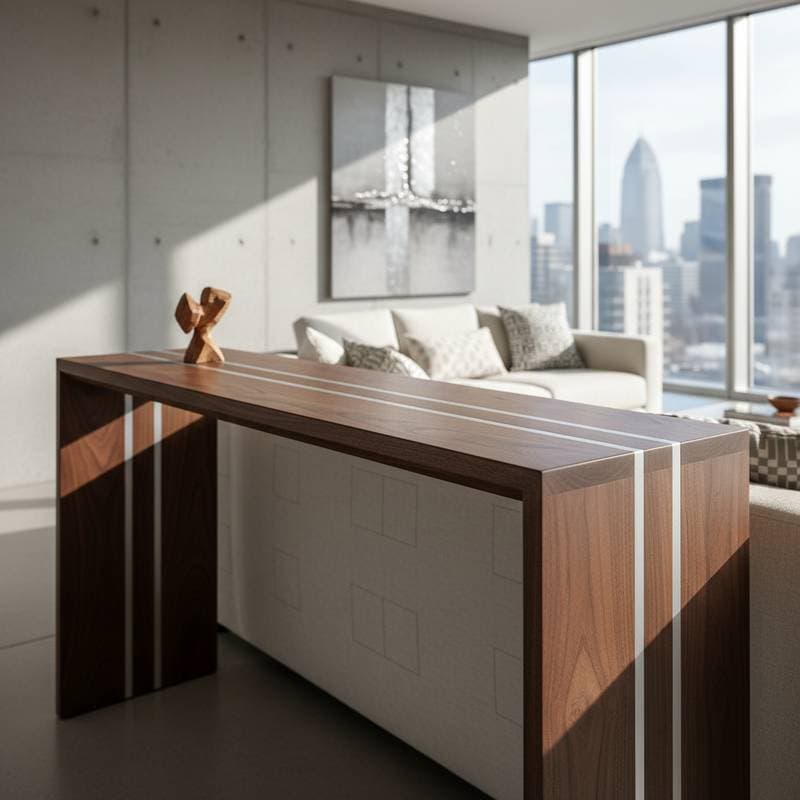
Aluminum Inlays: 2026's Game-Changing Wood Trend
Woodworking undergoes a quiet revolution. Aluminum inlays emerge as the preferred accent, surpassing traditional wood species or finishes. These metal elements redefine contrast, durability, and precision. The result appears clean, contemporary, and versatile. Custom furniture and architectural millwork incorporate aluminum to outline edges, trace lines, and form patterns that capture light while respecting the wood grain.
Designers and makers emphasize that this approach extends beyond aesthetics. Aluminum inlays provide structural reinforcement and unlock creative possibilities unavailable through conventional joinery. The method aligns with modern interiors that harmonize organic warmth and industrial clarity.
Why Aluminum, Why Now
Aluminum inlays gain prominence due to two key trends. Demand grows for pairings of natural and industrial materials to create striking contrasts. Precision tooling advances make it feasible for professionals and skilled hobbyists to cut grooves and recesses suitable for metal insertion.
Aluminum excels through its combination of strength, machinability, and low weight. The material cuts smoothly, resists corrosion, and accepts diverse finishes. Options such as polished, brushed, or anodized surfaces produce varied reflections that complement wood tones.
"Wood still carries the warmth and soul," notes designer Tom Keller, who incorporates brushed aluminum into walnut cabinetry. "But the metal line controls the eye. It defines the geometry."
At a Glance
- Application: Furniture, cabinetry, wall panels, and custom flooring
- Materials: Aluminum strips, bars, or CNC-cut inserts combined with hardwoods or veneers
- Tools: Router with precision base or CNC mill, epoxy adhesive, fine sandpaper, and polishing pads
- Design teams leading the trend: Studio Lark, Axis Workshop, Northline Design
- Typical scale: From 1/8 inch (3 millimeters) accent lines to full 2 inch (50 millimeters) panel bands
Before: The Limits of Wood-Only Detailing
Woodworkers historically achieved visual interest through contrasting wood species or stains. Techniques like ebony stringing, maple banding, and veneered marquetry offered subtle patterns but lacked strong reflectivity. In minimalist interiors, these methods often appeared overly traditional.
Furniture maker Cara Nguyen recalls efforts to update her detailing prior to adopting aluminum. "I wanted crisp lines that looked almost architectural," she explains. "Dark or light wood inlays provided insufficient contrast. The aluminum delivered the precise edge required."
Precision and maintenance posed additional challenges. Wood inlays shift with humidity changes, potentially causing visible seams. Aluminum maintains dimensional stability when embedded in epoxy, ensuring flush joints that endure without adjustment.
After: A Fusion of Clarity and Warmth
Aluminum inlays alter the visual dynamics of a piece. Traditional designs concealed joints, but this technique highlights them. A slim brushed metal strip along a tabletop or drawer front functions as a deliberate line, linking surfaces and directing attention.
Northline Design applied aluminum channels to outline cabinet fronts in a recent kitchen installation. These elements mirror stainless fixtures and diffuse light from overhead LEDs. The outcome proves graphic yet serene, with wood grain providing softness and metal introducing rhythm.
"Light behaves differently against the aluminum," states project lead Erin Soto. "It bounces across the surface, which makes the room feel brighter without additional fixtures."
Pairing aluminum with oak or ash yields equilibrium between tactile appeal and sharp definition. The fusion conveys handcrafted quality alongside modern restraint, carrying less visual heft than steel or brass.
Design Details
- Groove depth: 1/16 to 1/8 inch (1.5 to 3 millimeters) for accents, up to 1/4 inch (6 millimeters) for structural elements
- Finishes: Brushed for texture, polished for reflection, anodized for color
- Adhesives: Two-part epoxy or thin-set resin based on the substrate
- Sanding sequence: Advance from 180 to 400 grit before polishing
- Protection: Clear oil or polyurethane, steering clear of wax that dulls metal
Precision governs the wood-aluminum interface. Irregularities become evident under light. Sand both materials jointly after curing to achieve a level surface.
Expanded Applications
Furniture
Tables and desks employ aluminum inlays to underscore form. An Axis Workshop dining table features a continuous metal line encircling the top and extending down one leg, establishing a framing effect. At 1/8 inch (3 millimeters) wide, the inset secures the overall composition.
Cabinetry
Contemporary kitchens and bathrooms integrate aluminum reveals in place of handles. Recessed channels with aluminum lining facilitate pulls while shielding wood edges from damage. This pairs effectively with matte lacquer.
Wall Panels
Architectural panels incorporate broader aluminum strips to divide veneer expanses. Illumination from above causes subtle glimmering, serving as integrated accents.
Flooring
High-end flooring occasionally uses aluminum to delineate planks or borders. Success depends on controlled environments with limited movement.
The Making Process
- Plan the pattern. Draw lines or shapes that complement the grain rather than compete with it.
- Cut the groove. Employ a router or CNC machine for uniform depth.
- Prepare the aluminum. Trim strips slightly larger, then test the fit prior to applying adhesive.
- Bond and clamp. Spread epoxy uniformly, position the inlay flush, and clean excess material.
- Level and finish. Sand progressively after curing and seal with a protective coating.
Accuracy proves essential. Digital calipers verify aluminum fits within 0.005 inch (0.13 millimeters) of groove dimensions. Such tolerances eliminate gaps and sustain seamless appearance.
Why It Matters
Aluminum inlays reshape perceptions of value and endurance in woodworking. Resistance to moisture and abrasion prolongs the service life of surfaces and cabinetry. The approach broadens design options with stable lines and motifs.
Clients value the upscale yet understated aesthetic. Metal and wood together evoke natural and engineered qualities, suiting diverse settings from urban lofts to renovated farmhouses.
"People used to think metal meant cold," observes Nguyen. "Now it means precision."
How to Try the Look
Begin modestly to build familiarity. Experiment with a stripe on a cutting board or tray before advancing to expansive pieces.
Entry level approach:
- Source pre-cut aluminum bar stock from suppliers.
- Form a single linear inlay parallel to the grain.
- Seal with oil to accentuate the contrast.
Intermediate level:
- Arrange thin strips into grids or chevrons.
- Test black-anodized aluminum for tonal variation.
- Select light woods like maple or birch for enhanced visibility.
Advanced level:
- Embed CNC-routed metal forms within joinery.
- Add LED edge lighting for glowing contours.
- Coat both materials with clear matte lacquer for consistent finish.
Progressive practice refines handling of adhesion, finishing, and material response.
Key Takeaways
- Aluminum inlays deliver modern contrast ideal for furniture and built-ins.
- Proper bonding enhances durability and counters wood expansion.
- Success hinges on precise tooling and methodical sanding.
- Finishes influence light play, with brushed options softening reflections and polished ones intensifying them.
- Initiate with simple projects to gain proficiency.
This practice aligns with the shift toward hybrid materials in craft. Exemplary work employs metal sparingly as accents or guides.
Maintaining Your Investment
Aluminum inlays demand minimal care. Clean with a soft cloth and mild solution. Refrain from steel wool or strong chemicals to prevent scratches. Buff lightly with an abrasive pad if oxidation occurs.
Reapply oil to wood finishes periodically for sustained richness. Polyurethane requires only routine wiping. Maintain humidity between 35 and 55 percent to preserve joint integrity.
Consistent attention safeguards materials and upholds the defining sharp lines.
Living with Your Design
Aluminum inlay pieces offer enduring visual interest. Shifting light animates the metal subtly throughout the day, infusing furniture and cabinetry with composed vitality. The integration of grain and precision fosters a sense of balance and refinement.