
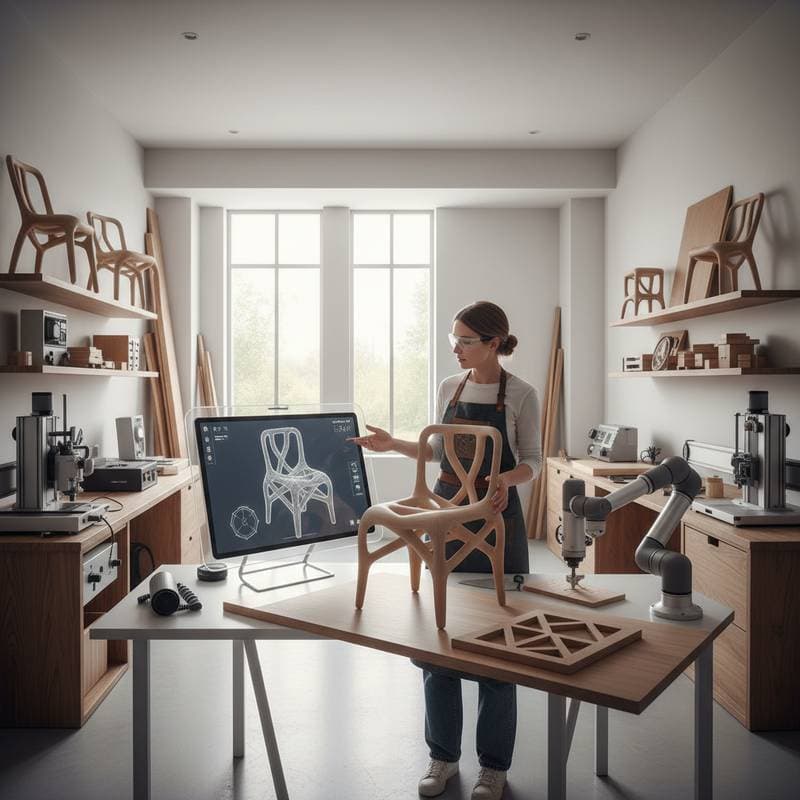
AI Revolutionizes DIY Furniture Design
Artificial intelligence reshapes the process of designing and constructing furniture. Tools once reserved for architects and industrial designers now enter home workshops. Makers employ digital algorithms to form plywood, hardwood, and composites into shapes that previously demanded engineering teams. This shift introduces parametric furniture design, driven by AI and available to those with basic equipment like a laptop and CNC router.
At a Glance
Who: Independent makers, small woodshops, and design hobbyists
Where: Digital workshops, including home garages and shared fabrication spaces
Size: Compact studios of 150 square feet (14 square meters) to expansive shops of 1,200 square feet (111 square meters)
Design teams: AI-driven software such as Rhino with Grasshopper, Autodesk Fusion, and machine learning plug-ins
Photographer: Studio documentation by CraftLab Visuals
Challenges of Traditional DIY Design
DIY furniture design historically involved hand sketches or magazine plans. Skilled woodworkers encountered barriers in converting organic concepts to precise joinery. Transitioning from idea to cut list demanded advanced CAD expertise or costly professional assistance.
"Before AI tools, I was guessing a lot," said maker Lena Ortiz, who operates a small urban workshop. "I could visualize curves and interlocking parts, but modeling and testing them took forever."
Iteration proved sluggish in traditional methods. Changes necessitated redrawing, recalculating, and retooling. Errors emerged late, frequently after material cuts. Complex designs remained inaccessible without formal training.
Transformations Through AI-Assisted Tools
Contemporary AI software alters this landscape entirely. Parametric design formerly required extensive coding. AI now discerns user intent and proposes structural solutions instantly. Describe a stool that folds flat, bears 250 pounds (113 kilograms), and assembles without fasteners; the software delivers a fabrication-ready model aligned with specified constraints and aesthetics.
Ortiz noted, "I start with prompts like ‘lightweight, interlocking plywood chair with curved backrest.’ The system generates several versions, each adjusted for strength or style. I tweak the one that feels right, export the toolpaths, and cut the panels."
Unlike legacy systems that relied on manual parameter entry, AI automatically evaluates material thickness, joint types, and load distribution. It simulates stress and balance, providing immediate feedback prior to any cutting. This approach compresses design cycles from weeks to hours, allowing woodworkers to emphasize craftsmanship and finishing over mathematical computations.
Core Design Elements
- Software tools: Grasshopper enhanced with AI plug-ins, Fusion 360 featuring generative design, and browser-based applications compatible with CNC routers or laser cutters.
- Materials: 0.75-inch (19-millimeter) birch plywood, maple, oak veneer, and recycled laminates.
- Joinery: Finger joints, press-fit slots, and variable-angle notches derived fromgeometry.
- Lighting integration: Concealed LED channels routed into panels, with AI optimizing placement for uniform illumination.
- Storage efficiency: Nested cutting layouts that minimize waste by 12 to 18 percent, varying by material dimensions.
Precision defines each creation. Edges align seamlessly, balance feels intuitive, and surfaces demand little sanding. Beyond optimization, AI sequences production to streamline workflow.
AI's Approach to Woodworking
Parametric AI systems evaluate constraints and interdependencies. Input dimensions, functions, and materials; the algorithm explores thousands of configurations. It prioritizes outcomes for stability, aesthetics, and efficiency.
Consider a side table defined by parameters like height, top diameter, leg quantity, and load capacity. The AI tests variations, eliminates unstable options, and polishes viable designs. A series of shapes appears on screen, each prepared for production.
Specialized algorithms target aspects such as structural integrity, ergonomics, or fabrication pace. Machine learning, informed by furniture archives, distinguishes enduring profiles from avant-garde forms. Users guide outputs toward minimalist Scandinavian lines or bold sculptural elements.
AI converts descriptive language to 3D models. A prompt like “floating shelf with hidden brackets and curved front edge” yields geometry, complete with bracket suggestions based on wall loading.
Significance for Makers
AI-enabled parametric design equips small operations with capabilities rivaling large manufacturers. It equalizes access to innovative forms and integrates traditional skills with computational power. The divide between conception and execution narrows; the same hands that work the wood refine the digital parameters.
Hobbyists gain assurance to venture beyond basic geometries. Professionals accelerate prototyping and personalize client orders without prolonging timelines.
"AI is like an apprentice who never sleeps," said designer and educator Theo Marsh. "It tests joinery ideas, predicts material waste, and flags imbalances before you even open the simulation."
Predictive features reduce errors and enhance build quality. They also foster bold experimentation, as virtual trials spare costly materials.
Elements of a Modern Woodshop
A contemporary digital woodshop blends analog and digital realms. Laptops rest alongside clamps, while dust collectors operate near CNC routers. Plywood sheets stand by walls where projectors render parametric visuals.
AI integrates these components via data flows. Cut files adapt to machine parameters, inventory updates with dimension changes, and lighting adjusts for documentation or quality checks.
The process supports modularity. Design on a tablet, refine on a desktop, and export to fabrication tools. Systems retain preferences like joint tolerances and grain orientations across sessions.
AI even monitors equipment. Vibration and noise analysis forecasts router bit replacement, preventing defects and sustaining cut uniformity.
Fabrication from Model to Completion
With design finalized, production adheres to proven steps enhanced by digital accuracy. AI generates nested layouts suited to standard sheets. Parts include QR codes or labels indicating assembly sequence.
CNC routers produce panels that interlock with scant sanding. Algorithmic tolerances ensure flawless alignment. Apply glue, secure with clamps, and proceed to finishing.
Incorporate lighting, wiring, or storage features next. Designs accommodate cable paths and airflow. For drawers, clearances of 0.125 inch (3 millimeters) avoid sticking while preserving sleek profiles.
Finishing imparts character. Oils accentuate grain, water-based options maintain clarity. AI previews finish effects under diverse lighting, aiding selections.
Investment and Entry Points
Initial digital setups demanded substantial outlays for software and hardware. Current AI tools operate in browsers or open-source platforms, with pricing via exports or subscriptions. A basic configuration includes:
- Laptop equipped with 16 GB RAM and a mid-range GPU.
- CNC router featuring a 2-by-4-foot (0.6-by-1.2-meter) bed.
- Sheet materials, clamps, orbital sander, and finishing materials.
- Entry-level AI software, frequently available at no cost.
Projects typically cost 150 to 800 dollars, factoring materials and intricacy. Relative to conventional methods, expenses drop up to 40 percent via waste reduction and swift revisions.
Steps to Get Started
Programming skills prove unnecessary. Initiate with modest endeavors like stools or shelves.
- Select a platform. Rhino with Grasshopper offers depth; ShapeDiver or Autodesk online tools provide intuitive guidance.
- Specify constraints. Define material thickness and load requirements precisely.
- Employ natural language. Articulate design objectives to elicit initial forms.
- Refine interactively. Modify curves, angles, and scales via sliders or additional prompts.
- Conduct simulations. Verify stability and resource consumption.
- Generate toolpaths. Opt for nested arrangements to conserve materials.
- Produce the piece. Employ routine woodworking for cutting, joining, and completing.
Repetition builds proficiency. Accumulate adaptable parametric templates for future applications.
Balancing Ethics and Innovation
designs prompt authorship inquiries. Software originates forms, yet human input shapes direction. The maker retains creative agency, with AI serving as a supportive tool.
Concerns arise that automation might dilute originality. Evidence suggests enhancement instead. By managing technical limits, AI liberates focus on sensory and conceptual elements.
"The software does not replace imagination," said furniture artist Rina Cho. "It gives me more room to explore proportion and texture. I can chase ideas that used to take weeks to prototype."
Open sharing of files promotes communal advancement, echoing historical craft exchanges.
Essential Outcomes
- Speed: Cycles from design to build shorten by up to 80 percent.
- Efficiency: Waste diminishes 12 to 18 percent through strategic nesting.
- Accessibility: Web tools ease entry for novices.
- Customization: Parameters enable endless adaptations from core models.
- Precision: Integrated tolerances guarantee seamless assembly.
These benefits support diverse applications. Small studios craft bespoke series without repetitive redesigns.
Integrating AI-Designed Pieces into Daily Use
Parametric furniture exhibits unique harmony. Curves trace load paths, joints expose engineering rationale, and dimensions achieve equilibrium with novelty. In homes, these items blend artisanal warmth and calculated elegance.
Hands-on processes preserve authenticity. Sanding, joining, and finishing occur manually. The result evolves with use, acquiring patina and history akin to conventional crafts.
Adaptability appeals to users. A table suiting a 37-inch (94-centimeter) corner adjusts via parameter tweaks and recuts. Base models resize effortlessly for varied spaces.
Sustaining Crafted Works
Precise assembly simplifies upkeep, though routines apply universally. Clean joints periodically, refresh finishes yearly, and monitor humidity. Digital origins facilitate repairs; regenerate components from archived files as needed.