
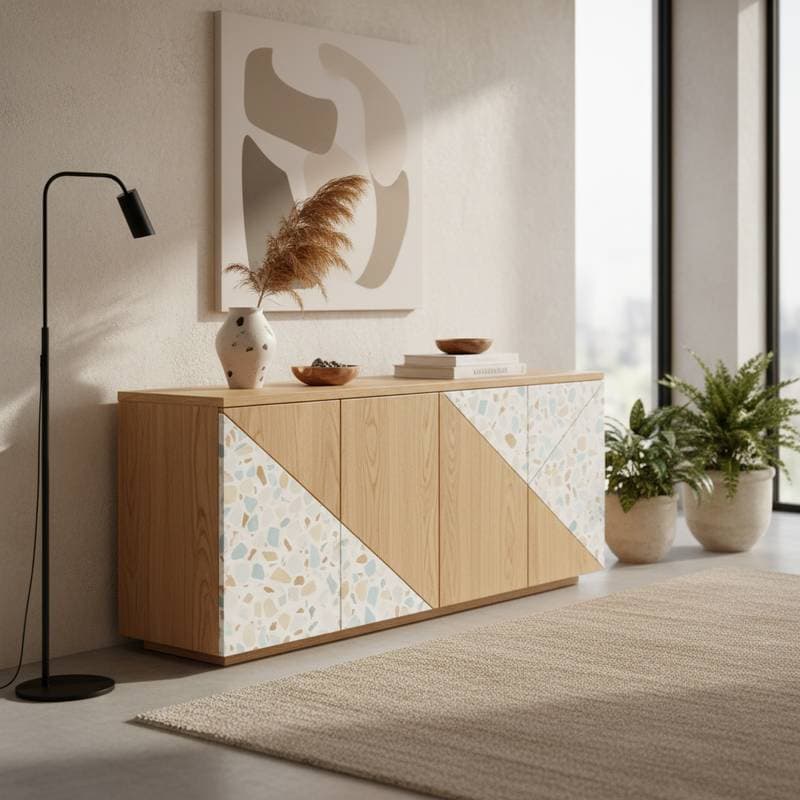
How Terrazzo Inlays Are Revolutionizing Wood Furniture Design
Terrazzo transitions from traditional flooring and surfaces into the core of wood furniture creation. This resurgence emphasizes texture, visual contrast, and meticulous craftsmanship. Designers incorporate terrazzo fragments into tabletops, drawer faces, and chair backs, producing items that harmonize organic warmth with robust longevity. The key innovation lies in the inlay technique, where finely worked wood interfaces with composite stone to yield a result that appears eternal yet innovative.
At a Glance
- Who: Independent furniture artisans and specialized studios pioneering hybrid material explorations
- Where: City-based workshops and localized craft centers
- Size: Designs span from 36-inch (91-centimeter) accent tables to 8-foot (2.4-meter) conference expanses
- Design Teams: Studio Forma, Grainline Design, Atelier Miro
- Photography: Lin Chen, Mateo Ruiz
Before
Woodworkers previously approached terrazzo with reservation due to its heft and variable setting behavior. Concerns included the potential to dominate the wood's inherent patterns or disrupt precise assembly methods. “We used to see terrazzo as a surface material, not a structural partner,” said interior designer Laura Kim. The primary obstacle involved merging substances with divergent thermal expansion properties and surface qualities while preserving accuracy and firmness.
After
Contemporary furniture creators address these historical issues via reduced-weight terrazzo formulations, slimmer applications, and advanced adhesive compounds. Recent lines feature terrazzo inlays as level geometric inserts within frames of walnut or ash. This yields striking differentiation that amplifies rather than masks the maker's expertise.
Images from Studio Forma's facility capture a console with a terrazzo ellipse embedded in a dense oak slab. The aggregate particles mirror the wood's subtle hues, linking motif and framework. Overhead LED fixtures illuminate the refined face, generating a gentle luminescence after dark. “The terrazzo gives the wood a sense of permanence,” said founder Rafael Ortiz. “It feels grounded but not heavy.”
Design Details
- Materials: Oak, walnut, and maple paired with terrazzo blends incorporating recycled glass
- Finish: Matte coatings that align the luster of wood and stone
- Edges: Subtle 1/8-inch (3-millimeter) bevels to guard against fractures at junctions
- Joinery: Hidden pegs and epoxy adhesives ensuring fluid connections
- Color Palette: Subdued grounds accented by specks of amber, coral, or charcoal
- Lighting: Integrated functional and ambient sources to accentuate surface nuances
These components collectively advance a narrative of sensory experience. Wood contributes fluidity and comfort, while terrazzo provides stability and vibrancy. The pairing forms a cohesive expression of skill, distinct from mere superposition.
Why It Matters
Terrazzo inlays reflect a broader evolution toward deliberate materials and evident workmanship. Amid a sea of uniform surfaces, the mottled richness of terrazzo conveys authenticity and individuality. It honors the stages of blending, casting, and refining, imprinting the creator's influence. For residents, this method yields furnishings that blend aesthetic merit with utility. The stone layer withstands thermal exposure and spills, whereas the timber base maintains portability and restorability.
Professionals observe that the style accommodates diverse environments. In sparse settings, terrazzo introduces subtle dynamism. In varied interiors, it stabilizes schemes through organic diversity. The pairing aligns with current ecological priorities, as numerous terrazzo compositions repurpose stone and glass byproducts from manufacturing sectors.
Adapting the Look at Home
Incorporate this aesthetic into personal endeavors through these deliberate actions:
- Start small. Experiment with terrazzo accents on serving boards, nightstands, or hardware elements prior to larger undertakings.
- Match tones. Select aggregate compositions that resonate with the base colors of the selected timber type.
- Control depth. Limit inlay thicknesses to under 3/8 inch (9 millimeters) to achieve equilibrium and control mass.
- Seal consistently. Apply a uniform low-gloss protectant over both substrates to integrate appearances.
- Light with intention. Direct illumination toward aggregate inclusions to reveal details without excess reflection.
Experienced fabricators recommend prototyping seam samples to evaluate material responses to environmental shifts. Novices to terrazzo should opt for factory-molded sheets that allow customization and even installation.
Key Takeaways
- Terrazzo inlays elevate wood furniture to hybrid expressions that merge tradition with forward-thinking design.
- Progress in adhesive technologies and featherweight aggregates ensures reliable and reproducible unions.
- The approach promotes environmental responsibility through the reclamation of stone and glass waste.
- Strategic illumination and surface treatments harmonize the inherent qualities of each element.
- Modest inlay applications invigorate surroundings and emphasize manual precision.
Sources or Credits
Design Teams: Studio Forma, Grainline Design, Atelier Miro
Photography: Lin Chen, Mateo Ruiz
Quotes: Laura Kim, interior designer; Rafael Ortiz, furniture designer at Studio Forma
Terrazzo inlays demonstrate that forward-looking furniture can honor established methods while projecting vitality. They encourage interaction, capture illumination, and narrate tales of intentional creation.