
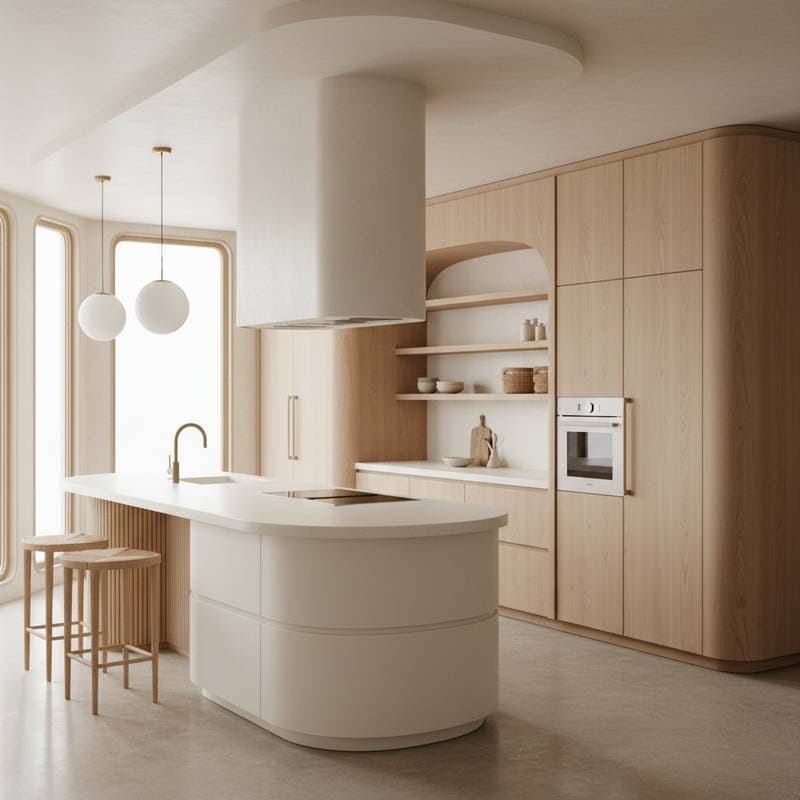
Curved Cabinetry: The Softest Revolution of 2026
Curves are reshaping the heart of the home. After years dominated by right angles and hard edges, curved cabinetry emerges as the quiet shift redefining kitchens and living spaces. This approach delivers a gentle, sculptural aesthetic paired with deep practicality. What started as a boutique detail now serves as a mainstay in modern millwork, demonstrating that soft lines provide both warmth and precision.
At a Glance
Homeowners: A young family of four
Location: Portland, Oregon
Size: 320 square feet (29.7 square meters)
Design Team: Studio Madera
Photographer: Celia Hart
The kitchen possessed solid structural elements but appeared boxy and enclosed. Designers introduced curved cabinetry to smooth transitions, enhance circulation, and foster a sense of calm. The outcome transforms the area into something resembling a crafted piece of furniture rather than standard cabinets.
Before
The original kitchen featured square-edged cabinets that converged in sharp corners. Sightlines suffered from upper cabinets crowding the ceiling. The peninsula restricted traffic flow between the sink and range. Storage options existed, yet they seemed disjointed and inefficient.
"Every corner felt like an obstacle," said homeowner Alex R., explaining how navigation through the space required constant sidestepping of edges or ducking under low clearances. The cabinetry appeared dated and excessively angular, which restricted both movement and comfort.
After
Studio Madera substituted the outdated runs with continuous curved cabinetry that envelops the kitchen in a single smooth arc. The curved island tempers the room's geometry, establishing a natural pathway among preparation, cooking, and dining areas.
In place of former upper cabinets, the team added open shelves featuring rounded undersides to reduce visual weight on the wall. A full-height pantry at one end incorporates a subtle concave door face, which visually recedes into the surface. This new configuration expands circulation space by nearly 18 inches (45.7 centimeters) in the primary aisle, allowing two individuals to collaborate side by side with ease.
Lighting integrates in layers to complement the softened forms. Recessed ceiling fixtures distribute even illumination across the curved fronts. A linear pendant with frosted glass provides diffused radiance over the island. Under-shelf LEDs accentuate the gentle radius of cabinet edges, elevating everyday function to sculptural elegance.
"The goal was to make the kitchen feel like it was breathing," said lead designer Maria Laren. "Curves slow you down just enough to notice the craftsmanship."
Design Details
- Cabinet Material: White oak veneer with a hand-rubbed matte finish
- Edge Profile: Continuous 3-inch (7.6 centimeter) radius along corners and island ends
- Countertops: Honed quartzite with eased bullnose edge
- Hardware: Integrated finger pulls, no visible handles
- Lighting: Three layers, including task, ambient, and accent fixtures
- Storage Moves: Pull-out trays in the curved base units, hidden toe-kick drawers, and a pivoting corner carousel
- Finish Palette: Soft natural wood, limestone gray, and brushed nickel accents
Each element contributes to quiet cohesion. Curved fronts interact with light variably across the day, introducing subtle surface movement. The lack of handles preserves uninterrupted lines, while the matte finish mitigates glare and emphasizes shadow depth.
Why Curves Matter Now
Curved cabinetry aligns with the growing emphasis on organic design principles. As residences prioritize comfort and tactile quality, these forms convey ease and accessibility. The human eye perceives curves as inherently natural, rendering a kitchen more akin to a living environment than a mere workstation.
Fabrication techniques have advanced to meet rising demand. Enhanced bending plywood, thermoformed laminates, and adaptable veneers enable precise curves without sacrificing structural integrity. CNC routers now produce uniform radii and compound corners that previously demanded extensive hand shaping. Consequently, finishes achieve an artisanal appearance while supporting efficient installation.
Designers highlight additional benefits in safety and longevity. Rounded corners lessen impact risks in busy zones, particularly beneficial for households with young children. Continuous edges reduce the number of joints and seams, which simplifies maintenance and curtails long-term wear.
Mini Guide: Bringing Curves Home
Curved cabinetry adapts from subtle accents to bold statements. Consider these three approaches to incorporate the style:
- Rounded Island Ends: Apply a gentle curve to one or both ends of an island to foster smoother circulation. This suits compact kitchens effectively.
- Full Radius Corners: Substitute sharp cabinet intersections with a 2- to 3-inch (5- to 7.6-centimeter) radius. Such a targeted change alters the flow of an entire run.
- Custom Banquette or Bar: Embed curved millwork into a seating alcove or beverage station to reinforce organic motifs without a complete kitchen overhaul.
During planning, ensure a minimum of 42 inches (106.7 centimeters) clearance between curved fronts and opposite surfaces. This upholds ergonomic access and comfortable passageways.
Select materials thoughtfully. Opt for flexible plywood or MDF cores designed for bending. Apply veneers via vacuum pressing to prevent spring-back. Conclude with a low-sheen topcoat that harmonizes with ambient light.
Key Takeaways
Curved cabinetry signals a more humane approach to kitchen evolution. It merges aesthetics with lived experience, converting movement into fluid choreography. Practical advantages extend to tactile interactions and spatial dynamics.
A complete renovation proves unnecessary for adoption. Initiate with curved drawer fronts, floating shelves, or a soft radius on a vanity. Consistent repetition amplifies the overall impact.
Designers view curves as a lasting evolution rather than a temporary fad. They promote equilibrium and serenity. Forward-thinking interiors will blend meticulous execution with intuitive usability, artistry with everyday ease.
Sources or Credits
Design Team: Studio Madera
Photographer: Celia Hart
Homeowners: Alex and Robin R.
Curved cabinetry transitions from specialized choice to essential feature, illustrating how the gentlest contour can assert profound influence. Envision the subtle authority of a curve guiding your home's daily rhythm.