
Transform Messy Drawers into Custom Storage with CNC-Cut Inserts
Disorganized drawers disrupt efficiency in kitchens and workshops. The issue extends beyond limited space; it involves adapting storage to specific needs. CNC-cut inserts offer DIYers a method to achieve professional organization without expensive custom cabinetry. Basic digital plans and a CNC router enable the creation of precise inserts for utensils, tools, and hardware.
At a Glance
Residents: A couple who enjoy home cooking and woodworking projects
Setting: Suburban home with integrated workshop and kitchen
Area: 180 square feet (16.7 square meters) for combined spaces
Designer and Fabricator: Homeowner Michael Tran
Photographer: Julia Henson
Before the Transformation
Kitchen drawers provided ample depth yet lacked structure. Utensils and tools shifted with each pull, complicating daily tasks. Michael Tran noted, "We had sufficient storage capacity but no means of control." Cooking and woodworking sessions involved repeated searches for essential items. Workshop drawers faced greater challenges. Router bits migrated to inaccessible corners, while sandpaper sheets crumpled beneath stacks of clamps. Absent dedicated compartments, time and resources suffered from inefficiency.
After the Transformation
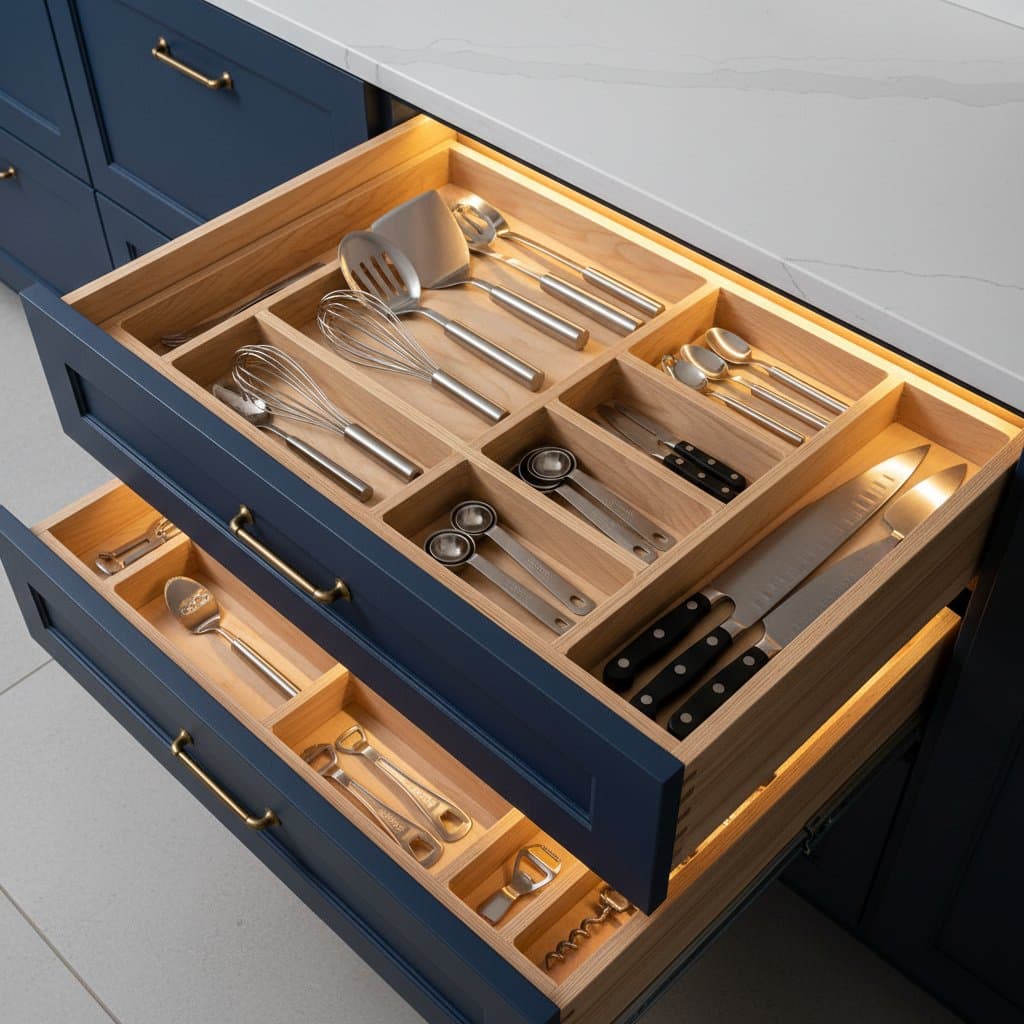
CNC-cut inserts reshaped both areas into models of order. Birch plywood trays form grids tailored to exact drawer dimensions. Compartments accommodate knives, chisels, and measuring spoons based on their actual sizes, avoiding vague approximations. Inserts remove effortlessly for cleaning or rearrangement. Workshop drawers include tiered sections for drill bits, sanding discs, and marking tools. Finger pulls integrate directly into plywood surfaces, ensuring smooth access without added hardware.
Photographs reveal a harmonious arrangement. Utensils nestle in contoured slots, with chamfered edges for safety. Each division appears deliberate and purposeful. Under-cabinet LED strips illuminate the light birch, banishing previous shadows and enhancing visibility.
Tran operated a compact CNC router in his garage, following straightforward CAD files. He observed, "Mapping the drawer interior highlights previously overlooked wasted space." Inserts align with tolerances under one-sixteenth inch, securing stability while permitting easy extraction.
Design Specifications
- Material: Half-inch (12 millimeter) Baltic birch plywood, protected by matte polyurethane sealant against moisture
- Joinery: Dado and rabbet joints secured with glue for strength
- Layout: Modular grids matching standard kitchen drawers, 20 inches (50.8 centimeters) wide by 22 inches (55.9 centimeters) deep
- Finish: Sanded to 220 grit, with edges rounded slightly to safeguard fingers and contents
- Lighting: Thin LED strips mounted beneath drawer edges for improved visibility
- Organization: Multi-level trays featuring finger grooves, supporting dual storage tiers per drawer
- Hardware: Full-extension slides supporting 100 pounds (45 kilograms), suitable for heavy workshop loads
Digital templates facilitate replication and modification of each insert. CNC accuracy prevents divider misalignment and material waste. The approach scales readily from individual drawers to full cabinet systems.
How CNC-Cut Inserts Deliver Results
Computer numerical control directs tools via digital instructions for consistent precision. This technology allows DIYers to blend artisanal appeal with industrial exactness. Users define grooves and dividers in software before any cutting occurs. The router then executes the design flawlessly.
Consistency stands out as a primary advantage. Matching inserts ensure uniform functionality across drawers. Layout adjustments require only file edits and recuts, promoting adaptability. This versatility positions CNC inserts as a worthwhile tool. Begin with kitchen applications, then extend principles to tool chests, vanities, or craft benches.
Steps for DIY Implementation
- Measure drawer interiors precisely, noting width, depth, and height. Account for a one-sixteenth inch (1.6 millimeter) clearance around all edges to aid insertion and removal.
- Sketch item arrangements on paper, prioritizing frequent-use groupings for optimal access.
- Develop designs using free CAD programs or web-based tools to outline dividers and compartments.
- Perform cuts on scrap plywood to prototype and refine fits before final production.
- Apply sanding and a protective sealant to enhance durability and simplify maintenance.
These procedures replicate high-end drawer systems affordably. The reward lies in the seamless operation of a well-organized drawer, justifying initial efforts.
Essential Insights
- Precision Drives Efficiency: CNC routers remove uncertainty, ensuring tailored fits for every space.
- Flexible Adaptation: Digital files allow resizing and application across diverse areas.
- Streamlined Routines: Organized layouts conserve time daily, fostering productive environments.
- Enhanced Visibility: Lighting and reflective surfaces reduce search efforts and eye strain.
- Long-Term Strength: Baltic birch withstands warping and routine demands in active settings.
In kitchens, inserts manage spices, cutlery, and preparation tools with professional precision. Workshops benefit from protected edges and swift transitions between tasks. Craft zones and vanities gain sorted compartments in compact spaces.
Integrating the Design into Daily Use
Inserts integrate seamlessly into routines over time. Designated spots simplify upkeep and highlight absences promptly. Organization evolves into an intuitive habit.
Tran reflected, "The inserts altered our approach to cooking and building. We devote less effort to locating items and more to the work itself." This embodies the subtle effectiveness of CNC technology in practical storage solutions.
Credits
- Design: Michael Tran, homeowner and fabricator
- Photography: Julia Henson
- Materials: Baltic birch plywood with matte polyurethane
- Hardware: Blum full-extension slides and LED lighting strips
A drawer calibrated to personal habits delivers immediate clarity. CNC-cut inserts enable this level of customization, infusing homes with expert organization, craftsmanship, and tranquility.