
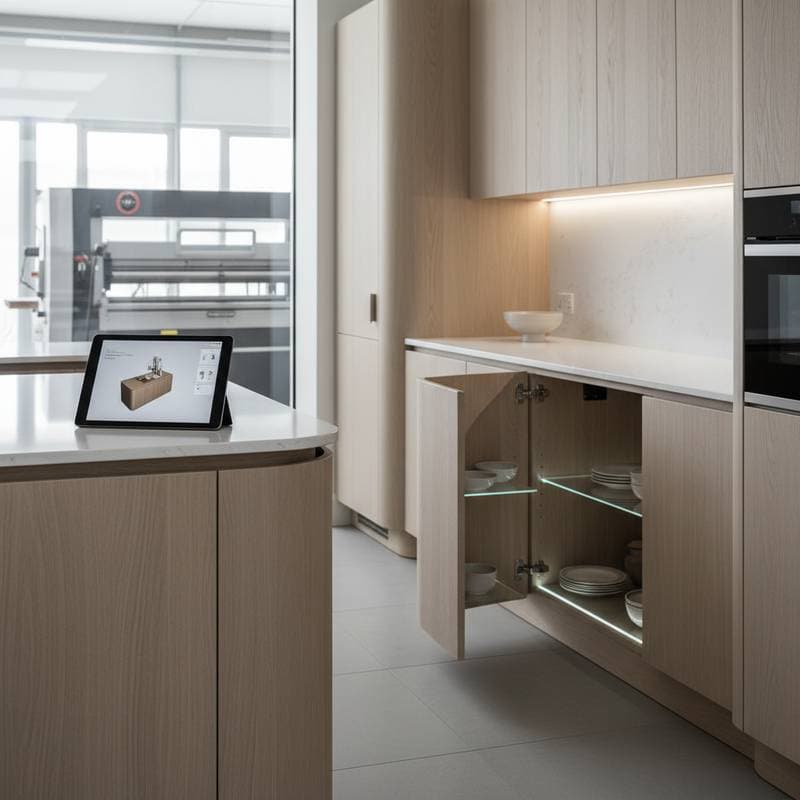
3D Bending Technology Democratizes Curved Cabinet Doors
Curved cabinet doors previously required extensive custom labor available only to upscale workshops. Recent advancements in 3D bending technology alter this landscape significantly. Processes that once demanded prolonged steaming, clamping, and meticulous shaping now rely on precise digital molds and automated controls. This shift yields superior curve quality, accelerated production timelines, and diminished labor expenses, rendering curved doors viable for standard installations.
Key Specifications
- Cost range: $250 to $600 per curved door, varying by dimensions and surface treatment
- Production duration: 2 to 5 days from initial template to completed form
- Required expertise: Intermediate knowledge for initial configuration, basic skills for routine operation
- Suitable materials: Plywood, medium-density fiberboard, and adaptable laminates
Transforming Cabinet Design Through 3D Bending
Conventional methods for curved doors involved steam bending or layered segment assembly. These approaches necessitated substantial expertise and ongoing oversight. In contrast, 3D bending, often termed cold-form or controlled-pressure molding, employs computer-directed molds to distribute heat and pressure uniformly over the material surface. Integrated sensors monitor moisture levels, thermal conditions, and structural tension during the bending phase, ensuring outcomes that surpass the variability of handmade techniques.
Small-scale cabinetry operations can now fabricate radius-fronted panels with tolerances below one millimeter. Previously, such accuracy demanded vacuum presses or an array of custom jigs. Moreover, this technology minimizes material waste by as much as 30 percent, as bends adhere precisely to digital prototypes rather than iterative experimentation.
The primary benefit for design lies in expanded creative possibilities. Fabricators can align curved doors seamlessly with contoured kitchen islands, suspended vanities, or contemporary wall systems without engaging external specialists. The method accommodates medium-density fiberboard cores encased in veneer or thermofoil, broadening choices for surface aesthetics.
Practical recommendation: For curved configurations in kitchen or bathroom designs, inquire whether your vendor offers digitally formed panels. Obtain a sample with the intended radius to evaluate alignment and surface quality prior to placing a complete order.
Understanding the Mechanics of 3D Bending
The equipment features a heated aluminum mold tailored to the specified radius. Material sheets, typically 3 to 18 millimeters in thickness, undergo vacuum-assisted pressure while sensors regulate temperatures from 140 to 190 degrees Fahrenheit. Each panel completes the cycle in mere minutes. Upon cooling, the form remains fixed without rebounding.
This approach bypasses the preparatory soaking and steaming of legacy techniques. It also facilitates simultaneous lamination of multiple layers. Workshop operators note reductions in labor time by up to 60 percent relative to manual bending. Consequently, one technician can oversee multiple panels with limited intervention.
Core principle: Even application of pressure combined with regulated moisture levels averts fiber breakage and layer separation. The resulting stable curvature integrates edge banding and fittings as readily as flat surfaces.
Implementation suggestion: Shop owners should consider upgrading a compact vacuum press with a digital regulation system. Basic units begin at approximately $8,000 and recoup investment after processing around 100 curved panels.
Managing Costs and Financial Strategy
Anticipate expenditures of $250 to $600 per curved cabinet door, influenced by curve radius, finishing method, and base material. Veneer-overlaid medium-density fiberboard falls toward the lower spectrum, whereas solid wood assemblies or bespoke foil applications approach the upper limit. By comparison, traditionally steam-formed doors frequently surpass $900 apiece owing to intensive manual effort.
Influential cost elements include:
- Curve radius: Tighter bends necessitate additional cycles and elevated pressure settings.
- Material selection: Pliable plywood conforms readily, but solid hardwoods demand enhanced preparation.
- Finishing technique: Painted or foil-encased panels require precise post-bending edge work to maintain integrity.
Economies arise from batching doors of identical radii or employing a versatile mold across varied dimensions. Certain providers offer mold rentals at about $150 weekly, ideal for limited production volumes.
Financial advice: Position curved doors as a premium enhancement in client proposals. Customers typically endorse a 10 to 15 percent surcharge for the unique visual appeal.
Options for DIY and Professional Fabrication
An adept hobbyist can utilize flexible plywood alongside a leased vacuum mold. Essential tools encompass a heat source, vacuum apparatus, and protective gear. Plan for roughly four hours per door, accounting for cooling periods. Primary hazards involve inconsistent pressure, which may produce wrinkles or fractures.
Commercial facilities gain from automated systems that oversee thermal and temporal parameters. For substantial quantities or radii under 12 inches, professional equipment justifies the outlay. Confirm that any hired operation maintains insurance coverage and adheres to regional standards for ventilation and safety, given the potential emission of vapors from warmed adhesives.
Vendor evaluation: Request a trial panel and verify back-side moisture levels between 8 and 10 percent. This measure guarantees resilience against environmental humidity fluctuations.
Pitfalls to Sidestep in Production
- Neglecting moisture assessment: Excessively arid panels fracture under stress.
- Excessive adhesive heating: Temperatures exceeding 200 degrees compromise bonding strength.
- Disregarding grain alignment: Engineered woods still favor specific directional flex.
- Employing conventional clamps: Irregular force distribution generates planar distortions.
Remediation strategy: Conduct a preliminary test bend on a minor sample. Refine thermal and pressure variables until the form solidifies without defects.
Enhancing Projects with Curved Elements
Incorporating curved doors elevates standard cabinetry to sophisticated levels, blending functionality with aesthetic distinction. This technology empowers woodworkers to deliver premium results efficiently, broadening market appeal for custom and residential applications. As production barriers diminish, curved designs become integral to innovative, client-pleasing outcomes that stand the test of time.