
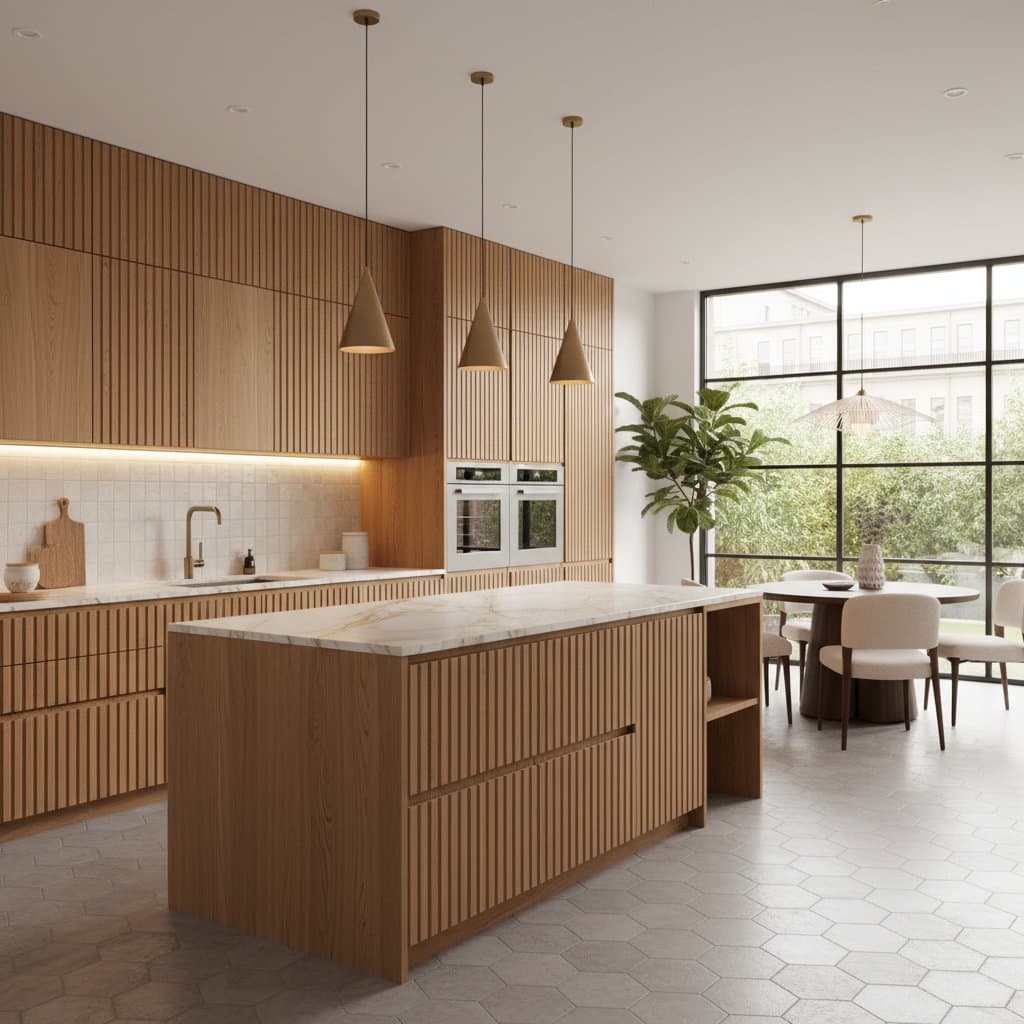
The Textured Revolution: Ribbed Oak Takes Over Cabinets
Texture serves as a foundational element in contemporary kitchen and bath design, with ribbed oak cabinetry leading the transformation. This style delivers a tactile quality, structured form, and understated expression. Shallow vertical grooves capture light and shadow, imparting depth to otherwise planar surfaces. Once limited to custom accents, ribbed oak now shapes entire kitchen ensembles, bathroom vanities, and integrated storage solutions across diverse aesthetics. Professionals view it as the progression of natural wood grain, merging traditional skill with precise contemporary execution.
At a Glance
Who lives here: Homeowners who prioritize structured warmth in their designs
Location: Urban and suburban renovation projects
Average kitchen size: 220 square feet (20.4 square meters)
Design teams: Studio Evolve Interiors, Northline Cabinetry, Atelier Hark
Photography: Jane Carter and Luis Mendoza
After
Ribbed oak emerges as an ideal balance between traditional millwork and minimalist modern cabinetry. The change proves immediate and impactful. Vertical fluting, typically spaced from one quarter to three eighths of an inch (6 to 9 millimeters) apart, establishes a rhythmic flow on doors and drawer fronts. Designers apply this technique to introduce motion without excess embellishment. "You achieve a texture that appears architectural rather than merely decorative," explained cabinetmaker Ryan Holt of Northline Cabinetry.
Photographs highlight the dramatic effect. Light skims each ridge, producing bands of illumination and shadow. In natural oak finishes, these variations mellow the wood grain for a woven-like visual. Darker stains cause the grooves to recede, fostering refined elegance. Kitchens acquire a sense of increased verticality, while bathrooms appear more elongated and polished.
Functionally, ribbed fronts resist fingerprints effectively, particularly with matte sealants. The channeling conceals light scuffs and daily marks. Numerous homeowners opt for integrated pulls carved into the upper door edges, preserving a seamless facade. Alternatives include combining ribbed panels with polished brass or matte black hardware to create striking contrasts.
Why It Matters
Ribbed oak unites skilled craftsmanship with practical application. The patterned surface encourages interaction, conveying premium quality. It spans generational design preferences seamlessly. In sleek modern environments, it tempers the severity of stone countertops and glass elements. In classic settings, it revitalizes wooden features absent heavy carving. "This material stands out for feeling both current and enduring," noted designer Hark Mendez of Atelier Hark.
Sustainability drives the popularity further. Fabricators frequently employ thin oak veneers to minimize solid wood consumption while maintaining an authentic feel. Low-VOC sealants provide durability alongside eco-friendliness. Refinishing or restaining ribbed panels preserves their defining lines, prolonging usability and aesthetic value.
Light as a Design Partner
Strategic lighting elevates ribbed oak from understated to captivating. Install warm LED strips under upper cabinets or near toe kicks to accentuate the fluting. Pendants featuring broad diffusers distribute gentle illumination that skims the texture, unveiling its nuances. Natural daylight interacts uniquely with the surface, altering the appearance throughout the day.
Professionals advise experimenting with light directions prior to final placement. A low-angle grazing light accentuates the grooves' profundity, whereas direct overhead illumination minimizes it. Select bulbs with warm color temperatures to complement the oak's golden undertones. "The goal remains visibility of the texture without distracting reflections," advised lighting consultant Paula Nunez.
The Craft Behind the Look
Producing ribbed oak requires meticulous technique. Computer numerical control (CNC) routing ensures uniform groove intervals and depths, complemented by manual edging for refinement. Certain workshops employ linear molding machines to shape solid oak strips, which assemble onto a core substrate. Others apply fluted veneers straight to panel bases. Selection hinges on the project's scope and financial allocation.
Bespoke fabricators apply a surcharge for such detailing. Anticipate expenses 15 to 30 percent above standard flat-panel options, varying by wood type and treatment. Homeowners consistently affirm the expenditure's worth. The added dimension and light play render standard spaces uniquely custom. Construction experts observe that ribbed designs enhance photographic appeal, boosting market value.
To implement ribbed oak effectively, start by selecting groove spacing that aligns with room proportions; narrower intervals suit compact areas, while wider ones enhance larger volumes. Pair with complementary materials like quartz counters in neutral tones to let the texture shine. For bathrooms, consider moisture-resistant finishes to safeguard the wood's integrity over time.
Key Takeaways
- Ribbed oak introduces architectural texture with broad stylistic adaptability.
- Space vertical grooves approximately one quarter inch (6 millimeters) apart for optimal rhythm and perceived height.
- Integrate lighting thoughtfully to maximize the pattern's dimensional qualities.
- Opt for veneer builds to promote environmental responsibility and structural reliability.
- Apply ribbed elements selectively, such as on islands or accent walls, to avoid overwhelming the space.
- Maintain ease comes from gentle vacuuming and non-glossy coatings.
- Though premiums cover expert labor, enduring benefits justify the choice.
Sources or Credits
Design Teams: Studio Evolve Interiors, Northline Cabinetry, Atelier Hark
Photography: Jane Carter, Luis Mendoza
Contributors: Elise Tran, Ryan Holt, Hark Mendez, Paula Nunez.
Enhancing Your Space with Ribbed Oak
Incorporating ribbed oak elevates daily environments into refined retreats. This design choice not only beautifies but also withstands modern lifestyles. Consult local experts to tailor the texture to your vision, ensuring a harmonious blend of form, function, and sustainability.