
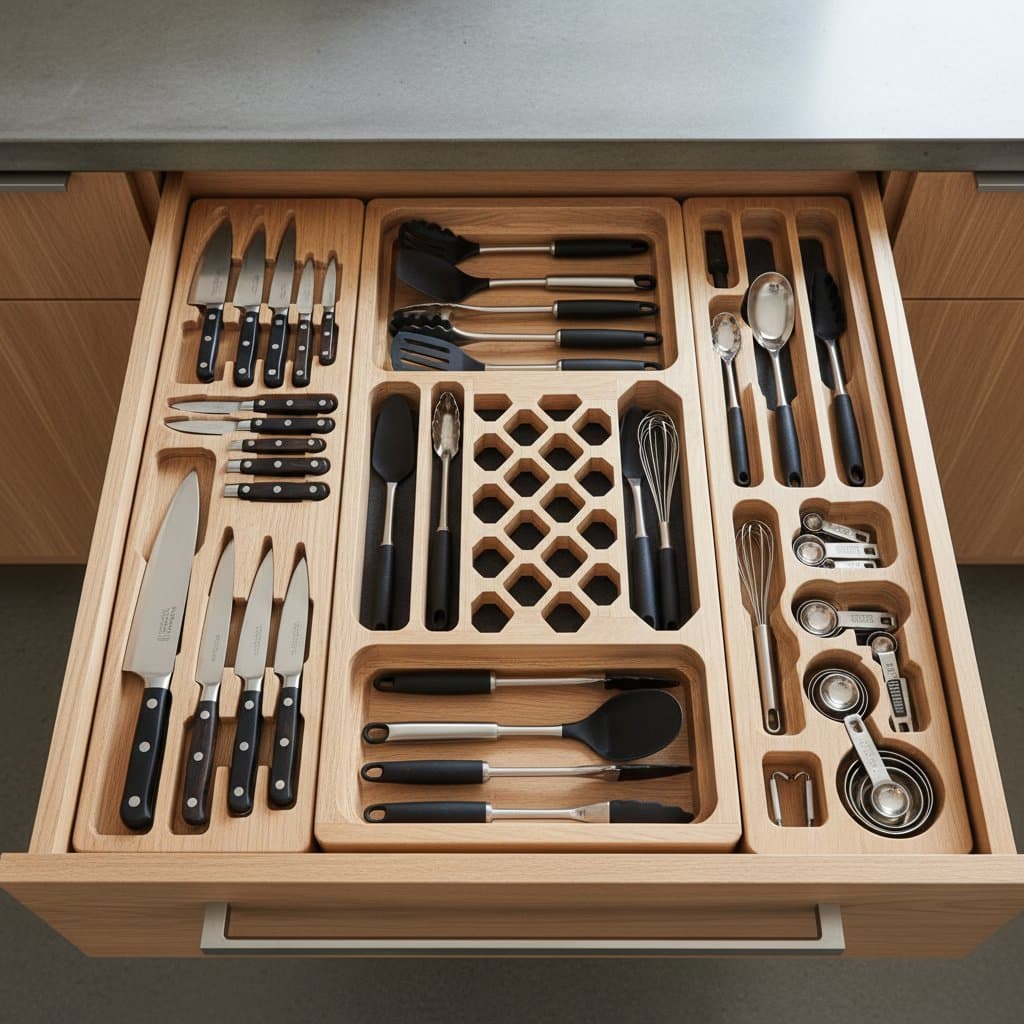
CNC Custom Inserts: Revolutionizing Drawer Organization
Drawer organization often involves compromise. Standard dividers fail to accommodate actual collections of tools or utensils, and modular kits create unused gaps. CNC custom inserts resolve these issues through computer-controlled precision that shapes storage to match specific items. Woodshops and homeowners benefit from drawers that function efficiently.
At a Glance
Primary users: Professional woodworkers, kitchen designers, and homeowners pursuing customized storage
Common settings: Workshops and residential installations
Typical drawer dimensions: 24 inches by 18 inches (610 by 457 millimeters)
Involved professionals: Custom millwork studios, cabinetmakers, and CNC specialists
Visual documentation: Images from shop teams and interior photographers capturing precision joinery
The Precision of CNC Custom Inserts
CNC machining for custom inserts introduces a fundamental change in approach and implementation. Designers begin with the stored objects rather than adapting contents to fixed compartments. Inserts emerge from solid sheets of plywood, hardwood, or high-density laminate, guided by digital files that capture exact measurements.
The process starts with scanning or tracing outlines of tools or utensils. These files feed into a CNC router, which carves pockets with tolerances under a fraction of an inch. This accuracy ensures purposeful placement: a screwdriver secures in its slot, a chef's knife aligns in a felt-lined groove, and measuring spoons remain stable.
Integrated lighting enhances the effect. Designers incorporate LED strips under drawer edges or in overhead cabinets, illuminating contents upon opening. This illumination accentuates the carved details, elevating storage to an element of design.
Homeowners experience improved daily routines. Items return to designated spots instinctively. The precise fit promotes organization. Homeowner David Ruiz, who collaborated with a local CNC shop for his kitchen retrofit, noted, “It’s like the drawer teaches you where things belong. Everything moves faster because you stop searching.”
Enhancing Workshop Efficiency
In professional woodshops, time represents a critical resource. Locating a square or sanding block disrupts productivity. CNC inserts establish systematic storage that delivers ongoing returns.
Layout optimizations
Drawers provide full-extension access with visible positions for each tool. Deep units feature layered inserts: upper trays for hand tools, lower sections for power tool accessories. Tray clearances measure approximately 1.5 inches (38 millimeters) to support smooth operation and clear sightlines.
Increased storage capacity
A 24-inch by 36-inch (610 by 914 millimeters) cabinet gains up to 20 percent more effective space by removing voids between dividers. Custom cuts conform closely to tool shapes, minimizing empty areas left by standard trays.
Illumination and surface treatments
Matte plywood finishes reduce glare under task lighting. Motion-activated LED strips provide automatic illumination. Together, precise contours and targeted light transform functional areas into showcases of skill.
Designer and fabricator Paul Kim stated, “CNC inserts let us treat every drawer like a custom tool chest. The fit communicates quality. Even apprentices notice the difference.”
Applications in Residential Settings
Kitchens serve as key testing environments. Custom CNC inserts replace generic cutlery trays with tailored solutions for utensils, knives, and appliances. Layouts derive from inventories of household items, yielding clutter-free spaces that streamline preparation.
Vanity drawers feature routed pockets that secure makeup brushes vertically and stabilize bottles. Office drawers accommodate pens, chargers, and devices with integrated cable routes linked to concealed power sources.
Practical benefits for households
- Minimizes search time
- Maintains clear surfaces through designated placements
- Prolongs drawer longevity by limiting load shifts
- Fosters visual serenity via uniform spacing and precise lines
Aesthetically, inserts integrate seamlessly with cabinetry. Crisp edges and even finishes distribute light, promoting composure when drawers remain open.
Creating Custom CNC Inserts
Woodworkers equipped with CNC routers find insert production rewarding. The method combines digital planning with hands-on refinement.
-
Assess and measure inventory
Arrange tools or items and record length, width, and height. Include at least 1/8 inch (3 millimeters) clearance per object. -
Develop digital arrangement
Employ CAD or CAM software to outline shapes and position them within drawer dimensions. Allocate space between items for access. -
Select appropriate material
Opt for 1/2-inch (13 millimeters) plywood in most cases. Choose solid maple or bamboo for higher-end projects. -
Execute cuts and verify fit
Route the design, sand edges, and test pockets. Modify depths as required prior to sealing. -
Apply finishes and install
Use clear coat or oil, then place the insert in the drawer. Add screws for fixed positioning if desired.
Prototypes frequently inspire broader applications. The precision and utility encourage comprehensive cabinet updates.
Pricing and Scalability
Costs depend on design intricacy and materials. A basic workshop insert ranges from 80 to 150 dollars, while complete kitchen sets span 400 to 1,000 dollars. Savings accrue through reduced search times and tool preservation.
CNC inserts support efficient scaling. Existing files enable quick duplication for multiple drawers or projects. This efficiency suits cabinet shops handling diverse clientele.
Essential Benefits
- Tailored fits conserve time. CNC precision aligns with object contours, removing unused areas.
- Digital files lower expenses. Designs reproduce rapidly for evolving requirements.
- Robust materials endure. Plywood, hardwoods, and phenolics withstand moisture and impacts superior to plastics.
- Integrated lighting boosts access. LEDs render deep drawers practical and attractive.
- Customization aids maintenance. Engravings, icons, and layers promote effortless organization.
Preserving Insert Quality
Maintain inserts with soft brushes or vacuums at intervals. Limit moisture contact, particularly on unsealed plywood. For tool changes, update digital files and produce replacements to avoid suboptimal arrangements.
The adaptable CNC framework permits system evolution without full overhauls. Retain CAD file copies as workshop records for consistent future adaptations.
Daily Impact of Organized Drawers
Effective drawer systems reshape routines. Workspaces remain uncluttered with reliable item locations. Even visitors navigate cooking or tidying intuitively due to intuitive layouts.