
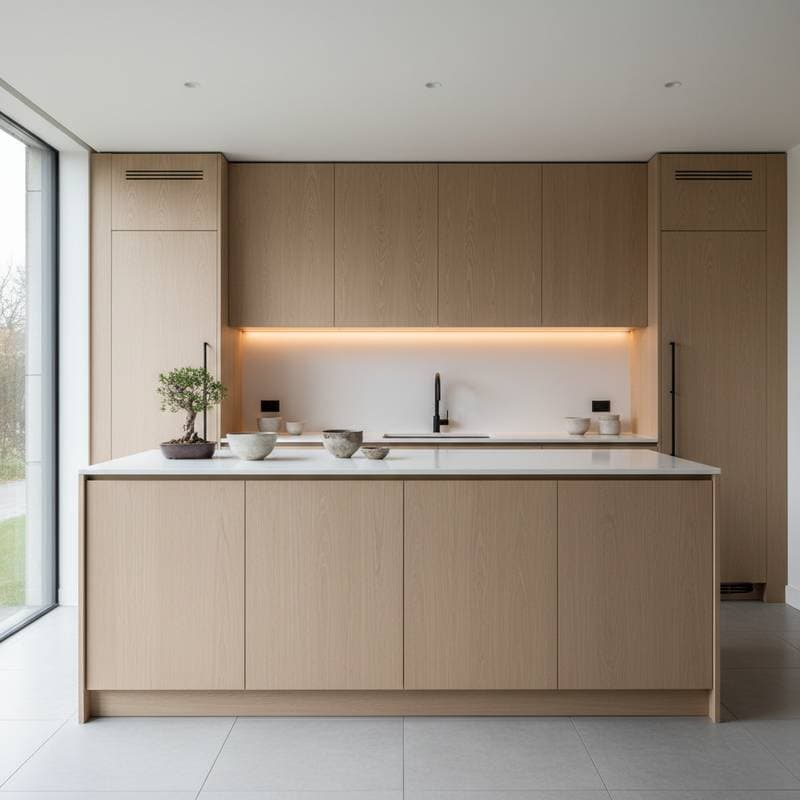
Japandi Secret to Hardware-Free Minimalist Cabinets
The calm precision of Japandi design has reshaped how modern kitchens and living spaces handle cabinetry. The look is unmistakable with clean planes, soft wood tones, and a sense of quiet order. At the heart of that stillness is one small but defining move: the decision to go hardware-free. Push-to-open cabinets, paired with warm wood and seamless joinery, deliver the minimalist flow that defines this hybrid of Japanese restraint and Scandinavian warmth.
At a Glance
- Homeowners: A couple who love clean, functional living
- Location: Pacific Northwest
- Size: 380 square feet (35.3 square meters) kitchen and dining zone
- Design Team: Studio Kumo, led by interior designer Hana Sato
- Cabinetry Fabrication: Timberline Woodworks
- Photographer: Evan Cole
Before
The original kitchen was built around standard shaker fronts with brushed metal pulls. Each surface competed for attention, from glossy upper cabinets to a heavy crown molding. It felt busy even when it was spotless, said the homeowner. The couple wanted a space that encouraged calm cooking and easy cleanup. Storage was adequate but not intuitive, and the visual noise distracted from the home forest views.
After
The redesign stripped the cabinetry back to its essence. Studio Kumo replaced the face-frame units with full-height slab fronts in white oak. Every line now runs uninterrupted. Base cabinets open with a light press, thanks to a magnetic push-to-open system concealed behind the panels. The absence of handles gives the eye a continuous horizontal flow across the room, linking prep zones and dining space in one gesture.
Removing hardware let us focus on proportion and grain, said designer Hana Sato. Your hand finds the door by feel, not sight, which fits the Japandi idea of quiet connection.
Lighting deepens the calm mood. Linear LED strips sit beneath the floating oak shelves, casting soft downward light that highlights the grain rather than the mechanics. A matte plaster backsplash keeps reflection low, which makes the oak appear warmer. The palette holds to three materials: light wood, stone, and plaster. The restraint feels deliberate, not sparse.
Storage improved without adding bulk. Deep drawers beneath the cooktop hold layered cutlery trays and stacked plate organizers. A full-height pantry wall hides behind what looks like a single panel. Inside, adjustable oak shelves and a narrow pull-out ladder maximize reach. Every inch is used, yet nothing feels crowded.
Design Details
Materials and Finishes
- Quarter-sawn white oak veneer over plywood cores
- Matte waterborne finish for a natural touch
- Neutral limestone counter at one inch (2.5 centimeters) thick
- Clay-based plaster backsplash in pale sand tone
Hardware-Free System
- Magnetic push latches paired with soft-close hinges
- Concealed aluminum channels for alignment
- Hand-sanded edges for tactile comfort
Lighting Layers
- LED strip lights at 2700 Kelvin under open shelving
- Recessed ceiling fixtures aligned with cabinet runs
- Integrated toe-kick lighting for night navigation
Organization Moves
- Modular drawer inserts for utensils and spices
- Vertical tray dividers for baking sheets
- Pull-out waste sorting bins near prep sink
Each move reinforces the idea that simplicity requires precision. The craftsmen at Timberline Woodworks adjusted every reveal gap to 1/8 inch (0.3 centimeters). The push latches align vertically so that each door opens with consistent pressure. These small calibrations make the absence of hardware feel intentional rather than incomplete.
Why Hardware-Free Works in Japandi Design
Japandi interiors balance Japanese wabi-sabi values with Scandinavian utility. Both traditions prize clarity of line and an honest relationship with materials. Hardware-free cabinetry fits this philosophy because it removes visual clutter and encourages tactile connection. Instead of grasping a protruding handle, you interact directly with the cabinet face. The gesture feels natural and slows the pace of movement, matching the mindful rhythm central to Japandi living.
In practical terms, the lack of knobs or pulls also simplifies cleaning. No crevices collect dust or grease. The surfaces wipe down in a single motion, which keeps the kitchen fresh with minimal effort. For families or compact homes, the streamlined look can make a modest footprint feel spacious.
The Craft Behind the Seamless Look
Building push-to-open cabinets that last requires careful coordination between design and fabrication. The hinges must align perfectly with the latch mechanism, and the door weight must match the spring force. Sato team worked closely with Timberline Woodworks to prototype one base unit before committing to the full kitchen.
They tested different hinge brands and spring tensions until the doors opened with a consistent tactile response. The key is to avoid any slap or bounce, said cabinetmaker Leo Grant. You want the door to move smoothly, then close itself without a sound.
Edge finishing is another hallmark of quality. Each panel was lightly chamfered by hand to prevent sharp corners while keeping the planes crisp. The edges catch light softly, which gives the cabinets a sculpted appearance in photographs.
Ventilation details also matter. Because the doors reach floor to ceiling, narrow shadow gaps at the base provide airflow and a subtle line of separation. The gaps double as toe space, keeping the user upright when working at the counter.
Applying the Idea at Home
You can adapt hardware-free cabinetry to many budgets and room sizes. The main decision is how you want the cabinet doors to open. True push-to-open systems use spring-loaded magnetic latches. A lighter version uses integrated finger pulls or edge profiles routed into the door. Both achieve a handleless look, but the tactile experience differs.
Start by identifying where you need the cleanest visual lines. In most homes, that means lower base cabinets or tall pantry runs. Upper cabinets can keep simple edge pulls for convenience if daily use is frequent. The goal is balance, not total elimination of hardware.
When planning a retrofit, check your existing hinge placement. Some push latches can reuse standard concealed hinge cups, while others need deeper drilling. Measure door thickness carefully, especially if using veneer panels. A difference of even 1/16 inch (0.15 centimeters) affects the latch alignment.
For a new build, coordinate early with your cabinetmaker. Ask for samples of push-to-open hardware and test the feel before installation. Consider lighting placement too, since handle-free fronts reflect light differently. Soft, angled illumination enhances the grain and avoids glare.
Key Takeaways
- Form follows function. Hardware-free cabinets create uninterrupted planes that emphasize material beauty.
- Precision is essential. Even minor misalignments show more when no pulls distract the eye.
- Maintenance is easier. Smooth fronts clean faster and resist wear around frequently touched zones.
- Lighting completes the look. Warm, diffused layers highlight the craftsmanship behind the simplicity.
- Balance comfort and minimalism. Keep accessibility in mind. Push latches should require gentle contact, not force.
Living with Japandi Cabinets
Over time, the homeowners say the kitchen feels calmer and more intuitive. Each cooking task flows without the small interruptions that hardware once created. It is quiet, the homeowner said. You do not hear drawers clink or doors snap shut. Everything moves softly.
The light wood has taken on a slight patina that deepens its character. Because there are no metal handles to date the look, the design feels timeless. The push latches remain firm after years of use, needing only occasional adjustment.
The same principles now extend throughout the home. The entry bench hides storage under flush panels. The bathroom vanity repeats the push-to-open system in walnut veneer. The continuity reinforces the sense of calm that starts in the kitchen.
Maintaining Your Investment
Handle-free cabinetry demands care during cleaning and seasonal adjustments. Wood expands and contracts slightly with humidity, which can shift door alignment. Check reveal lines twice a year and adjust hinges to keep even spacing. Use a soft, damp cloth for cleaning, followed by a dry wipe to preserve the matte finish.
Avoid leaning or pushing with excessive force. The latch mechanisms are designed for light touch. If a door sticks, clean around the edges before resetting the magnet. Replacement latches are inexpensive and can be swapped without removing the entire panel.