
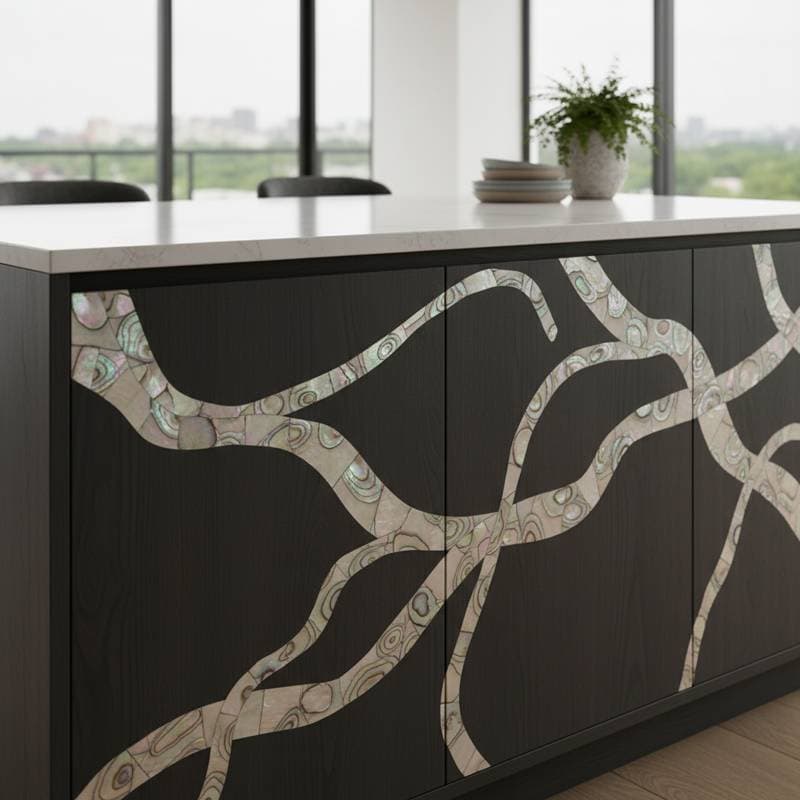
Why Oyster Shell Inlays Define Luxury Cabinets
Replacing a set of premium cabinets can cost between $15,000 and $40,000. The finish often makes a bigger impression than the wood species itself. Designers and homeowners who want to stand out are turning to oyster shell inlays.
These inlays give cabinetry a luminous depth that painted or veneered surfaces cannot match. The shimmer comes from nature, not pigment. The craftsmanship behind it signals serious investment value.
Before you decide whether this detail fits your next build or remodel, it helps to know what makes real shell work so distinctive, how it is sourced, and what it takes to execute it well.
The Allure of Natural Iridescence
Oyster shell inlay captures light in a way that synthetic laminates cannot. Each fragment of shell refracts color differently. It shifts from soft silver to green and pink depending on angle. Cabinetmakers prize this because it creates movement across an otherwise static surface.
The effect works best on flat panel doors or drawer faces where the pattern can stay continuous. In high-end kitchens and baths, builders often use shell in narrow bands or geometric motifs that echo jewelry design. Even a two-inch border can elevate plain walnut or maple into gallery-grade furniture.
Shell contains microscopic layers of calcium carbonate that act like prisms. When light hits those layers, it scatters and creates depth that paint cannot reproduce. That optical play is what makes mother-of-pearl buttons, instruments, and luxury watch faces so captivating.
When planning your design, ask your cabinetmaker to provide a mock-up panel at least 12 by 12 inches. Seeing how the shell reacts to your room lighting will confirm tone and placement before production starts.
Craftsmanship and Labor Requirements
Installing oyster shell inlay takes patience and precision. The process usually involves these steps:
- Preparation: The cabinet face or substrate is sanded flat to at least 220 grit.
- Routing: A channel or pocket is cut about 1.5 millimeters deep.
- Adhesion: Shell segments are set with clear epoxy or cyanoacrylate adhesive.
- Leveling: Once cured, the surface is sanded flush using fine abrasives.
- Finishing: A clear coat or oil enhances color and protects the edges.
Each door or drawer front may require four to six hours of labor depending on pattern complexity. Because of this, shell work is often priced separately from the cabinet carcass.
Skilled inlay artists often charge $85 to $120 per hour. The precision tools they use can add another $500 to $1,000 in setup costs. For production shops, CNC routers can rough out consistent recesses, but final fitting is still done by hand.
The slight irregularities of hand placement catch light differently across the surface. This gives the design warmth that machine repetition cannot mimic.
Budget for at least 20 percent extra shell material to allow for color matching and breakage. Store pieces flat and dry until installation to prevent warping.
DIY or Professional Installation
If you have moderate woodworking experience, small inlay repairs or single-line borders can be a satisfying DIY task. You need only a rotary tool, fine bits, and patience. A basic toolkit might include a rotary router with micro base, a vacuum table or clamp system, an N95 mask and gloves for dust control, UV-stable epoxy, and 600 to 1200 grit sandpaper.
Plan about three hours per linear foot for your first attempt. Keep in mind that shell dust is sharp and can irritate eyes and lungs, so safety gear is essential.
Professional installation is recommended for larger surfaces or intricate patterns. Experienced shops use vacuum presses to hold veneers flat during curing and prevent delamination. They also match finishes precisely so the shell sits level with surrounding wood.
Hire professionals when coverage exceeds 2 square feet per panel, when curved or beveled surfaces are involved, or when the project requires color grading across multiple doors.
To vet contractors, ask to see at least three physical samples of previous inlay work. Verify that adhesives and finishes are formaldehyde-free if you are pursuing green certification. Ensure the shop carries liability insurance covering specialty finishes.
Living with Your Design
Once installed, oyster shell inlay requires little more than gentle care. Its reflective surface keeps kitchens bright, even in limited natural light. Over time, subtle patina develops and adds warmth rather than wear.
Homeowners often find that shell cabinetry increases resale appeal. Appraisers report that custom inlay details can raise perceived value by 8 to 12 percent, especially when paired with solid hardwood frames. Buyers associate the sheen of mother-of-pearl with craftsmanship and rarity.
If you are building for longevity, consider pairing shell with marine-grade finishes. These create a moisture barrier that protects both wood and inlay from humidity swings.