
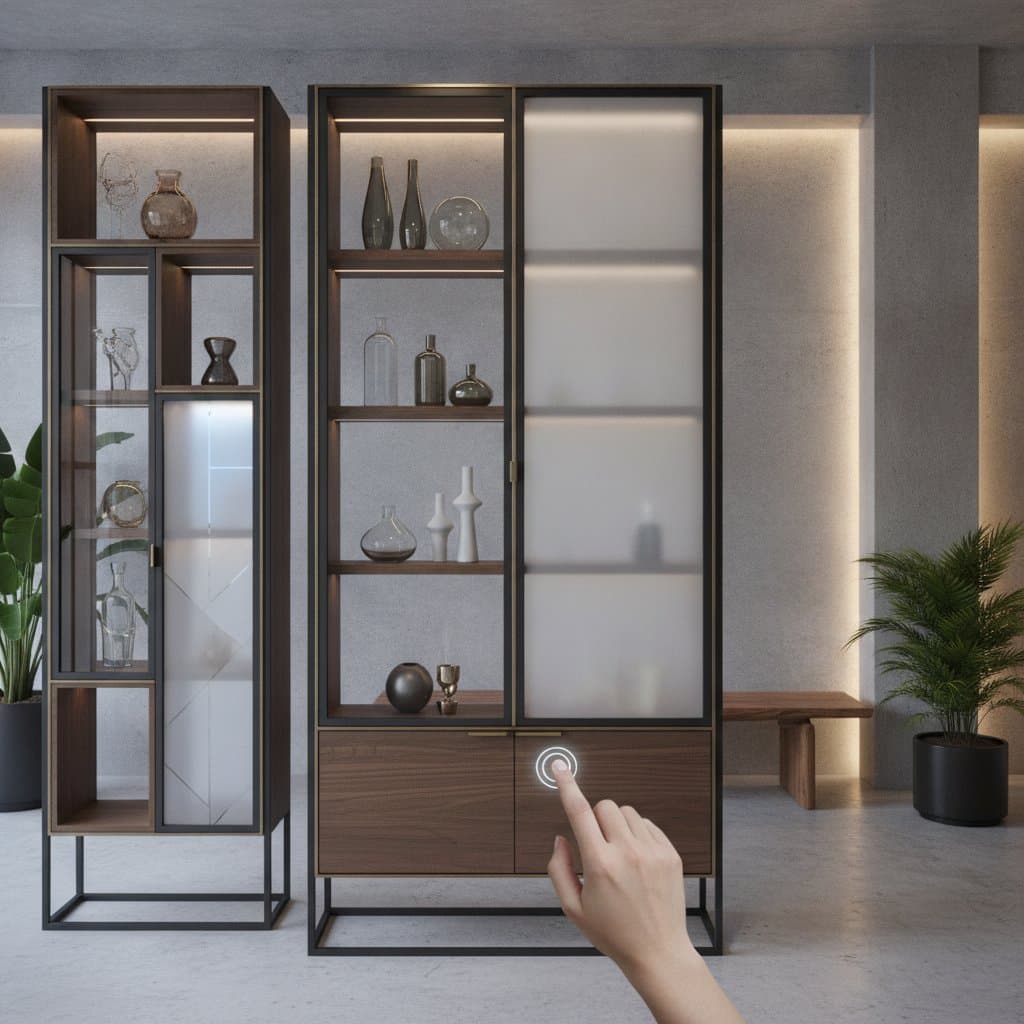
Smart Glass Cabinets Put Touch-Dim Tech Within Reach
Picture your kitchen cabinets turning from clear to frosted with a single touch. The same glass that hides clutter can instantly reveal your favorite dishware. Smart glass cabinets, often built with electrochromic glass, are turning that idea into an achievable upgrade for homeowners and custom woodworkers. What was once a luxury feature in high-end showrooms is now within reach for small shops and residential projects.
These systems blend cabinetry craftsmanship with technology that controls light and privacy. The result is cabinetry that looks sleek, performs intelligently, and gives homeowners new ways to manage space and style.
How Smart Glass Cabinets Work
Smart glass cabinets rely on a specialized glazing that changes transparency when powered. The most common types used in cabinetry are electrochromic glass and polymer-dispersed liquid crystal panels.
Electrochromic glass darkens or frosts when a low electrical current moves ions within a thin conductive layer. Polymer-dispersed liquid crystal glass scatters light using suspended liquid crystals that align when voltage is applied. Both operate safely on low voltage, usually between 12 and 24 volts.
A small transformer powers the system, and control can come from a wired touchpad, a concealed button, or a Bluetooth-enabled app. When you tap or swipe to activate, the glass shifts from transparent to translucent in under two seconds. The effect is smooth and quiet, with no mechanical parts.
The technology uses the same core science found in smart windows for commercial buildings, scaled down to fit cabinetry. Because the glass is laminated and sealed, it resists humidity and cleaning solvents, making it suitable for kitchens, bathrooms, and display cases.
Plan wire routing before assembly when designing new cabinetry. For existing cabinets, select retrofit panels with edge-mounted connectors that can run along existing hinge sides.
Costs and Budget Planning
Smart glass cabinetry costs depend on panel size, glass type, wiring complexity, and control method. A single electrochromic door panel typically runs 450 to 1200 dollars, including wiring but excluding labor. Polymer-dispersed liquid crystal panels are often 20 to 30 percent less expensive but may show a faint haze when switched off.
A budget breakdown for a small kitchen setup includes four upper cabinet doors at 2000 to 3800 dollars, a power supply and transformer at 150 to 300 dollars, touch controls or an app hub at 100 to 250 dollars, and labor for installation at 400 to 800 dollars. For a professional installation, total costs average 2600 to 5000 dollars for a modest kitchen section. A full custom kitchen using integrated smart glass doors can exceed 10000 dollars depending on glass type and control systems.
Buy panels in bulk from the same vendor, since color tone and opacity may vary between batches. If you are comfortable with light electrical work, you can save roughly 300 to 600 dollars by installing wiring yourself under electrician supervision.
Request written quotes from at least two suppliers, confirming that transformers and controllers are included. Some budget kits exclude these items, which adds hidden cost later.
Common Mistakes to Avoid
Smart glass cabinets are straightforward once installed, but small missteps can lead to performance issues. Learning from others mistakes can save you time and money.
Frequent problems include poor wire management. Tangled or pinched wires near hinges can interrupt power flow. Use flexible cable guides and leave slack for door movement.
Incorrect transformer size is another issue. Underrated transformers cause flickering or incomplete dimming. Match transformer output to total panel wattage.
Moisture exposure presents risks as well. While panels are sealed, open connectors can corrode in humid areas. Apply dielectric grease or use waterproof couplers.
Overlooking cleaning methods can damage components. Avoid ammonia-based cleaners that can damage edge seals. Use mild glass cleaner or diluted vinegar instead.
Skipping ventilation shortens component life. Transformers produce mild heat. Without airflow, internal cabinet temperatures can rise.
Before finalizing your layout, sketch wire routing and mounting points. Label each connection. This simple step prevents confusion during installation and later maintenance.
Smart Glass and the Future of Cabinetry
As prices drop and technology improves, smart glass is becoming a realistic option for more homeowners. Manufacturers continue refining clarity and color accuracy, making panels that look identical to standard glass when powered off. Some developers are introducing touch-dim hybrid panels that combine LED lighting with dimmable glass layers, creating ambient light without extra fixtures.
Cabinetmakers can benefit by offering this technology as an upgrade path. Clients appreciate the blend of craftsmanship and digital control, especially in open-concept kitchens and multipurpose rooms. Smart glass can also reduce the need for decorative hardware, since switching replaces physical handles in some designs.
Electrochromic and polymer-dispersed liquid crystal systems merge practical lighting control with visual flexibility. They give cabinetry a dynamic role in room design, rather than a fixed backdrop.
If you run a woodshop, consider building one display cabinet with smart glass panels. Demonstrating the change in person often convinces clients faster than any brochure.
Integrating Smart Glass in Your Next Project
Smart glass brings measurable value to custom work by combining privacy control with refined aesthetics. Woodworkers who master the installation details position themselves to meet growing demand for modern, functional cabinetry solutions.