
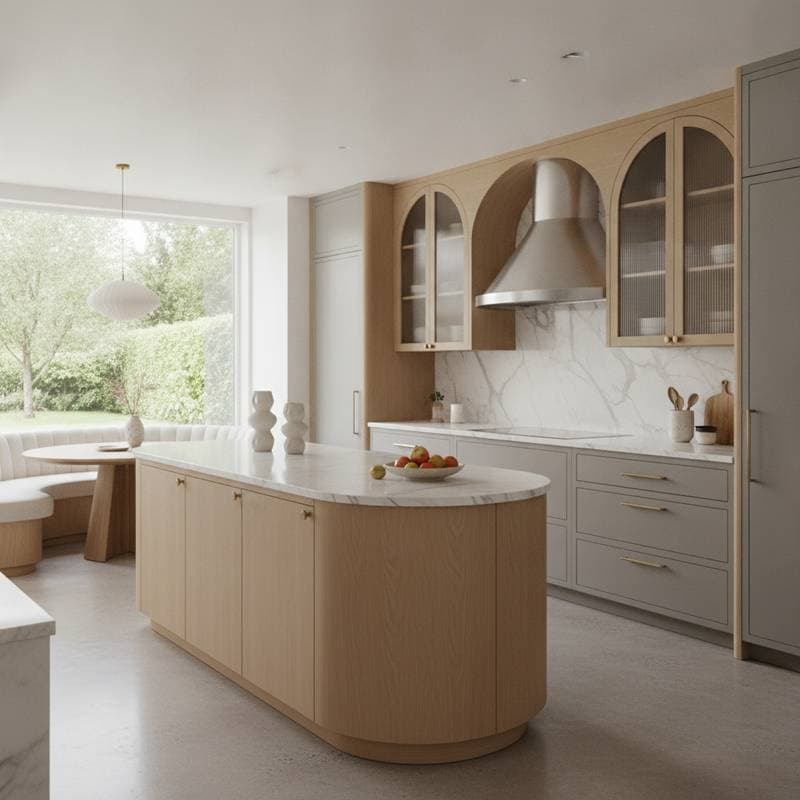
Why Curved Cabinetry Defines Contemporary Kitchen Design
Rising kitchen remodel costs prompt homeowners to pursue designs that feel personal and enduring. Curved cabinetry restores comfort, flow, and craftsmanship to the center of the home. Custom cabinetmakers report that rounded profiles now appear in at least one third of new kitchen projects. This growth marks a clear departure from decades of straight lines and rigid geometry.
Curves soften kitchen appearance, raise safety in confined areas, and display advanced woodworking skill. They also photograph well, which accelerates popularity across digital platforms and showrooms. The sections below examine what curved cabinetry means for design choices, fabrication methods, and lasting value.
The Appeal of Curves in Kitchen Design
Straight cabinets have shaped modern kitchen layouts for decades. Their simplicity supported modular production, yet many homeowners now seek softer forms that create a welcoming atmosphere. Curved cabinetry meets this preference through organic movement and visible craftsmanship that flat fronts cannot match.
Rounded corners reduce sharp edges near busy zones such as islands or sink areas. This change improves safety during movement and increases comfort for households with children or older adults. Even a modest radius on a corner cabinet can make the room feel more fluid and less boxy.
Curved surfaces also reflect light in varied ways. Subtle shifts in surface angle produce gentle highlights that add depth and warmth. This optical effect helps smaller kitchens seem larger because the eye travels continuously instead of halting at hard edges.
Mark main circulation paths on the floor plan during early planning. At points where traffic lines intersect, evaluate whether a curved end or radius corner would improve movement.
Design Applications That Highlight Curvature
Curved cabinetry adapts to multiple aesthetics. It suits coastal kitchens finished in white oak and soft blues as well as high end modern homes that favor matte black surfaces. Success depends on applying curvature with purpose rather than covering every surface.
Rounded Islands
A curved island softens the room center and improves walk around clearance. The typical cost increase for a curved island front ranges from 1500 to 3000 dollars compared with a straight version because of added shaping and veneering work.
Barrel Hoods and Arched Range Surrounds
Curved hoods form a focal point that balances tall cabinet runs. Woodworkers construct these elements with laminated ribs and flexible medium density fiberboard, then finish them with veneer or paint grade panels.
Radius End Cabinets
Curved ends added to a run of base cabinets prevent abrupt visual stops and protect hips from sharp corners. This detail adds roughly 300 to 600 dollars per cabinet.
Integrated Banquettes and Bars
Curved seating or bar backs support conversation and smooth traffic. Designers often pair these features with stone or quartz tops cut to match the cabinet radius.
Maintain a consistent radius across every curved element. A three foot radius suits most kitchen corners and aligns with the turning arc of countertop edges.
Fabrication Choices: DIY Versus Professional
Curved cabinetry ranks high on the woodworking difficulty scale. Advanced hobbyists can produce gentle arcs, yet tight radii and seamless finishes require industrial equipment such as vacuum presses or computer numerical control routers.
Simple open shelving or floating shelves with gentle curves can succeed as do it yourself projects. Medium density fiberboard panels bent over pre cut forms work for paint grade applications. Lamination projects that use flexible plywood and standard clamps also remain feasible. A small curved shelf may require about 150 dollars in materials and six to eight hours including glue cure time.
Built in kitchen cabinetry that must align with countertops or appliances calls for professional fabrication. Projects that demand matched veneer grain around curves or radii under twelve inches also benefit from shop resources. Professional environments control moisture and employ precision jigs to achieve repeatable results.
Request photographs of prior curved work rather than flat cabinetry alone. Verify membership in recognized woodworking associations. Confirm that the shop uses moisture resistant adhesives rated for kitchen conditions.
Alignment With Modern Living Patterns
Open concept homes require kitchens that merge with living areas instead of dominating them. Curves support this transition by creating visual continuity. Rounded edges link the kitchen to adjacent rooms without abrupt visual breaks.
From a functional view, curves improve traffic movement. In a typical 150 square foot kitchen, replacing two sharp corners with radius ends can free eight to ten square feet of usable space. This modest gain often determines whether two people can work side by side comfortably.
Curves further support wellness oriented design. Smooth transitions lower visual stress and produce a calmer setting. Designers note that clients describe curved kitchens as softer and more inviting even when material selections stay unchanged.
Request both linear and curved renderings during design meetings. Compare how each option affects walk paths and sightlines from nearby rooms.
Sustainability and Long Term Performance
Curved cabinetry may consume more material per square foot, yet the lamination process creates multiple bonded layers that resist cracking better than single thick panels. Many fabricators now select low volatile organic compound adhesives and sustainably harvested veneers to satisfy green building standards.
Properly sealed curved cabinets hold their shape for decades. Routine care includes inspection for edge separation and resealing of exposed joints every few years. Owners who keep indoor humidity between 35 and 50 percent observe minimal movement over time.
Assessing Curved Cabinetry for Your Next Project
Review circulation patterns, material choices, and budget allowances before committing to curves. Consistent radii, professional fabrication where needed, and attention to humidity control together deliver kitchens that remain comfortable and valuable for years.