How Changing One Dimension Updates Your Entire Cabinet
Parametric design tools transform the way woodworkers construct custom cabinets. What once demanded dozens of manual adjustments now requires only a few targeted inputs. Cabinetmakers who adopt programs such as Fusion 360 gain precision, repeatability, and a flexible workflow suited to the demands of contemporary shops.
At a Glance
Who uses it: Custom cabinetmakers, millwork operations, and small woodworking studios
Core tools: Fusion 360, Grasshopper, and similar parametric modeling platforms
Key benefits: Accelerated design revisions, precise component fits, optimized material utilization
Why it matters: Parametric tools convert measurements into interconnected relationships, allowing one alteration to refresh the full model
Traditional Workflow Challenges
In conventional processes, each cabinet drawing remains static. A client request to modify a wall dimension or appliance size forces the shop to recreate multiple views. Such a revision often consumes hours as joinery, hardware placements, and cut lists require realignment.
"Changing one opening meant starting over," notes Jason Liu, a cabinetmaker who transitioned his shop to digital methods five years ago. "Even a small error in the drawing would ripple through the whole job."
These iterative updates constrain customization options. Many shops default to standard cabinet modules and steer clear of projects involving intricate geometries. The approach functions adequately, yet it hampers innovation and restricts creative potential.
Parametric Modeling Advantages
Parametric modeling inverts this dynamic. Designers establish relationships rather than drafting individual panels in isolation. Drawer fronts remain centered, doors preserve reveal spacing, and toe kicks adapt automatically to height variations.
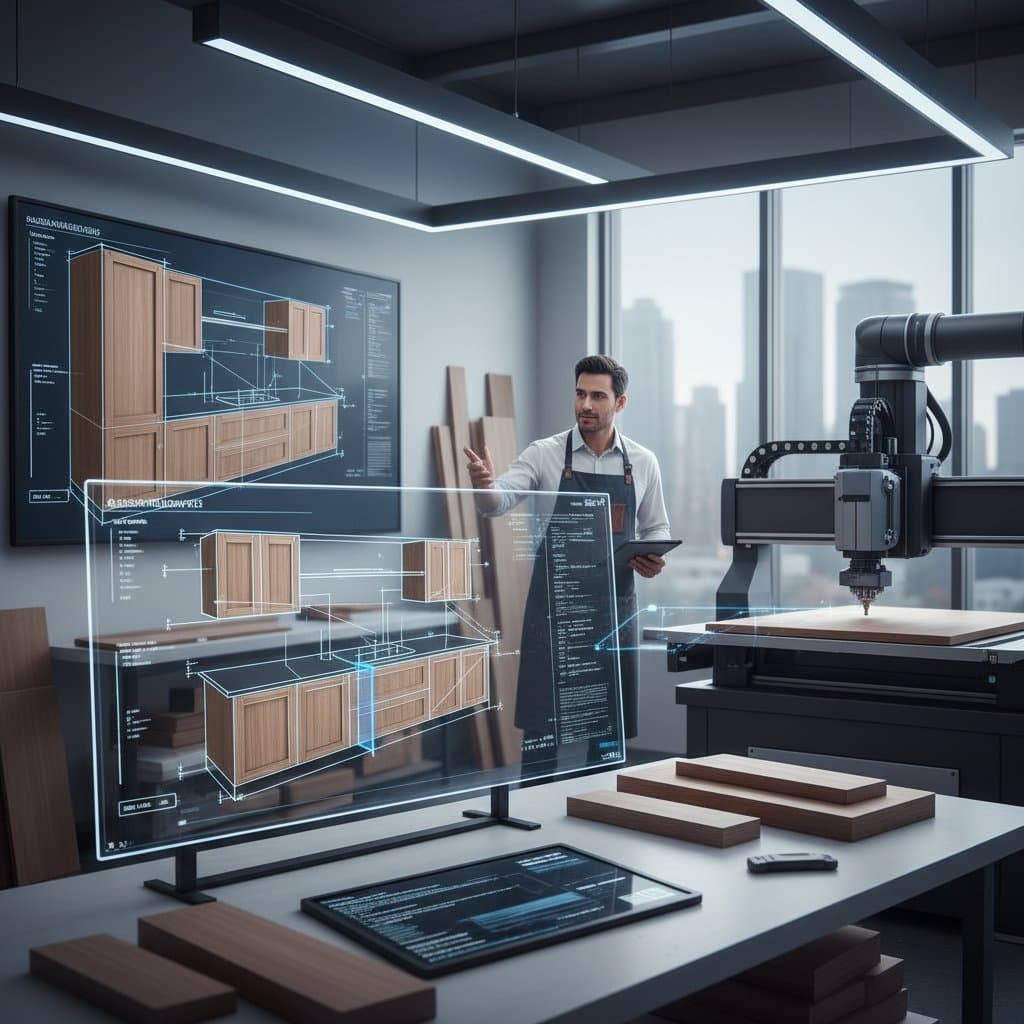
Within Fusion 360, for instance, every cabinet component connects to a defined parameter set: overall width, height, depth, material thickness, and hardware clearances. Alterations to these values trigger an immediate model refresh. The 3D visualization, shop drawings, and toolpaths synchronize in response.
This capability enables rapid prototyping, configuration testing, and site-specific tailoring. Kitchens featuring irregular walls or built-in media centers beneath stairs achieve accurate representation prior to any material cutting.
"Once you build a parametric template, every project becomes repeatable," observes industrial designer Maria Ortega, who creates cabinetry systems for bespoke residences. "It frees you to design for space and function instead of worrying about redrawing panels."
Essential Design Features
Layout flexibility
- Cabinet widths expand or contract while preserving door reveals.
- Shelf spacing adjusts proportionally to total height.
- Base and wall cabinet runs align automatically, accommodating variations in ceiling lines.
Storage optimization
- Internal dividers and drawers adhere to predefined spacing formulas.
- Hardware mounting points shift in tandem with cabinet scaling.
- Cut lists generate directly from the model, minimizing material waste.
Lighting and finishes
- Parametric lighting channels integrate into upper cabinets and adapt to length modifications.
- Edge banding thickness and finish layers receive model tracking, guaranteeing precise CNC dimensions.
Fabrication efficiency
- CAM toolpaths derive straight from the parametric model.
- Nesting layouts recalibrate with each design adjustment, maximizing sheet utilization.
- Assembly documentation updates alongside revisions, reducing shop floor errors.
Core Benefits
Precision and Consistency
Parametric tools bolster accuracy by removing human error from routine operations. Each part draws from a central variable set, ensuring dimensional uniformity throughout the project. A request for a broader pantry prompts uniform expansion of the cabinet and its components. This reliability prevents expensive errors in bespoke fabrication.
Accelerated Revisions and Approvals
Clients frequently require previews of alternatives prior to final decisions. Parametric modeling simplifies the presentation of options. Designers switch between variants, assign varied materials, or modify door configurations without reconstruction. Real-time visibility in shared models facilitates collaboration.
Seamless Integration with CNC and Shop Equipment
Upon design completion, the model directly informs production. Exported toolpaths integrate with CNC routers or panel saws. This direct linkage eliminates discrepancies between design intent and manufacturing output. Shops progress from initial concept to fabricated parts within a unified process, enhancing efficiency and margins.
Optimized Material Utilization
Parameters govern sheet dimensions, grain orientation, and part placement, enabling nesting software to minimize waste. In plywood or veneer applications, such oversight safeguards costs and aesthetics. Offcuts emerge as planned remnants rather than haphazard losses, promoting sustainable practices.
Reusable Templates for Scalability
Shops that cultivate a parametric library adapt swiftly to diverse assignments. A base cabinet template yields numerous iterations, ranging from a compact nightstand to an extensive kitchen array. Each iteration retains standardized joinery and construction elements, elevating quality amid customization.
Practical Implementation
Homeowners experience these advantages through everyday functionality. Doors align flawlessly, drawers operate with ease, and proportions harmonize across spaces. Should a remodel introduce new appliances or alter layouts, the digital model reopens for targeted adjustments. Cabinet geometries evolve alongside the environment.
Designers and fabricators face an initial learning phase. Constructing the inaugural parametric model demands time and deliberate relationship planning, including consistent naming protocols. However, established systems accelerate subsequent projects. Revisions that previously spanned days now resolve in minutes.
"Parametric modeling taught me to think like an engineer," reflects Liu. "Now I design the logic, not just the shape."
Building a Lasting Digital Foundation
Adopting parametric tools extends beyond velocity gains. It cultivates a repository of reusable assets. Cabinet families, hinge configurations, and lighting integrations form an expanding digital collection. This resource codifies a shop's distinctive elements and simplifies onboarding for team members.
Those contemplating adoption should commence modestly. Develop a model for a basic cabinet with variable width and height. Introduce relationships incrementally until responses prove intuitive. Witnessing the model's adaptive intelligence reveals the appeal that draws woodworkers to this methodology.
Parametric tools elevate custom cabinetry by fusing intelligent design with fabrication accuracy. They enable unfettered experimentation, lucid documentation, and assured construction.