
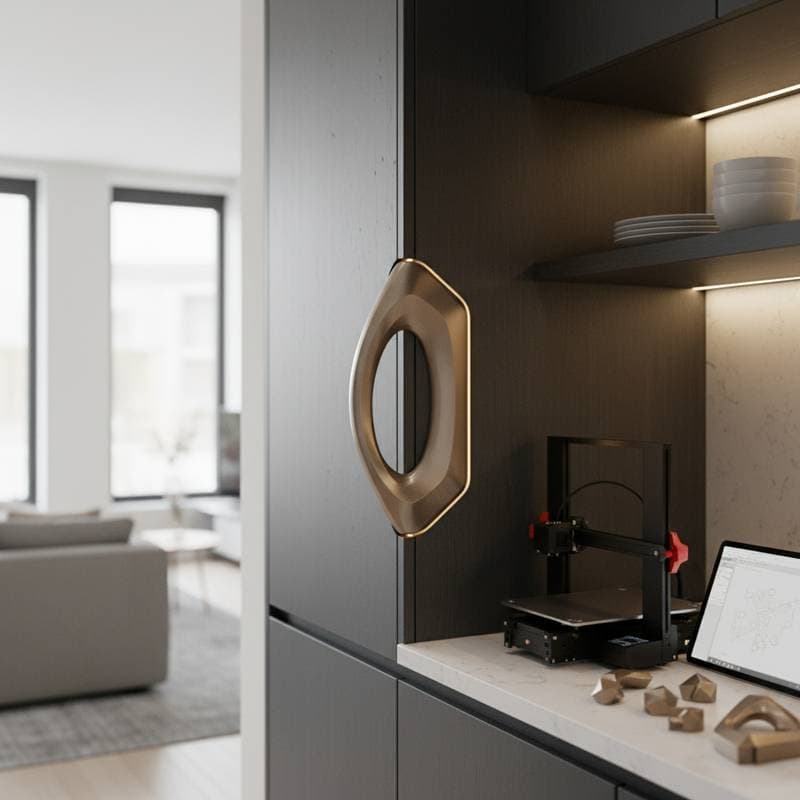
3D-Printed Hardware Revolutionizes Custom Cabinet Doors
The adoption of 3D-printed hardware transforms the design, construction, and finishing of custom cabinet doors. Tasks that previously demanded specialized tools or extended lead times now occur within compact workshops and design studios. Advanced printing materials and parametric modeling tools enable fabricators to produce hardware tailored to specific door profiles and movement sequences with exact precision. This innovation accelerates prototyping, enhances design expression, and ensures hardware integrates seamlessly rather than serving as an afterthought.
This evolution extends beyond technical aspects. It influences how designers approach movement, proportion, and tactile elements. Rather than selecting hardware to complement a door, creators now develop both in unison. The cabinet and its hinge or pull form a unified, fluid expression.
At a Glance
Who: Independent woodshops, furniture designers, and custom kitchen fabricators
What: Integration of 3D-printed hardware into custom cabinet doors
Where: Small and mid-size workshops using parametric design workflows
Size: Projects span compact 120 square foot (11 square meter) studios to 400 square foot (37 square meter) fabrication spaces
Design Teams Featured: FormFound Studio, ArcWood Collective, and Studio Pliant
Photography: Courtesy of the design teams
Seamless Integration Through Parametric Design
Parametric modeling combined with 3D printing allows designers to generate hardware from the identical digital file used for the cabinet door. Hinges, pulls, and cover plates emerge as natural extensions of the door geometry rather than distinct components. This method removes reliance on standard catalog sizes and empowers workshops to align hardware precisely with panel thickness and overlay requirements.
FormFound Studio illustrates this in their recent kitchen series. Upper cabinets incorporate continuous pulls embedded along the door edge, fabricated from nylon composite and finished to a satin smoothness. The resulting texture aligns with the veneer grain, establishing an uninterrupted visual flow across the installation.
"We print directly from the parametric model," noted Eli Vargas, FormFound lead fabricator. "That means every handle follows the same curve as its door. We never need to adjust by hand."
Lighting integration advances further with this technique. LED channels embed within hinge covers or pull recesses during printing. Such design supports discreet undercabinet glow without additional drilling or wiring. The hardware thus serves dual roles as mechanical support and illumination enclosure.
Enhancing Light and Movement
3D-printed hardware redefines light interaction in cabinetry. Studio Pliant applied this in a bar installation where lower cabinet handles include channels for soft LED ribbons. Upon opening, the door edge emits a gentle glow that directs users without relying on overhead sources. The outcome delivers subtle warmth over dramatic effect.
"Because we printed the handles ourselves, we could control diffusion and angle," explained Tate Morgan, Studio Pliant designer. "We set the LED depth at three-sixteenths of an inch (5 mm) for even glow."
This approach refines spatial navigation. Light functions as a directional guide rather than mere ornament. Interaction with a door prompts intuitive response, while the lack of exposed fixtures preserves clean sightlines.
Streamlined Workflow for Small Shops
Small woodshops implement this process with minimal upfront costs. Reliable entry-level printers manage nylon and reinforced filaments effectively. Success hinges on accurate calibration and strategic print orientation.
- Modeling: Construct hardware forms within the same digital file as the cabinet door.
- Printing: Position load-bearing surfaces upward to minimize post-processing needs.
- Post-processing: Sand surfaces, apply primer, and seal with a robust coating.
- Assembly: Embed brass threads or steel pins in high-stress areas for reinforcement.
- Testing: Install on prototype doors to verify fit prior to full production.
Shops achieve up to 25 percent reduction in lead times versus traditional sourcing. Greater value emerges from regained design independence. Fabricators produce and evaluate ten pull variations in a single day, refining for optimal ergonomics before committing to batches.
Versatile Applications in Design Styles
3D-printed hardware suits diverse aesthetics. In sleek kitchens, it recedes into door edges for unadorned reveals. Rustic or industrial environments accentuate it through exposed layers or bold hues.
Contemporary Minimalism
FormFound deploys matte white resin pulls that merge with lacquered panels. Seamless integration highlights the form's essential volume.
Warm Modern
ArcWood Collective pairs oak-veneered doors with bronze-finished printed handles. A subtle patina echoes wood tones while providing secure grasp.
Industrial Contrast
Studio Pliant showcases print striations in black PLA accented with metallic tones against walnut. This adds depth and structural emphasis.
These instances highlight customization unattainable with off-the-shelf options.
Advancing Sustainability
3D-printed hardware aligns with eco-conscious practices. Conventional production relies on casting, plating, and global transport. Local printing minimizes shipping emissions and excess material.
Designers fabricate only required quantities, often using recyclable filaments like nylon composites or PLA. Scrap from imperfect prints recycles into new feedstock, forming a closed loop that slashes waste.
"We used to discard entire boxes of handles for minor finish flaws," Vargas recalled. "Now we just reprint with the correct pigment. Nothing goes to waste."
Stabilized workflows lower energy demands per component. Printers operate efficiently without molds or ovens, yielding cost reductions and reduced environmental impact for modest operations.
Overcoming Implementation Hurdles
Transition involves certain challenges. Initial efforts grappled with part durability and surface refinement. Visible layering and inferior strength plagued early composites, though material advancements now support extensive use cycles without failure.
Shops adjust to updated repair protocols. Replacements demand precise replication of original tolerances. Parametric files guarantee geometric fidelity, provided calibration remains consistent.
Finishing techniques demand practice. Achieving cabinetry-grade smoothness through sanding, priming, and coating requires methodical effort. Facilities that refine this process unlock enhanced creative latitude.
Economic Viability and Growth Potential
Initial investments vary, yet most studios recoup expenses after several projects. On-site printing curtails bulk purchasing and inventory demands. A standard kitchen setup saves hundreds in hardware costs alone.
Customization elevates perceived value. Clients select curvatures, textures, and finishes from visualizations, fostering immersive design sessions. This personalization drives loyalty and recommendations.
Essential Insights
- Parametric modeling synchronizes hardware and door forms for flawless alignment.
- 3D printing facilitates quick iterations and limited runs without custom tooling.
- Localized production and recycling bolster sustainability.
- Options for hue, surface, and embedded features expand personalization.
- Reinforced designs endure like conventional metal components.
- On-demand printing streamlines upkeep.
These elements propel workshops into an era blending artisanal skill with digital accuracy.
Preserving Performance
Routine care sustains 3D-printed hardware longevity. Clean components with mild soap and water, avoiding harsh chemicals. Inspect inserts yearly for secure fit. For loose elements, apply gentle heat and press to reseat without distortion.
Opt for matte finishes to mask daily wear. Address scuffs by sanding lightly and applying clear polyurethane. Archive digital models with version identifiers to ensure exact reprints.
Everyday Experience
3D-printed hardware elevates cabinet interaction. Tailored elements respond intuitively to touch, with hinges offering silent operation and lighting providing soft guidance. The design eliminates visual noise, emphasizing purposeful simplicity.
Users report heightened satisfaction in routine tasks. Handles conform to grip preferences, and integrated details enhance usability without distraction. Each interaction underscores thoughtful execution.