
Parametric Software Redefines Custom Cabinet Mastery
Parametric design has entered the woodshop. Tools once limited to architects and industrial designers, such as Grasshopper, now influence how custom cabinetmakers create sketches, refine iterations, and produce final pieces. This approach delivers speed alongside precision. One adaptable model accommodates storage needs across an entire home, while maintaining exact joints throughout.
At a Glance
Project Type: Custom cabinetry with algorithmic modeling
Location: Portland, Oregon
Size: 420 square feet (39 square meters) shop floor
Design Team: Fieldline Studio with cabinetmaker Ryan Keller
Photographer: Clara Voss
Keller faced the task of creating a complete kitchen, pantry wall, and built-in units for an open-plan residence. He explained, "We required perfect alignment along every edge." Traditional CAD proved too inflexible, but parametric tools established a dynamic connection between initial concepts and production specifics.
Traditional Workflow Challenges
The previous process depended on fixed CAD drawings and hand-made modifications. Any alteration, such as repositioning an appliance or fine-tuning a wall offset, demanded fresh elevation drawings and renewed checks on hardware spacing. These steps delayed progress and heightened the chance of mistakes.
Keller noted, "We spent more time correcting drawings than preparing parts." Storage configurations required manual duplication across spaces, which introduced minor discrepancies noticeable after assembly. Incorporating lighting posed further difficulties, as fixture positions seldom matched cabinet structures precisely.
Parametric Workflow Advantages
Grasshopper powered the new method, integrating every cabinet into a unified, responsive framework. Adjustments to depths, face-frame outlines, or door patterns occurred immediately upon changes to wall measurements. The digital model refreshed joinery details, hinge locations, and material lists in unison.
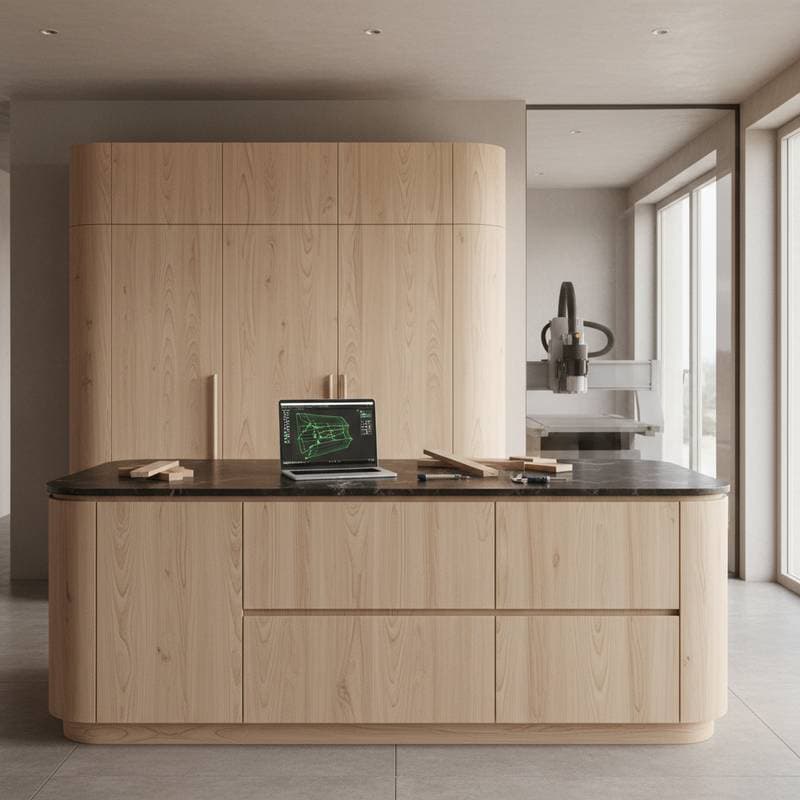
Images reveal a fluid kitchen layout where base units connect smoothly to an elevated pantry section. White oak veneers display uninterrupted grain patterns over doors, including around bends, due to coordinated nesting derived from the parametric data. LED channels embed into the undersides of upper cabinets, positioned exactly 2 inches (5 centimeters) from the front edge to ensure uniform illumination.
This method strengthens the bond between planning and manufacturing. Keller's crew exports files straight from the algorithmic structure to CNC machines, minimizing intermediate processes. He observed, "When the entire system reacts to one adjustment, you grasp the level of control available."
Project Specifics
- Core Material: White oak veneer applied over plywood, finished with solid edging
- Finish: Low-sheen water-based lacquer that highlights grain definition
- Hardware: Full-extension undermount slides paired with concealed hinges offering 110-degree range
- Lighting: Continuous LED strips at 3000K temperature, equipped for dimming
- Storage Innovation: Drawers with variable depths that adapt to internal limits automatically
- Organization: Built-in divider slots defined parametrically, enabling rapid spacing modifications
- CNC Integration: Tool paths produced from the active model, cutting setup time by 40 percent
The parametric framework also monitored load distribution. Tall units received reinforced rear panels and extra mounting cleats based on computed weights. Each shelf adhered to a standard deflection threshold, prompting automatic thickness increases to uphold rigidity.
Broader Implications
Parametric techniques in cabinetry emphasize accuracy, flexibility, and consistency rather than mere automation. Designers evaluate proportions without reconstructing forms. Fabricators produce shop drawings, component inventories, and machining instructions from a single reliable dataset.
Homeowners experience superior fits and quicker setups. If a wall deviates by 3/8 inch (1 centimeter) from vertical, the digital file adjusts without delay. Edges of panels receive trims within the model, avoiding on-site alterations. Openings for lighting, airflow, and appliances adapt accordingly.
Keller added, "Clients perceive the enhanced alignment. Everything appears deliberate because calculations ensured it."
Expanding Applications
Woodworking operations nationwide apply parametric design to diverse endeavors beyond kitchens. Integrated benches, wall-mounted storage, and display fixtures gain from structures responsive to their surroundings. Smaller workshops leverage ready-made Grasshopper templates, modifying only essential parameters like dimensions or connection styles.
Learning the system takes less time than anticipated. Cabinetmakers often start by integrating Grasshopper with existing Rhino files used for client visualizations. The tool functions as a logic applicator, automating those files through rules rather than repeated manual inputs.
Certain shops collaborate with design specialists to develop versatile scripts. These incorporate standards for accessibility clearances, standard counter elevations, or optimal reach distances. Established parameters support numerous projects with few changes.
Essential Insights
- Efficiency: Parametric models remove redundant drafting tasks and halve revision durations.
- Precision: Components refresh uniformly, enhancing overall alignment and assembly accuracy.
- Customization: Real-time adjustments to sizes and features suit individual client needs.
- Integration: Data for lighting, airflow, and fittings resides in the unified model.
- Sustainability: Optimized nesting and cutting patterns minimize material waste.
These advantages support ongoing upkeep too. Generated from parametric records, replacement parts match originals precisely when needed later. The workshop maintains a digital catalog of all undertakings.
Everyday Impact
In the Portland home, routines improved through understated enhancements. Drawers operate smoothly in unison, and cabinet fronts match adjacent door frames flawlessly. The kitchen conveys serenity through its precise alignments. The pantry wall conceals functionality beneath seamless wood surfaces, while lighting engages effortlessly upon door activation.
Keller reflected, "This approach provided creative latitude without sacrificing oversight. We pursue refined proportions while confirming build feasibility."
Parametric cabinetry stands as a practical reality today. It blends traditional craftsmanship with computational methods. Woodworkers adopting these tools design thoughtfully and construct assuredly, redefining bespoke quality through precise algorithms and material expertise.