
Introduction to Steam Bending
Steam bending offers woodworkers a way to shape lumber into graceful arcs without relying on cuts or fasteners. This traditional technique softens wood fibers through heat and moisture, allowing the material to conform to custom forms. The result is furniture and objects that flow naturally, showcasing the wood's inherent beauty and strength.
Professionals and hobbyists alike value steam bending for its efficiency and aesthetic appeal. It preserves the wood's grain pattern across bends, creating seamless transitions that enhance both durability and visual interest. As environmental awareness grows, this approach aligns with sustainable practices by optimizing material use.
Essential Techniques and Tools
Prepare wood to approximately 20 percent moisture content before steaming, as green wood yields the most pliable results. Use a moisture meter to verify levels and avoid cracking or excessive warping.
Steam the wood for about one hour per inch of thickness. A simple setup includes a PVC pipe connected to a wallpaper steamer, enclosed in an insulated box to retain heat and humidity.
Construct forms from plywood or medium-density fiberboard, shaped to the desired radius. Cover the form with packing tape or plastic wrap to prevent the wood from adhering during the bending process.
Clamp the steamed wood to the form starting from the center and working outward. This method ensures even pressure distribution and reduces the risk of fractures.
Account for springback, which typically measures 5 to 10 percent. Design forms slightly tighter than the intended final shape to compensate for this natural rebound.
After bending, allow the wood to dry in the form for at least 24 hours. Once stable, sand lightly and apply oil or clear lacquer to accentuate the dynamic grain patterns.
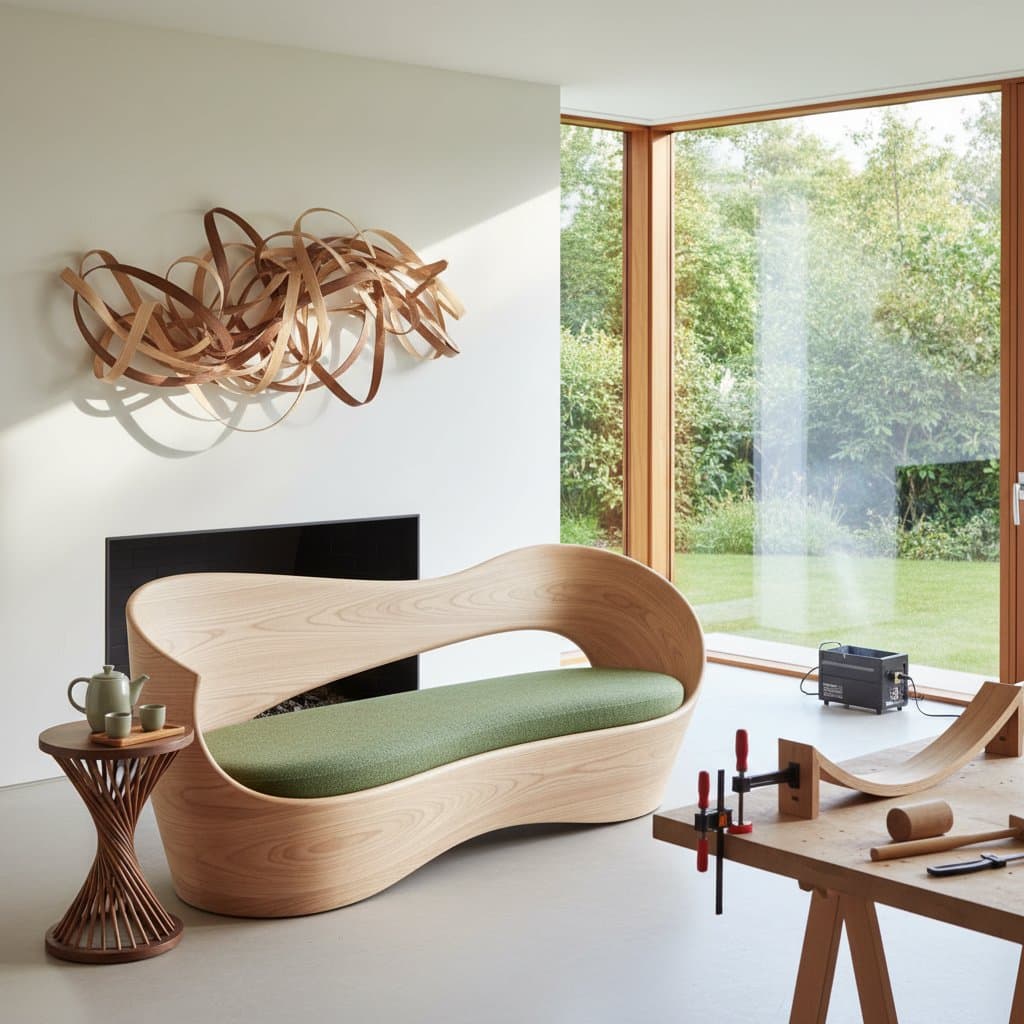
These steps form the core of steam bending. Basic equipment, including a steamer, forms, and clamps, costs under three hundred dollars and utilizes readily available materials. Visual guides, such as photographs of prepared forms and clamped bends, illustrate the process clearly, making it accessible for beginners.
The Value of Steam Bending in Modern Woodworking
Steam bending supports sustainability by requiring less stock and generating minimal waste compared to traditional joinery. It eliminates the need for chemical glues or metal hardware, resulting in cleaner, more eco-friendly constructions.
The technique enhances structural integrity through continuous grain lines, which distribute stress more effectively than assembled joints. This leads to lighter yet robust pieces that demand fewer reinforcements.
Creatively, steam bending shifts design thinking from rigid geometries to fluid dynamics. Woodworkers visualize curves as extensions of the material's natural tendencies, fostering innovative forms in stools, shelves, and frames.
Thomas Greer, a woodworker and educator, observes, "When you start bending wood, you stop fighting it. You listen to how far it wants to go. That relationship makes better furniture."
Practical Steps for Success
- Begin with modest projects like hooks, handles, or lamp arms to understand wood behavior under steam and pressure.
- Monitor moisture precisely; excess dryness causes fiber breaks, while over-saturation leads to uneven warping.
- Align designs with grain direction to maximize strength. Steer clear of knots or areas where grain runs out.
- Oversize forms to adjust for rebound and achieve accurate final dimensions.
- Dry components gradually in forms to minimize distortion during the setting phase.
- Select natural oil finishes to emphasize the unbroken grain that defines steam-bent work.
Mastering these elements builds proficiency. The principles apply equally to small crafts and ambitious furniture builds, scaling with experience.
Integrating Steam-Bent Elements into Daily Use
Furniture featuring steam-bent components offers subtle ergonomic benefits. Chair backs yield gently under load, providing support without added mechanisms. Curved rails facilitate smooth connections between surfaces, optimizing space in compact areas.
These designs interact with light in captivating ways, as rounded contours diffuse illumination to create a serene ambiance that evolves throughout the day.
In home workshops or compact studios, steam bending promotes creative exploration. Artisans produce unique items or coordinated sets, with each curve reflecting precise control over heat and form.
Upkeep remains straightforward. Protect against drastic humidity changes and renew finishes periodically. Properly maintained, steam-bent pieces retain their form and vitality for generations.
Advancing Your Craft
With foundational skills in place, explore compound bends that twist in multiple planes or layered forms for complex shapes. Combine bent sections to form unified frames, or incorporate woods of varying tones for added depth.
Introduce tapers prior to steaming to refine profiles and enhance elegance. These variations deepen the dialogue between artisan and material, yielding pieces that honor wood's organic essence.
Steam bending ultimately encourages a collaborative approach to creation. Each achieved curve represents a balance of thermal energy, hydration, and the wood's intrinsic character.