
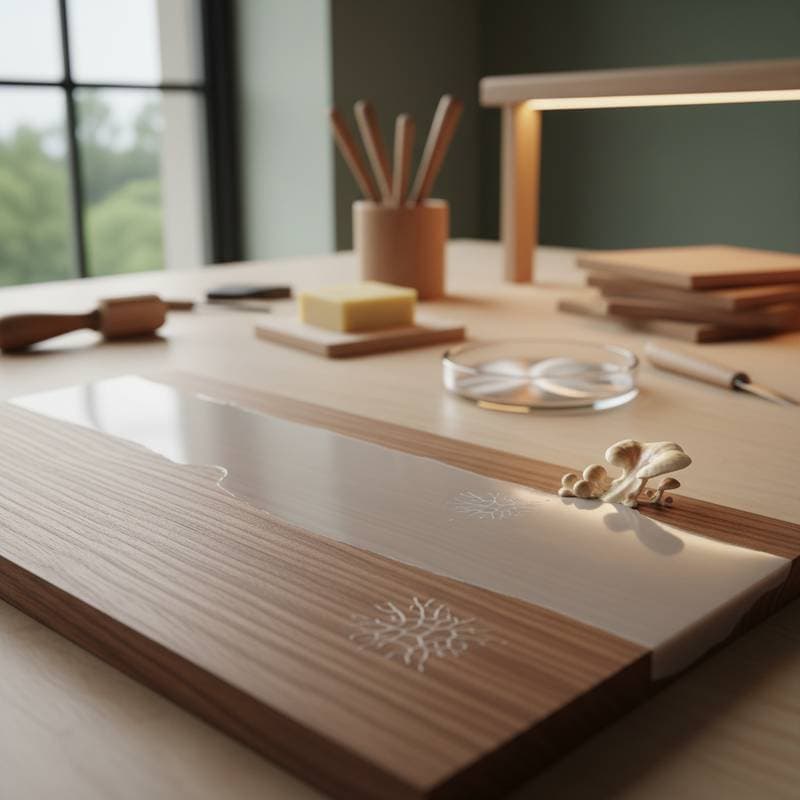
Mycelium Coatings: Wood's Sustainable New Finish
Woodworkers seek coatings that safeguard surfaces without environmental harm. Conventional varnishes and urethanes provide gloss and strength, yet rely on petrochemical binders and solvents that require ventilation and generate waste. Mycelium coatings, sourced from fungal root structures, introduce a renewable, biodegradable protective layer. This innovation alters not only the chemistry but also the visual and sensory qualities of wood, influencing how it ages and interacts with its surroundings.
At a Glance
Project type: Bio-based coating development and studio testing
Location: Multi-site collaboration between research labs and custom woodshops
Size: Scalable for small-batch to industrial use
Design team: BioFab Studio and Elmwood Design Lab
Photographer: Studio K.T. Imaging
Before
Standard wood finishes shield surfaces but involve significant drawbacks. Oil-based polyurethane yellows with age, waterborne options may raise the grain, and hardwax oils demand regular upkeep. The ecological toll spans production through disposal. Small operations often use solvent-based sealers that release VOCs and necessitate careful management.
"Every finish decision involves compromise," said cabinetmaker Luis Ortega. "We were searching for a coating that sealed like a resin but came from a living source, not a refinery."
The primary hurdle lay in performance. Could a biologically derived coating rival the clarity, hardness, and moisture resistance of synthetics while remaining safe for applicators and the environment?
After
Designers achieved a breakthrough by working with mycelium, the intricate fungal network that binds organic materials. Cultivated in controlled settings, mycelium develops into a flexible, protein-rich film that adheres effectively to wood's lignin and cellulose components.
Applied thinly, the mycelium forms a semi-translucent skin upon drying. It combines traits of shellac and wax, highlighting grain patterns without dulling color. The result features a soft matte luster akin to oiled wood, yet with greater uniformity.
BioFab Studio's lead designer, Hannah Keller, noted the transformation. "The first boards looked alive. You could still see every pore of the oak, but the surface felt sealed and breathable at the same time."
Testing in simulated kitchens showed mycelium-coated tabletops enduring hot mugs and mild cleaners. On cabinetry and walls, it outperformed natural oils in resisting fingerprints. Unlike sprayed lacquer, it produced no fumes and eliminated the need for forced ventilation.
Design Details
Material Composition
- Base: Mycelium culture grown from agricultural byproducts such as sawdust or wheat straw
- Binder: Protein polymers activated by mild heat
- Finish: Optional wax or mineral topcoat for enhanced sheen
Application Process
- Sand the surface to 220 grit or finer.
- Brush or spray the liquid mycelium suspension evenly, then allow it to set for 15 to 20 minutes.
- Cure under gentle heat (95 to 105°F or 35 to 40°C) for several hours.
- Buff lightly with a cotton pad or low-speed buffer.
Storage and Maintenance
- Clean with a damp cloth and mild soap.
- Recoat as needed with thin layers to restore sheen.
- Avoid direct standing water or extended UV exposure.
Performance Stats
- Water absorption reduced by up to 60 percent compared to untreated wood
- Surface hardness equivalent to mid-grade shellac
- VOC emissions below detectable limits
The Science of a Living Finish
Mycelium functions as a dynamic network, adaptable to specific growth patterns and densities. In thin sheets, it yields a natural polymer film that clings to porous substrates. During curing, it establishes micro-bonds with wood fibers, creating a breathable barrier that accommodates humidity fluctuations.
In contrast to synthetic coatings that create rigid plastic shells, mycelium integrates seamlessly with the wood. This bonding minimizes peeling or cracking and facilitates spot repairs. Worn areas can be sanded lightly and recoated without noticeable seams.
Studies highlight strains like Ganoderma and Pleurotus for producing robust, consistent coatings. These can utilize recycled sawdust, establishing a closed-loop process where wood waste fuels its own safeguarding.
Visual Character and Texture
Finished boards exhibit subtle depth in images. Grain remains sharp, with an organic patterning evoking parchment. On maple, the coating imparts warmth without deepening tones. On walnut, it amplifies contrast while maintaining a gentle luster.
Lighting influences the appearance. Warm LED illumination yields a satin glow. Natural daylight renders the coating nearly imperceptible, allowing the wood's inherent color to prevail.
Keller emphasized this subtlety. "We wanted something that looked honest, not glossy or artificial. The finish should feel like an extension of the wood itself."
How It Changes Workflow
In small workshops, mycelium streamlines finishing tasks. The suspension applies via brush, spray, or roller and cleans up with water, bypassing solvents or thinners. Curing relies on low heat rather than chemical accelerators, cutting energy demands and safety protocols.
As a water-based product pre-cure, it accepts tinting with mineral pigments or natural dyes. Craftspeople experiment with ochres, indigo, and charcoal for nuanced color effects.
Preparation demands attention: surfaces require cleaning and fine sanding for optimal adhesion. Post-cure, the finish feels smooth yet grippy, ideal for furniture edges and railings.
Environmental Advantages
Mycelium coatings leverage renewable inputs and compost fully at lifecycle's end. Production consumes little energy and avoids toxic outputs. The material degrades harmlessly if removed or sanded.
Environmental consultant Rita Chang stated, "Every gallon of mycelium coating replaces a gallon of petrochemical resin. That substitution reduces carbon emissions and keeps volatile compounds out of the air."
Lifecycle analyses indicate mycelium's footprint is under half that of polyurethane. It promotes circularity, as fungal growth waste serves as mulch or fuel.
Practical Testing in Real Settings
Design studios conduct trials in kitchens, retail spaces, and furniture. For a café renovation, Elmwood Design Lab coated pine shelving with mycelium blended with mineral wax. The surfaces repelled coffee and oil stains while preserving a natural touch.
"Customers kept touching the shelves," said project manager Dana Laird. "They said it felt warm, not coated. That was the best feedback we could ask for."
In humid areas, it excels on interior millwork over sealed plywood. Outdoor evaluations continue, with wax or oil topcoats boosting weather resilience.
Challenges and Tradeoffs
Emerging materials present constraints. Mycelium production lags behind synthetics, requiring days for cultivation and varying by strain or substrate. It tolerates no standing water, limiting use to interiors rather than decks or wet zones.
Costs hover 20 to 30 percent above waterborne varnishes, though scaling lowers prices. Ecological gains and toxicity reduction often justify the premium for adopters.
"Think of it like early water-based finishes," said Ortega. "It took time for them to gain trust. Once people saw the results, adoption followed."
Key Takeaways
- Renewable Source: Derived from fungal mycelium on waste wood or straw.
- Low VOC: Nearly zero volatile emissions during use or curing.
- Breathable and Repairable: Integrates with fibers, avoiding brittle layers.
- Soft Sheen: Delivers matte enhancement that reveals grain.
- Closed Loop: Production waste cycles into compost or fuel.
- Simple Cleanup: Water-based process minimizes disposal needs.
These attributes position mycelium coatings for furniture, millwork, and non-toxic applications.
Pro Tips for Application
- Surface Prep: Sand to 220 grit evenly, then vacuum all dust.
- Temperature Control: Maintain workspace at 68 to 80°F (20 to 27°C) for reliable curing.
- Layering: Use two thin coats over one thick for optimal smoothness.
- Buffing: Employ a soft pad post-cure to reveal sheen.
- Color Enhancement: Incorporate natural dyes for subtle toning without synthetics.
These practices yield a durable finish that accentuates wood's structure.
Maintaining Your Investment
Mycelium finishes develop a graceful patina over time, akin to aged wax. Light scratches buff out with a damp cloth or localized recoating, sans full refinishing. Breathability prevents moisture buildup that leads to warping or mold.
For demanding items, recoat lightly every few years to sustain defense. Layer compatibility simplifies upkeep with minimal waste. The absence of off-gassing further elevates indoor air quality compared to synthetics.