
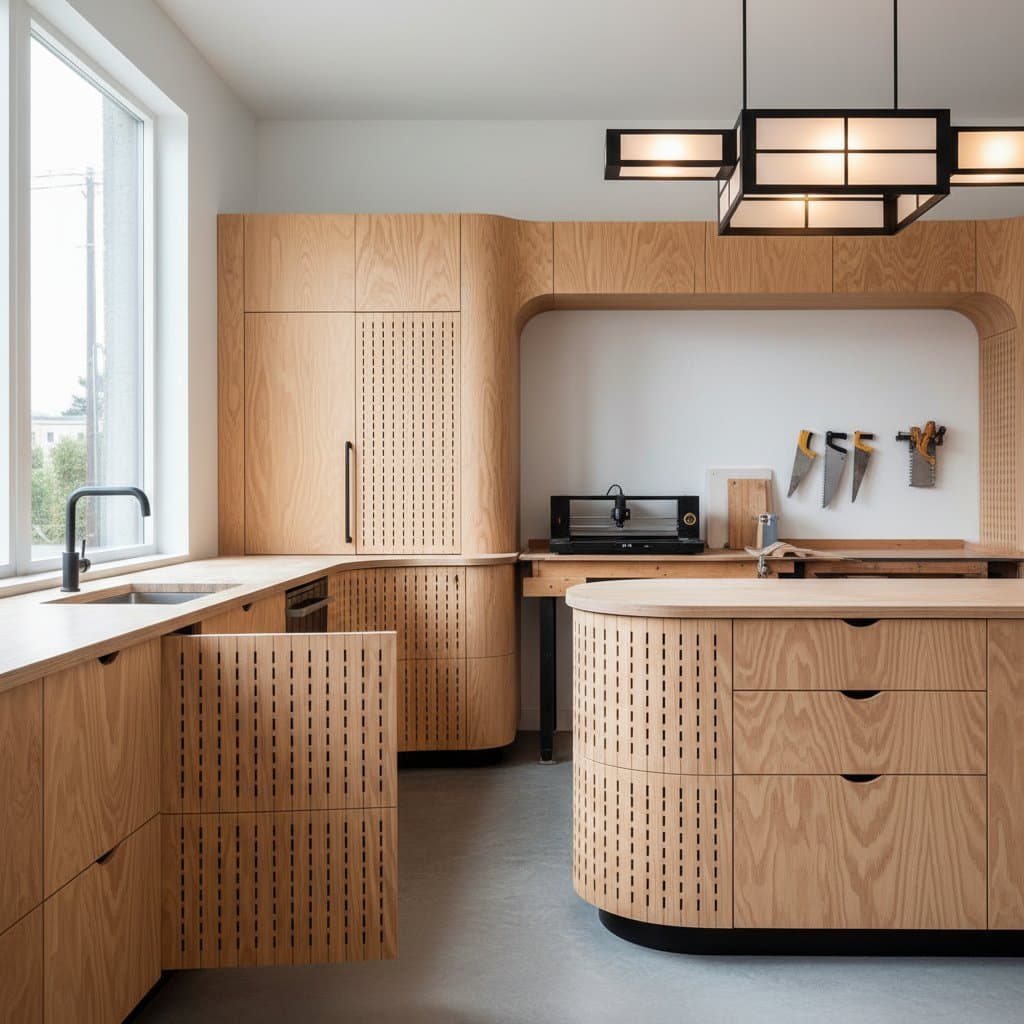
Bending Plywood Cabinets with Living Hinges
At a Glance
Location: Portland, Oregon
Size: 340 square feet (31.6 square meters) workshop
Design Team: Studio Alder Woodcraft
Photographer: Marco Lane
Before
Flat panels dominated the compact workshop. Cabinet edges formed sharp right angles, and joints followed rigid patterns. The layout lacked fluidity. Erin Hall, the owner and cabinetmaker, noted, "Everything felt boxed in. Corners interrupted the workspace, and light never seemed to move across the surfaces."
The primary challenge involved introducing organic movement while preserving structural precision. Hall envisioned cabinets that curved subtly around corners, easing transitions and improving access to tools. However, standard plywood resisted such bending without advanced methods.
After
The breakthrough arrived through living hinges integrated into plywood sheets. Narrow kerfs, cut precisely into the back of the material, enabled the wood to flex and conform like a supple fabric. This method revolutionized the entire layout. Rather than a linear array of base cabinets, the new configuration sweeps along the wall in a gentle arc, providing unobstructed views to the central workbench.
Photographs capture the evolution vividly. The curved door panels interact with daylight throughout the day, altering hues as the wood grain follows the contours. Upper cabinets project slightly from the wall, with undersides equipped with warm LED strips that trace the curve and banish dark pockets.
Hall observed, "Once we learned how to control the kerf spacing, the wood responded. It felt alive." The space now flows as a unified expanse, free from the isolation of separate units.
Design Details
- Material: 3/4-inch (19-millimeter) Baltic birch plywood, featuring a 1/8-inch (3-millimeter) face veneer to enhance flexibility.
- Kerf Pattern: Parallel incisions spaced 3/8 inch (9 millimeters) apart, each preserving 1/16 inch (1.5 millimeters) of uncut material.
- Finish: Matte water-based polyurethane, which delivers a subtle sheen and facilitates straightforward repairs.
- Lighting: Continuous LED tape mounted in aluminum channels to diffuse light evenly and minimize glare.
- Hardware: Concealed hinges engineered for curved applications, offering adjustments in three dimensions.
- Storage: Spacious drawers integrated below the cabinets, paired with shallow, contoured trays above the workbench for essential tools.
Craftsmen shaped each curve over a temporary jig with a 36-inch (91-centimeter) radius. After bending the plywood, they secured the form using glue and internal reinforcing ribs. Although the process demanded careful attention, it yielded reliable outcomes without relying on steam bending or intricate lamination techniques.
Key Takeaways
Why It Works
Living hinges introduce flexibility where rigidity once prevailed. Precise slotting converts stiff plywood into a pliable panel capable of tight radii or broad sweeps. The resulting cabinets weigh less yet maintain robust load-bearing capacity. Curved surfaces distribute light more effectively across the workspace, softening shadows and reducing visual strain.
How to Try It
Experiment with leftover plywood to gauge the technique before tackling a complete cabinetry project. Employ a table saw or CNC router for uniform kerf cuts. Start with broader intervals between slots, then refine the density to achieve smooth bending without splintering. Protect the front veneer at all times, as it serves as the aesthetic outer layer.
For modest undertakings like drawer faces or desk edging, a 24-inch (61-centimeter) radius proves effective. Apply sealant to the exposed kerf edges to block moisture infiltration. Affix a backing veneer post-bending to conceal the slots and ensure a seamless appearance.
Budget and Maintenance
Anticipate a 15 percent increase in costs over conventional flat-panel cabinetry, attributable to additional labor and jig fabrication. Installed pieces require minimal upkeep. The rounded profiles withstand impacts better than sharp edges, and unbroken lines simplify dusting and cleaning.
Experiencing the Curved Workspace
Curved cabinetry extends beyond visual appeal; it reshapes daily interactions within the environment. Reaches extend uninterrupted around bends, and illumination spreads uniformly to support focused work. The living hinge method illustrates how deliberate incisions and strategic planning can imbue plywood with the vitality of a dynamic material, elevating both efficiency and enjoyment.