
** Zero grams per liter, ensuring safe indoor use without ventilation concerns.
- Shelf Life: Up to one year in powder form; mix only what is needed, as it lasts one day once prepared.
- Coverage: One quart covers approximately 150 square feet (14 square meters), providing efficient use for medium projects.
- Finish Options: Delivers a matte surface by default; seal with natural oil or wax for added protection.
- Color Range: Includes classic whites, modern neutrals, and rich deep tones to suit diverse aesthetics.
These features make milk paint a reliable option for professional and hobbyist applications alike.
Contemporary Applications
Furniture companies integrate milk paint as a core element of their design philosophy. Open-grain woods such as oak and ash take up the paint unevenly, resulting in visual depth and subtle variations that enhance natural beauty. Tight-grained species like maple yield a smoother, more uniform appearance.
This versatility suits Scandinavian-style pieces, where clean lines meet sustainable materials. In kitchen and bathroom cabinetry, milk paint provides a subtle luster without the upkeep demands of chalk paint. Sealing with plant-based oil enhances water resistance and withstands everyday use.
Fabricators often apply it as a base coat, then sand edges lightly to expose underlying wood for a distressed effect. Homeowner Julia Reyes shared her experience: "We wanted our kitchen to feel grounded, not glossy." She collaborated with a local carpenter to refinish cabinets in pale sage milk paint. "The color feels alive in different light. It is calm in the morning and warm in the evening."
The Science Behind the Finish
Milk paint achieves its strength through a curing process that involves chemical bonding. Lime in the mixture reacts with casein protein to produce calcium caseinate, which hardens into a crystalline structure. This mineral layer adheres firmly to porous wood surfaces and resists chipping under proper application.
Unlike film-forming paints, milk paint permits wood to expand and contract with humidity fluctuations. This breathability prevents cracking and maintains structural integrity over time.
Sustainability defines the product from production to disposal. Ingredients source locally, reducing transportation emissions, and lightweight packaging minimizes waste. Disposal requires no special handling, as it generates no hazardous byproducts.
Applying Milk Paint in the Shop
Preparation
Prepare the surface thoroughly for optimal results. Clean the wood to remove dust and debris, then sand to 150 grit or finer. Ensure no oils or waxes remain, as they hinder adhesion. For existing finishes, scuff-sand lightly and apply a bonding agent if necessary.
Mixing
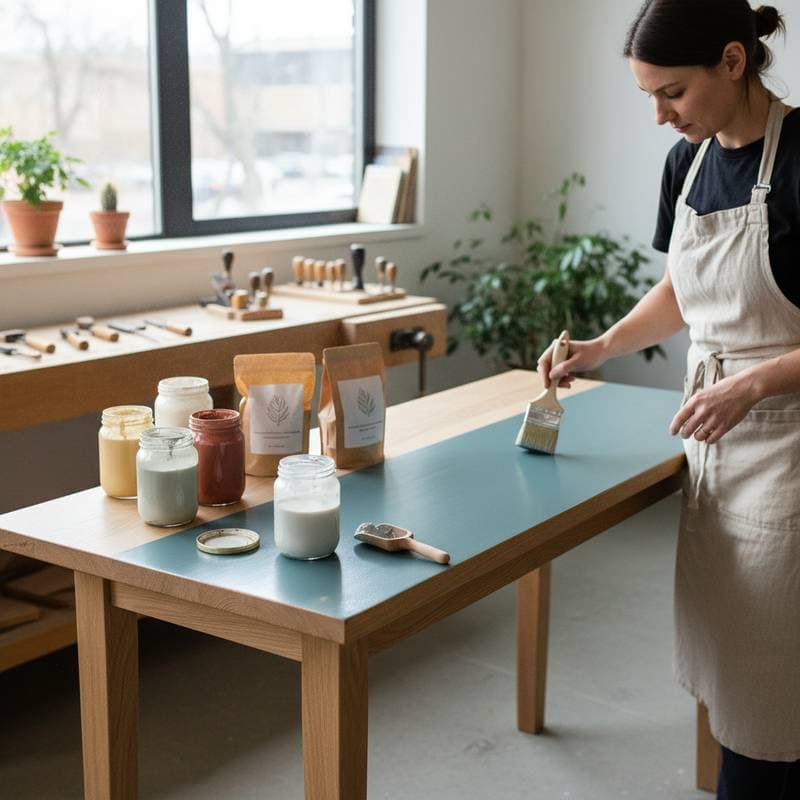
Measure one part powder to one part water by volume. Stir vigorously until fully dissolved, allow to rest for ten minutes, and stir once more. Strain through a fine mesh for spray applications. Aim for a consistency similar to light cream to ensure smooth handling.
Application
Use natural bristle or foam brushes for hand application, creating a traditional brushed effect. For larger surfaces, spraying provides even distribution. Work in sections due to the fast drying time, and keep a wet edge to avoid lap marks.
Finishing
After the first coat dries, sand lightly with 320 grit to address any raised grain. Add additional coats for opacity as required. Protect the surface by applying tung or hemp oil; for a satin sheen, buff with wax once the oil cures.
Cost and Efficiency
Expect to pay 20 to 25 dollars for a quart of milk paint powder, which covers 150 square feet (14 square meters). This pricing competes favorably with other VOC-free options, especially since unused powder stores without expiration. Efficiency improves through quick cleanup with soap and water, plus the absence of ventilation or disposal requirements.
Shops benefit from safer environments and reduced downtime, allowing focus on craftsmanship rather than safety protocols.
Trend Drivers in the Market
1. Health and Safety as Priority
Workshops prioritize materials that avoid toxins. Milk paint excludes formaldehyde, ammonia, and synthetic resins, aligning with this focus and promoting worker well-being.
2. Authentic Texture and Color
Current designs favor organic imperfections over polished uniformity. Milk paint's pigment distribution creates a layered, handcrafted appearance that bridges modern and classic styles.
3. Customization and Local Sourcing
Ease of tinting enables bespoke colors tied to local materials or client visions. This adaptability strengthens community-based manufacturing and reduces reliance on global supply chains.
4. Environmental Regulations
Stricter emissions rules compel shops to select compliant products. Milk paint surpasses these standards, simplifying adherence and future-proofing operations.
How to Try It at Home
Milk paint suits beginners due to its forgiving nature. Begin with a simple item like a stool or drawer front to build confidence.
- Test Color First: Prepare a small batch and apply to scrap wood. Note that colors lighten upon drying.
- Control Texture: Strain for smoothness and use a foam brush; opt for bristle brushes to retain visible strokes for rustic appeal.
- Seal Smartly: Apply natural oil for functional pieces or leave unsealed for display items.
- Layer Colors: Use two shades, then sand edges to uncover the base layer for added dimension.
These techniques allow personalization to match your project's style.
Key Takeaways
- Zero-VOC Advantage: Enhances air quality and fosters eco-friendly workspaces.
- Authentic Look: Provides depth, variation, and a pleasing matte tactility.
- Durability: Forms a chemical bond with wood to prevent peeling.
- Ease of Use: Requires only water for mixing and soap for cleanup.
- Design Flexibility: Adapts to styles from rustic farmhouse to sleek minimalist.
Living with the Finish
Milk paint matures gracefully, developing a patina that reflects use. Colors soften subtly, and high-touch areas acquire a natural sheen. This evolution enhances rather than diminishes appeal.
Maintenance involves regular dusting and periodic reapplication of oil or wax. Such care preserves the finish's integrity for years of enjoyment.