
Achieving Seamless Waterfall Edges with No-Miter Joinery
Clean lines and uninterrupted grain patterns characterize the waterfall edge as a signature element of contemporary cabinetry. Traditional approaches frequently use a 45-degree miter at the corner where the countertop or panel descends, but this seam interrupts the wood grain and invites chipping or misalignment from humidity shifts. Skilled woodworkers increasingly turn to no-miter joinery to preserve continuous grain while creating durable, stable corners. These methods produce an elegant appearance that resembles sculpture rather than simple assembly.
At a Glance
Project type: Custom kitchen island and base cabinetry
Location: Pacific Northwest
Size: 420 square feet (39 square meters)
Design team: Harris & Field Cabinet Studio
Photographer: Lila Chen
Before
The original kitchen included a large island covered in thick quartz. Its corners used standard miters that eventually showed fine cracks. Homeowners wanted to keep the crisp geometric shape but switch to a warmer material with fewer visible joints. "We liked the waterfall look but hated the constant maintenance," said homeowner Dana Rivera. "The seams needed refilling every few months." The design team developed a way to achieve a smooth visual flow without relying on fragile miters.
After
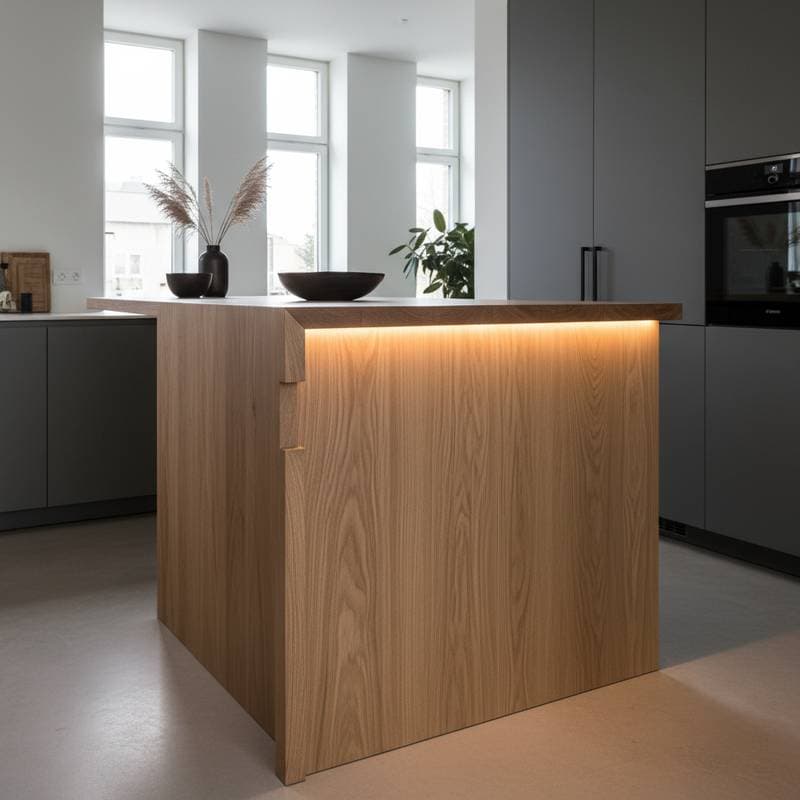
The updated island uses rift-sawn white oak panels that flow down the sides as one continuous piece. Instead of a standard miter, the corner features a shallow stepped lap joint. This design lets the vertical grain shift smoothly from the horizontal top to the vertical side, with the joint hidden along the back of the step. The result looks like a single solid wood block.
From everyday viewing angles, the grain runs without interruption across the top, down the leg, and to the toe kick. Photos reveal how light travels over the surface, highlighting the oak's fine rays and tall cathedrals. A low-sheen oil finish brings out the texture and maintains even color on all surfaces. "This no-miter corner handles wood movement from expansion and contraction effectively," said cabinetmaker Marcus Field. "It looks solid and holds up better over time."
Design Details
- Joinery: Stepped lap joint reinforced with hidden biscuits, offering a tight visual connection and room for wood to expand seasonally.
- Material: Rift-sawn white oak veneer over solid core panels, chosen and aligned for grain continuity across a 9-foot (2.7-meter) length.
- Finish: Hand-rubbed oil and wax blend that emphasizes texture and provides depth.
- Lighting: Integrated LED strips at 3000K for warm, neutral illumination.
- Organization: Deep drawers with full-extension soft-close slides, fronts matched to the overall grain pattern.
- Edge detail: 1/8-inch (3-millimeter) eased radius on edges to avoid chips and soften light bounce.
Key Takeaways
Reasons to Avoid Miters
Standard miters require precise angles and materials that resist dimensional changes. Small humidity variations can lead to gaps or mismatched grain. No-miter techniques focus on overlapping or interlocking parts rather than cut edges, reducing the chance of failure and simplifying clamping during assembly. Builders can preserve long grain runs from single boards, which boosts the piece's unity.
Grain Matching as a Core Principle
Continuous grain signals high-end custom work. It reflects careful planning and hands-on attention. Select panels from one flitch to carry the wood's story across multiple faces. Use this technique for kitchen islands, tall pantry stacks, and bathroom vanities with visible sides.
Finishing for Uniformity
Oil finishes work well with no-miter builds because they penetrate evenly into face and edge grains. Film finishes can accentuate joints or create uneven shine. Aim for consistent sheen and check color variations on connected surfaces before final assembly.
Lighting's Role in Enhancing Form
Grazing light on waterfall faces reveals any flaws. Plan lighting early, positioning beams to skim surfaces gently. Use low-placed warm washes to emphasize the grain's downward flow and hide minor transitions.
Steps for Woodworkers
- Build full-scale templates to confirm grain direction before making cuts.
- Conduct dry fits and mark alignments, since no-miter joints allow little correction after glue.
- Finish panels before joining to ensure even color.
- Reinforce corners with splines or biscuits away from visible areas.
Everyday Benefits of the Design
Homeowners find that the new island changes routine kitchen tasks. Surfaces wipe clean without catching on seams, and the oak flow feels like standalone furniture rather than fixed cabinetry. "It adds calm to the room now," said Rivera. This project shows how precise engineering improves daily use while preserving simplicity.