
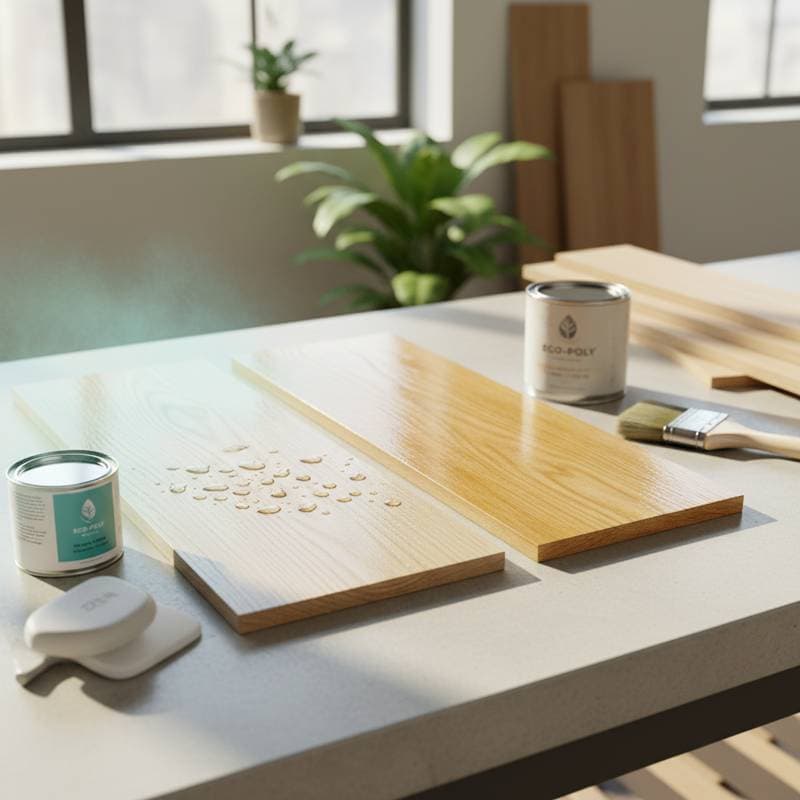
Why Waterborne Polyurethane Outperforms Oil-Based Finishes for Wood Projects
Wood projects require finishes that protect surfaces, enhance grain patterns, and align with environmental priorities. Waterborne polyurethane emerges as a preferred option for woodworkers, furniture builders, and homeowners seeking robust performance without exposure to harsh chemicals. This finish provides exceptional clarity, longevity, and minimal odor, meeting contemporary expectations for quality and sustainability.
At a glance:
| Feature | Waterborne Polyurethane | Traditional Oil-Based Finish |
|---|---|---|
| VOC Level | 50 to 150 g/L | 350 to 500 g/L |
| Dry Time | 2 to 4 hours per coat | 8 to 24 hours per coat |
| Cleanup | Soap and water | Mineral spirits |
| Odor | Very low | Strong chemical smell |
| Clarity | Clear to slightly amber | Deep amber tone |
| Typical Cost | $45 to $80 per gallon | $40 to $70 per gallon |
Key Differences in Waterborne Polyurethane
Waterborne polyurethane employs water as its main carrier, diverging from petroleum solvents in traditional formulas. The resin develops a durable film, but curing occurs through water evaporation rather than substantial volatile organic compound release. This approach transforms operations in finishing environments.
A gallon of waterborne polyurethane typically holds about 100 grams of VOCs per liter, compared to over 400 grams in oil-based variants. Reduced VOCs result in fewer emissions, lower ecological burden, and simpler adherence to indoor air quality guidelines.
The formulation enhances transparency as well. Oil-based products often yellow with age, particularly in sunlight. Waterborne options remain almost colorless, preserving the vibrancy of light woods such as maple, birch, and ash. For darker woods like walnut or mahogany, apply a tinted sealer beforehand to introduce desired warmth.
Mechanism of effectiveness: Smaller resin particles in waterborne polyurethane merge during curing to create a compact, wear-resistant film comparable to solvent-based durability. Water evaporates cleanly, yielding a protective coating free of trapped vapors.
Practical step: Test waterborne polyurethane on scrap wood when transitioning from oil-based products. Grain raising may occur after the initial coat; sand lightly with 220-grit paper before proceeding.
Durability Under Real-World Conditions
Early concerns about waterborne finishes centered on longevity, yet current versions bridge that divide. Laboratory evaluations indicate that premium waterborne polyurethane withstands scratches at levels within 10 percent of leading oil-based counterparts. In everyday settings, performance distinctions prove negligible.
Standard metrics include:
- Abrasion resistance: 85 to 90 on the Taber scale for waterborne, versus 90 to 95 for oil-based.
- Hardness (pencil scale): H to 2H for waterborne, HB to H for oil-based.
- Moisture resistance: Equivalent results in 24-hour water spot assessments.
These specifications apply directly to practical scenarios. A waterborne coating on a kitchen table endures routine handling, wiping, and spills without haze or delamination. For floors, three applications sustain protection for 7 to 10 years, requiring only minor buffing and renewal.
Mechanism of effectiveness: Crosslinking in polyurethane resin, whether water- or solvent-dispersed, solidifies the finish. Waterborne types incorporate coalescing agents that form robust polymer structures at ambient temperatures, ensuring hardness without extended drying.
Practical step: Permit at least two hours between coats in average humidity. Use three coats for furniture and four for floors. Limit sanding to light passes, as the build-up occurs rapidly.
Advantages for Health and the Environment
Substituting waterborne for oil-based polyurethane per gallon reduces VOC emissions by approximately 3 pounds. This reduction proves significant in confined workshops or residences with restricted airflow.
Low-VOC products facilitate compliance with local air standards and sustainable construction credentials. Certifications like GREENGUARD and Green Seal endorse waterborne polyurethane for minimal emissions. The absence of flammable solvents also lowers fire hazards.
Home applicators experience prompt benefits. Coatings apply without necessitating extended evacuation of living spaces. Odors dissipate quickly, and cleanup involves water plus mild soap, enhancing safety for households, animals, and those prone to chemical sensitivities.
Mechanism of effectiveness: Water serves as a non-toxic diluent for resin viscosity. Post-application, evaporation occurs without pollutant discharge, achieving clarity while supporting ecological objectives.
Practical step: Employ a box fan and open windows for 30 minutes following application. Air movement aids even curing, even with low-VOC formulations.
Streamlined Application Processes
Adopting waterborne systems alters more than composition; it accelerates production schedules. Coats dry in 2 to 4 hours, enabling multiple applications daily and shortening project timelines.
Delivery methods include brushing, rolling, or spraying. High-volume low-pressure (HVLP) setups optimize efficiency, minimizing material use and yielding even surfaces. For spraying, select a 1.3 to 1.5 mm tip at 25 psi for uniform distribution.
Essential preparation sequence:
- Surface preparation: Sand to 180 grit for furniture, 120 grit for floors.
- Dust elimination: Vacuum thoroughly, followed by a damp cloth wipe.
- Initial coat: Spread thinly and uniformly; dry for 2 to 4 hours.
- Inter-coat sanding: Employ 220 grit to address grain elevation.
- Subsequent coats: Maintain even application with consistent overlaps.
- Final curing: Allow 48 hours before subjecting to heavy use.
Mechanism of effectiveness: Rapid setting and simple maintenance halve labor demands. Small operations double output weekly by bypassing prolonged solvent evaporation.
Practical step: In high-humidity areas, operate a dehumidifier to hold relative humidity at 50 percent. Controlled conditions accelerate drying and avert bubbling.
Evaluating Costs and Efficiency
Waterborne polyurethane ranges from $45 to $80 per gallon by brand and finish level. Oil-based equivalents fall between $40 and $70. Initial expenses may exceed slightly, but savings in solvents, ventilation, and time offset the difference.
Project cost examples:
- Dining table (60 square feet): One quart suffices, costing $15 to $20.
- Hardwood floor (500 square feet): 2.5 gallons cover the area, at $120 to $160.
- Cabinet set (100 square feet): One gallon applies, for $50 to $70.
Coverage reaches 400 to 500 square feet per coat per gallon. Accelerated drying permits three coats in a single day, counterbalancing material outlay.
Essential investments: Choose synthetic brushes or spray tips designed for water-based products. Inferior natural bristles retain moisture, leading to uneven results.
Efficiency tips:
- Deploy gravity-fed HVLP sprayers to cut overspray by 25 percent.
- Seal remnants in airtight plastic to avoid skinning.
- Process in groups to consume cans before their one-year shelf life expires.
Practical step: For extensive work, assess material and time efficiencies. Reduced drying intervals lower operational costs, boosting profitability while upholding standards.
Suitability for DIY and Professional Applications
Waterborne polyurethane accommodates novice hobbyists and seasoned applicators alike. The process demands moderate expertise, with errors readily rectified.
For DIY users:
- Required skill: Moderate
- Equipment: Synthetic brush, foam roller, or optional HVLP sprayer
- Duration: One day for compact furniture, two for extensive floors
- Post-application: Rinse with water and detergent
For professionals:
- Expedited schedules for volume production
- Simplified regulatory adherence
- Uniform coloration in bulk applications
Assess project scale and airflow when choosing self-application or expert services. A modest table suits independent efforts. Vast floor areas exceeding 1,200 square feet benefit from specialists equipped for seamless integration.
Mechanism of effectiveness: The formula self-levels and minimizes stroke marks, tolerating novice techniques while satisfying expert criteria.
Practical step: Indoor spraying requires a respirator for organic vapors and particulates. Atomized droplets, despite low VOCs, warrant respiratory protection.
Avoiding Typical Application Pitfalls
Finishes present specific challenges. Sidestepping these ensures flawless outcomes.
- Excessive brushing: Repeated passes introduce bubbles; apply once and allow leveling.
- Neglecting inter-coat sanding: Uneven grain persists through top layers.
- Overly thick applications: Layers retain moisture, risking cloudiness.
- Inadequate preparation: Contaminants hinder adhesion.
- Suboptimal conditions: Temperatures under 60 degrees Fahrenheit delay curing and impair transparency.
Remedies:
- Sand minor bubbles with 320-grit after drying, then reapply.
- Counter white haze by boosting ventilation and warmth to expel residual water.
Practical step: Monitor humidity with a hygrometer. Consistent levels mitigate defects and refine drying estimates.
Long-Term Care for Finished Surfaces
Cured waterborne polyurethane demands little upkeep. Wipe with a damp microfiber cloth and soap solution. Steer clear of ammonia products that erode gloss.
Renewal skips full abrasion if integrity holds. Scuff gently with 320-grit, clean, and add a single coat. High-traffic floors refresh every 7 to 10 years.
Essential Benefits Summary
Waterborne polyurethane slashes VOCs by up to 75 percent relative to oil-based alternatives. Drying times halve project durations. Care involves straightforward renewal and non-toxic maintenance, delivering enduring value for wood preservation.