
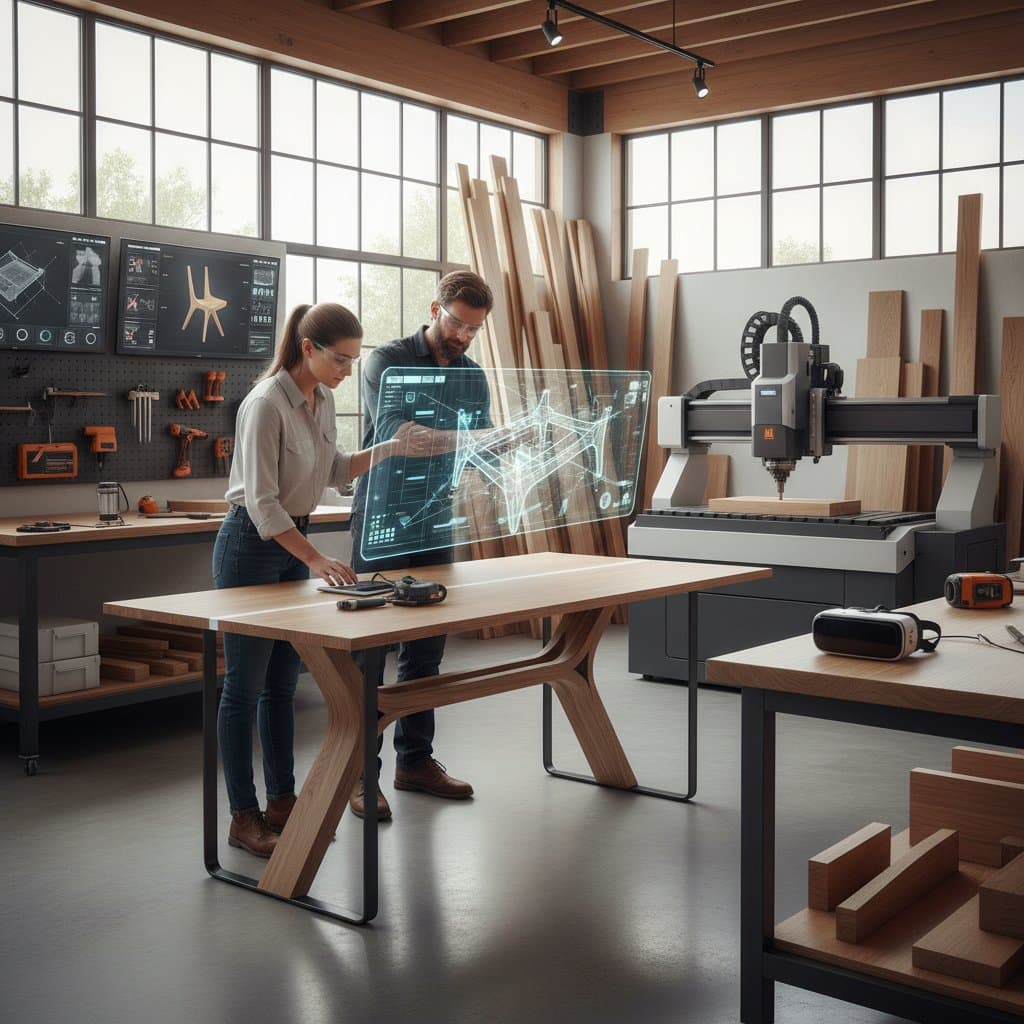
DIY Parametric Furniture: AI Crafts Custom Wood Designs
A single chair design often requires weeks of manual refinement. AI-driven parametric tools allow adjustments to shape, strength, and material thickness in mere minutes. The outcome consists of custom furniture that fits the intended space precisely while preserving the creator's unique vision.
Consider the traditional woodworking process, where each iteration involves sketching, measuring, and testing physical prototypes. This method demands significant time and resources. Parametric design, enhanced by artificial intelligence, shifts this paradigm by enabling rapid iterations through digital models. Woodworkers retain control over essential elements such as materials, finishes, and joinery techniques. The technology accelerates exploration of forms and incorporates data-driven refinements, eliminating reliance on intuition alone.
This integration of AI supports both novice and experienced makers. Beginners gain access to professional-level precision without extensive training. Seasoned woodworkers discover efficiencies that enhance productivity. The result fosters greater creativity, as time saved on technical aspects allows focus on artistic expression.
How AI Shapes Parametric Furniture Design
Parametric design relies on adjustable parameters to define structures. Examples include height specifications, curve radii, or joint spacings. Modifying a single parameter triggers immediate updates across the entire model. Artificial intelligence elevates this capability by proposing optimized patterns that address strength, weight reduction, or material efficiency.
Imagine designing a bookshelf. An AI-assisted platform evaluates the plywood thickness and recalibrates slot widths for optimal fit. It simulates load distribution to identify and reinforce potential weak points. Established programs such as Grasshopper, Fusion 360, and Rhino incorporate AI extensions. These tools generate recommendations tailored to user preferences, drawing from vast datasets of successful designs.
The core advantage lies in adaptability. A completed digital model serves as a foundation for scaling to various room dimensions or material types, eliminating the need for complete redraws. This approach conserves time, minimizes material waste, and ensures structural integrity remains consistent in all variations. Woodworkers achieve professional results with reduced trial and error.
For instance, consider a parametric table base. Adjusting the leg angle for stability prompts the AI to recalculate cross-bracing requirements. The system also suggests material substitutions, such as swapping oak for birch to balance cost and durability. Such features democratize advanced design, making it accessible beyond specialized workshops.
Action step: Select a free parametric modeling tool and experiment with one variable, such as thickness or curvature. Observe the model's response to understand how minor alterations impact the overall form. This hands-on trial reveals the power of parametric adjustments in real time.
Costs and Budget
Parametric furniture projects exhibit wide cost variations based on project scale, selected materials, and available tools. Understanding these factors enables effective budgeting from the outset.
Software represents the initial investment. Free options suffice for basic modeling, while advanced AI plug-ins or cloud-based computations range from $100 to $300 annually. Materials typically cost between $60 and $600, encompassing plywood sheets, medium-density fiberboard panels, or solid hardwood selections. Fabrication expenses, particularly when outsourcing to CNC services, fall between $30 and $200 depending on complexity and local rates. Finishing supplies, including sealers, stains, and sandpaper, add $40 to $100 to the total.
Beginners benefit from starting with open-source software and hand-cut prototypes to build familiarity. As proficiency grows, investing in paid AI tools accelerates modeling and simulation processes. Prioritize material quality to avoid setbacks. Inferior plywood frequently warps or delaminates under load, undermining the precision advantages of parametric methods.
Budgeting extends beyond direct costs. Factor in time savings, which offset expenses through faster project completion. A parametric workflow might reduce design time by 80 percent, allowing completion of multiple pieces within the timeframe of one traditional project. Track investments in tools as long-term assets that appreciate in value with repeated use.
For a sample project, a simple parametric stool using plywood and basic AI software totals around $150. Scaling to a full dining set increases costs to $800, yet the digital efficiency justifies the outlay through customizable outputs.
Action step: Maintain separate records for each expense category. This practice highlights areas where digital tools offset costs in materials or machining, informing future decisions.
Common Mistakes to Avoid
Parametric furniture designs risk failure without attention to essential details. Recognizing these pitfalls ensures successful outcomes.
One frequent error involves overcomplicating parameters. Introducing more than five adjustable values early on leads to model instability and unpredictable results. Limit variables to essential elements, gradually incorporating complexity as confidence builds.
Another oversight occurs when ignoring material constraints. AI recommendations occasionally overlook factors like wood grain direction or screw pull-out strength. Always verify designs against established woodworking principles to maintain realism.
Neglecting joinery clearance proves problematic as well. Digital models assume perfect fits, yet actual wood expands and contracts with environmental changes. Incorporate at least 0.2 millimeters of tolerance in tight joints to accommodate these dynamics.
Finally, skipping dry fits invites assembly issues. Even precise CNC cuts can vary due to tool wear or humidity fluctuations. Assemble components without adhesives first to detect interferences.
Addressing these mistakes enhances reliability. For example, in a parametric cabinet design, accounting for grain alignment prevents splitting during use. Such diligence transforms potential failures into durable creations.
Action step: Produce a scale paper model before committing materials. This low-cost method visualizes proportions and identifies interferences, preventing waste.
Integrating Parametric Designs into Daily Use
AI-driven parametric furniture empowers adaptation to personal spaces and needs. Resize a workbench to suit a compact shop or modify bookshelf heights for irregular ceilings. The workflow becomes intuitive over time, with each project informing the next.
This technology extends beyond initial creation. Update designs seasonally, such as adjusting outdoor furniture for weather variations. The digital library of models facilitates quick modifications, supporting evolving lifestyles.
Ultimately, parametric AI fosters a cycle of innovation in woodworking. Makers produce pieces that blend functionality with personalization, enhancing living environments. The precision and speed unlock creative potential, turning ideas into reality with minimal barriers.