
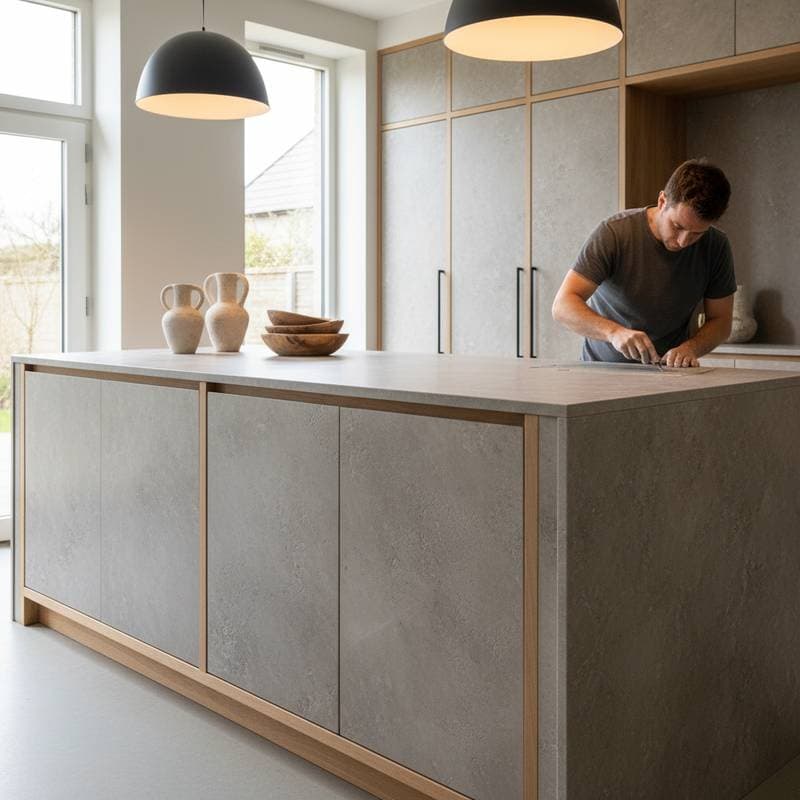
Venetian Plaster on Wood: Achieving a Stone-Like Finish
Venetian plaster extends beyond traditional walls to enhance wood surfaces. This lime-based finish now adorns cabinetry, furniture, and millwork, creating a stone-like appearance with a silky texture. Woodworkers and designers achieve high-end results without modifying joinery or proportions.
Project Overview
Client: Homeowner
Location: Pacific Northwest residence
Size: 2,800 square feet (260 square meters)
Design Team: Studio Aalto Design and Finishworks Woodcraft
Photographer: Lina Torres
The team addressed a request to retain wood's warmth while adding plaster's subtle depth. They combined Venetian plaster with a custom primer for hardwood adhesion. This approach transformed a built-in library into a matte, light-shifting surface.
Before the Application
The original oak shelves featured a standard stain that appeared reddish and glossy. The space lacked contrast and absorbed light, creating a heavy feel. The homeowner sought a tactile, calming finish that softened the grain without fully concealing it.
Adhesion posed the main challenge, as Venetian plaster suits mineral surfaces rather than wood's organic nature. Wood's movement risked cracking, and its smoothness repelled lime products. The team developed a flexible bridge to allow the plaster to breathe.
After the Transformation
The finish resembles pale limestone with a velvety quality. Light glides across it softly, and trowel marks introduce subtle movement. Wood grain subtly emerges from certain angles, adding layered character. The team applied a micro-aggregate plaster in warm gray.
The lead designer noted, "The aim was to impart an architectural quality to the wood, not imitate stone. Venetian plaster provides depth unmatched by paint or stain." This finish connects the library to the plastered dining room walls, fostering a serene, gallery atmosphere.
Application Details
- Preparation: Sanded oak veneer sealed with breathable bonding primer
- Base Layer: Flexible lime-cement plaster with acrylic modifier
- Finish Layer: Fine-grain Venetian plaster burnished with stainless trowel
- Protection: Matte mineral wax, buffed for controlled reflection
- Tint: Custom warm gray and ivory blend
- Thickness: About 1 millimeter (0.04 inch)
- Illumination: 2700 K LED strips to highlight texture
The result offers durability against minor scuffs, with touch-ups via polishing rather than repainting. Its breathability prevents moisture trapping, unlike polyurethane. The library now balances soft reflectivity for both day and evening use.
Benefits of the Technique
This method merges carpentry precision with masonry depth, suiting tactile minimalism trends. It provides luxury without gloss and uses low-VOC lime materials for sustainability. Woodshops gain a premium service for custom cabinetry, tables, and panels, with strong margins over staining.
Step-by-Step Process
The technique involves adhesion preparation, layered application, and polishing for endurance.
Adhesion Preparation
Ensure wood is dry, clean, and textured. Apply mineral bonding primer for micro-anchoring between fiber and plaster. For expansive areas, embed fiberglass mesh in the initial coat to avert cracks.
Layered Application
Build layers under 0.5 millimeter (0.02 inch) each. Spread with flexible trowel in consistent arcs. Cross-hatch the second layer for density. Allow one-hour rests between coats at stable humidity to prevent issues.
Polishing Finish
Burnish to compress lime crystals, sealing pores naturally. This yields a soft, low-sheen surface resistant to dirt. Apply beeswax or mineral wax as the final seal.
A skilled artisan covers 40 square feet (3.7 square meters) daily. For furniture, extend the finish over edges for a seamless effect.
Featured Installations
Coastal Retreat, California
Design: Studio Maree Interiors
Contractor: Pacific Surface Lab
Feature: Plastered walnut veneer on kitchen island
Advantage: Softens wood tone to complement marble counters, conceals fingerprints, and diffuses light in open kitchens.
Urban Loft, Chicago
Design: Rho Architects
Contractor: Brick and Board Finishes
Feature: Taupe-toned plastered oak stairs
Advantage: Matte texture warms glass elements, absorbs sound, and withstands wear.
Mountain Cabin, British Columbia
Design: Fieldline Studio
Contractor: Timbercraft Finishing
Feature: Lime-plastered cedar bedroom panels
Advantage: Evokes hand-carved organic feel with mineral scent and serene light reflection.
These examples show how color and texture adapt the finish to various moods, from airy pale tones to grounding darks.
Underlying Chemistry
Lime putty in Venetian plaster carbonates during drying, forming hard calcium carbonate crystals and reabsorbing CO2. On wood, acrylic modifiers ensure flexibility against movement. The high pH resists mold naturally.
Additives like mica, marble dust, or oyster shell introduce shimmer. Iron oxide tints replicate travertine or limestone effects.
Enhancing with Light
Grazing light accentuates plaster's shadows and texture. Use 2700 K to 3000 K LED strips under shelves or ceilings, paired with ambient sources. Maintain a 3-inch (7.6 centimeter) setback for even illumination without glare.
Warm light intensifies grays; cool light emphasizes texture. Test samples under intended lighting for accurate results.
Care and Longevity
The wax seal resists spills, though avoid prolonged wetting. Clean with soft cloth and pH-neutral solution. Buff minor scratches with fine steel wool and rewax.
In commercial spaces, add an extra sealer for protection. Micro-polymer glazes on high-contact areas preserve aesthetics while improving cleanability.
Investment Overview
- Materials: $8 to $12 per square foot ($86 to $129 per square meter)
- Labor: $10 to $18 per square foot ($107 to $194 per square meter)
- Total: $18 to $30 per square foot ($193 to $322 per square meter)
- Timeline: 3 to 5 days for medium projects
This pricing suits statement features like islands or surrounds, offering value over veneers or paints.
Implementing in Your Workshop
Begin with sample boards to assess adhesion and feel.
- Prime sanded wood with mineral bonding primer.
- Apply thin, flexible lime plaster.
- Burnish during drying.
- Seal with mineral wax or oil.
- Test under project lighting.
Suppliers provide training and wood-suited plaster batches. Flexible trowels and burnishing pads ensure uniformity.
Practical Considerations
Round edges to avoid chipping. Control temperature and humidity during work. Avoid outdoor use without special sealers.
Repairs demand expertise, and variation signals craftsmanship. Discuss expectations for non-uniform factory looks.
Essential Insights
Proper primers enable Venetian plaster to adhere to wood, yielding stone-like tactility for elevated designs. Lime's natural properties support sustainability. Strategic lighting reveals depth. Moderate costs deliver substantial upgrades.
This finish aligns with trends in quiet, sensory materials, uniting woodworking and masonry crafts.
Daily Experience
The homeowners describe the library as grounded yet bright, ideal for reading under soft light. The finish invites touch, evolving with light and seasons. It rewards close inspection with subtle, enduring elegance.