
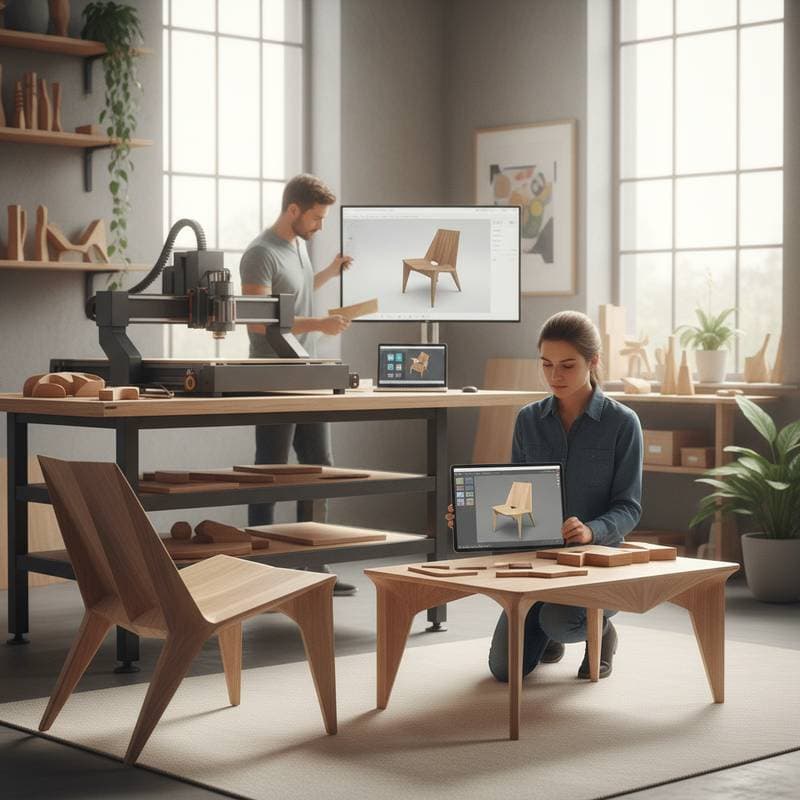
Parametric Design Revolutionizes DIY Custom Furniture
Woodworkers once spent hours sketching curves on plywood sheets. Today, algorithms produce countless unique chair outlines in mere minutes. Parametric design, previously limited to fields like architecture and aerospace, now enhances small workshops and home setups. This approach allows adjustments to table heights, leg angles, or storage configurations for irregular spaces without starting over.
How Parametric Design Integrates with Modern Woodworking
Conventional woodworking relies on static blueprints. Designers create a plan, then execute it. Parametric design establishes interconnected variables, so alterations to one element automatically update the entire structure. For instance, a bookshelf's overall height could connect to individual shelf intervals and required fasteners. Modify the height, and the software recalculates spacing and components accordingly.
Grasshopper, a visual scripting add-on for Rhino 3D, serves as an accessible starting point. It employs draggable nodes and adjustable sliders rather than written code. Users link shapes, equations, and material properties into an interactive framework. Sliding a control reshapes the model in real time. This adaptability aligns with the trial-and-error approach favored by many hobbyist builders.
Beyond digital creation, parametric tools generate accurate paths for CNC routers, laser engravers, and custom jigs. Benefits include superior precision and consistent results. Scale a design from a compact stool to a full bench without remeasuring or introducing errors.
To illustrate, consider designing a parametric trestle table. Set variables for tabletop width, leg spread, and brace thickness. Alter the width to fit a new room, and the legs adjust proportionally while maintaining stability ratios. Export the updated files directly to your CNC machine for seamless production.
Action Step: Begin with a basic parametric exercise, such as a simple stool or wall-mounted shelf. Establish three key variables: height, material thickness, and leg inclination. Observe how a single adjustment propagates through the model to reveal interconnected changes.
Costs and Budget Considerations
Entry-level setups for DIY enthusiasts typically range from $150 to $400. This budget includes essential software and introductory tutorials. Advanced configurations with integrated CNC equipment may climb to $1,000 through $1,200, accounting for accessories like cutting bits and securing clamps.
Detailed cost breakdown:
- Software: Grasshopper comes free with a Rhino license, priced at approximately $300 for non-commercial or educational purposes.
- Hardware: Entry-level desktop CNC routers begin around $600. Laser cutting systems often exceed this threshold.
- Materials: Sheets of Baltic birch plywood or select hardwoods cost $80 to $150 each.
- Learning investment: Dedicate 10 to 15 hours to tutorials on parameter manipulation and file output.
Optimize expenses by prototyping digitally first. Test scaled-down versions using inexpensive cardboard or medium-density fiberboard (MDF) prior to committing to premium hardwoods. Verify joint alignments in the virtual environment to sidestep material losses. Initial prototypes often reveal tweaks that save significant resources.
For example, a novice might simulate a cabinet door assembly. If virtual fits show interference, refine parameters before purchasing lumber. This method routinely prevents $100 or more in scrap from early errors.
Action Step: Define a budget for your inaugural project. Assign half to raw materials, one-quarter to software acquisition, and the remaining quarter to tools or educational resources. Select projects completable over a single weekend to build momentum.
Common Pitfalls in Parametric Furniture Projects
Experienced woodworkers encounter challenges when transitioning to parametric methods. Issues frequently arise in scaling, data management, and equipment preparation.
Key pitfalls to avoid:
- Excessive complexity in models. Novices tend to interconnect too many parameters, leading to computational glitches. Maintain simplicity in initial designs to ensure reliable outputs.
- Overlooking material thickness. Joint designs in parametric systems require exact thickness inputs. Use calipers to measure stock accurately before finalizing cuts.
- Omitting tolerance allowances. CNC operations involve minor offsets. Incorporate at least 0.1 inch of clearance for mating components to guarantee smooth assembly.
- Disregarding wood grain orientation. Digital tools do not account for natural grain patterns, yet physical strength depends on them. Manually adjust part orientations in layouts to maximize durability.
- Compromising on safety protocols. Secure workpieces thoroughly during machining. Automated paths can shift unexpectedly if fixtures loosen.
These errors often extend project timelines by hours. Develop a robust process to mitigate them. Run virtual simulations of tool movements, followed by scaled prototypes, before committing to full-scale builds.
A practical example involves a parametric joinery system for drawers. If tolerances prove too tight in simulation, widen gaps incrementally. Test on scrap pieces to confirm fit before production runs.
Action Step: Create a digital verification checklist covering parameter limits, stock measurements, and machining offsets. Review it systematically prior to generating any output files.
Essential Resources for Parametric Woodworking
Several tools and references accelerate mastery of parametric techniques. Rhino 3D with Grasshopper provides a robust foundation for beginners. Fusion 360 offers an alternative with built-in parametric features and free access for hobbyists.
Online communities, such as woodworking forums and software-specific groups, share parametric scripts and troubleshooting tips. Video series on platforms like YouTube demonstrate node connections for common furniture elements, from dovetails to mortise-and-tenon joints.
For visual guidance, sketchbooks of parametric iterations help track design evolutions. Maintain a library of reusable components, like adjustable leg sets or modular shelving units, to streamline future projects.
Incorporate these elements to build confidence. Experiment with open-source parametric files available in maker repositories to dissect and adapt successful models.
Achieving Professional Results with Parametric Tools
Parametric design elevates DIY furniture from standard replicas to tailored masterpieces. It saves time on revisions, reduces errors in execution, and unlocks creativity through endless variations. Woodworkers gain the ability to respond to client needs or personal preferences with speed and assurance.
Ultimately, this technology democratizes high-end customization. Hobbyists produce items rivaling commercial workshops, all from a home bench. Embrace parametric workflows to expand your capabilities and enjoy the satisfaction of precise, one-of-a-kind creations.