
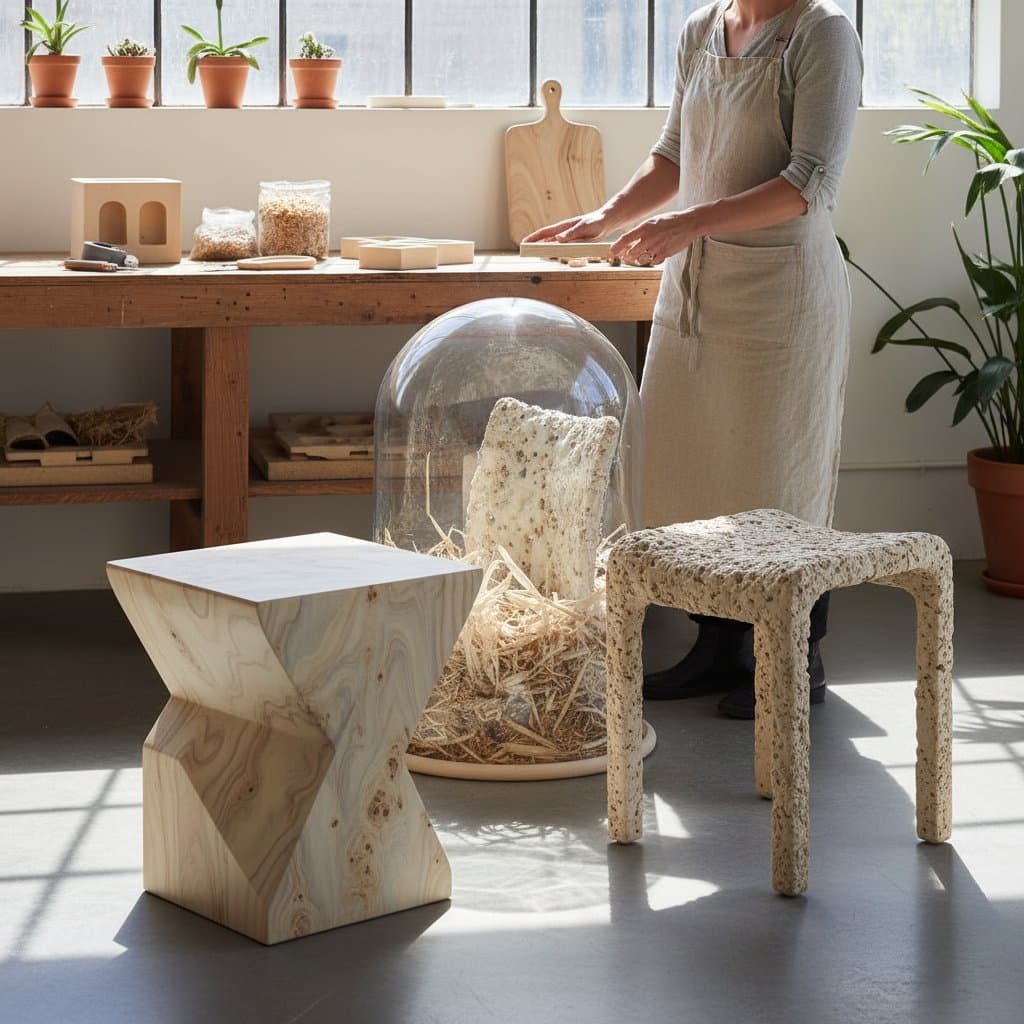
Grow Your Own Wood: Mycelium's DIY Furniture Shift
The next wave of sustainable furniture emerges not from sawmills or factories, but from controlled growth processes. Mycelium, the root-like network of fungi, reshapes approaches to materials like wood, foam, and plastic. Makers now view this bio-based option as a viable alternative for circular design, emphasizing cultivation over resource extraction to transform waste into durable forms.
At a Glance
Participants: Independent makers, small design studios, and DIY furniture builders
Locations: Global workshops focused on bio-based materials
Project Scales: From compact 18-square-inch (116-square-centimeter) stools to full 48-inch (122-centimeter) tables
Key Contributors: Ecovative Design, Mogu, and open-source maker groups
Visual Documentation: Studio Mogu and Ecovative Labs
Traditional Challenges
Conventional woodworking involves cutting, joining, and finishing solid or composite woods. These steps generate material waste, demand significant energy, and often yield inconsistent results. Foam and resin fillers provide lightness yet depend on petroleum sources, while sourcing reclaimed or responsibly harvested timber proves expensive and unreliable for small operations.
Furniture designer Lina Torres highlighted supply issues as her primary obstacle. "I wanted low-impact material that behaved like wood but grew from waste. Mycelium felt like a living workshop partner," she said.
The Mycelium Process
Mycelium furniture inverts traditional methods by beginning with a mold rather than a pre-formed board. Agricultural byproducts such as sawdust, hemp hurds, or straw mix with mycelium spores and pack into forms. Within a few days, the fungus binds the substrate into a cohesive mass; subsequent heating halts growth and strengthens the structure.
The outcome resembles a pale, fibrous wood composite with a soft, cloud-like texture and subtle striations from the mold. Edges sand or seal similarly to plywood, achieving densities comparable to pine at 30 to 40 pounds per cubic foot (480 to 640 kilograms per cubic meter), based on substrate choice and growth duration. Studio lighting accentuates the material's gentle light diffusion, creating a tactile warmth distinct from glossy finishes.
"It feels warmer than plastic, lighter than wood, and more personal because you grew it," Torres noted.
Design Specifications
- Substrate Composition: Sawdust, coffee grounds, flax shives, or hemp hurds blended with mycelium spores
- Growth Duration: 4 to 10 days, influenced by temperature and humidity
- Curing Method: Heat treatment at 180 to 200 degrees Fahrenheit (82 to 93 degrees Celsius), followed by optional sealing with natural wax or plant resin
- Density: 30 to 40 pounds per cubic foot (480 to 640 kilograms per cubic meter)
- Required Equipment: Basic molds, breathable fabric liners, and a convection oven or dehydrator
- Storage Conditions: Maintain dryness to avoid unintended regrowth
- Application Suitability: Ideal for indoor furniture, decorative panels, or reinforced structural elements
Broader Implications
Mycelium addresses demands for reduced industrial waste and lower energy consumption. Unlike engineered woods, it avoids formaldehyde adhesives and high-pressure processing. The material repurposes agricultural residues that would otherwise decompose or incinerate, with low entry costs for small workshops through reusable molds and simple plastic containers.
Beyond sustainability, the approach fosters creative innovation. Designers cast fluid, organic shapes unattainable with solid wood, while hollow interiors minimize material and weight. Experimentation thrives in this hands-on method.
Getting Started at Home
No specialized laboratory is necessary; patience, clean containers, and a dedicated workspace suffice. Follow these steps for initial projects.
- Gather Substrate: Select sawdust or shredded cardboard with particles smaller than 0.25 inch (6 millimeters).
- Sterilize Mixture: Apply brief steam or oven heat to eliminate competing organisms.
- Incorporate Spawn: Source commercial mycelium cultures from suppliers like Ecovative and mix thoroughly.
- Fill Molds: Line plastic forms with breathable cloth and ensure small ventilation holes.
- Initiate Growth: Maintain darkness at 70 to 80 degrees Fahrenheit (21 to 27 degrees Celsius).
- Apply Heat Cure: This step terminates growth and enhances rigidity.
- Refine Surface: Sand edges, add wax, or apply mineral-based paints as needed.
Expect 5 to 7 days for development, during which the mix remains moist with an earthy aroma. White filaments signal successful network formation; avoid interruptions.
Workshop Insights
Studio Mogu demonstrates scalable production by forming panels up to 36 inches (91 centimeters) wide. Teams layer hemp hurds with mycelium slurry in molds, allowing one week for solidification before light pressing and baking.
The environment resembles a controlled nursery more than a conventional woodshop, with shelves of incubating trays and staff in protective gear ensuring sterility. Translucent coverings allow light to illuminate the emerging white networks.
Designer Carlo Mogu emphasized collaboration with the material. "We treat each batch like a living material cycle. You guide growth; you do not force it." This philosophy yields furniture that embodies organic form and narrative.
Performance Versus Conventional Materials
Mycelium does not yet supplant dense hardwoods like oak or maple for load-bearing applications, but it rivals MDF, cork, and foam in versatility. The surface sands evenly, accepts finishes, and maintains integrity in typical indoor conditions. Compressive strength reaches 30 to 50 psi (206 to 345 kilopascals), supporting stools, side tables, and panels.
For assembly, integrate mechanical fasteners or embed dowels during molding; adhesives may compromise the bio-integrity, so prioritize friction-based joins. Pair with bamboo, steel, or reclaimed wood frames to blend natural and modern aesthetics.
Innovative Applications
Hybrid constructions expand possibilities, such as mycelium cores veneered with thin wood for panels one-third the weight of plywood. The porous nature suits acoustic panels or light diffusers in partitions and fixtures.
Substrate influences color: coffee grounds produce warm browns, straw yields soft creams. Introduce pigments during molding for marbled patterns. Each creation reflects its unique growth history.
Essential Considerations
- Pricing: Kits cost 8 to 12 dollars per cubic foot (0.03 cubic meter), undercutting foam or MDF
- Longevity: Heat-cured and sealed pieces last indefinitely
- Upkeep: Clean with a dry cloth; prevent moisture exposure
- Repairs: Patch damages with new mycelium blend, regrow, and recure
These factors enable prototyping in modest spaces without heavy machinery. First-time users often note the material's surprising tactility and subtle scent, even post-curing.
Core Insights
- Mycelium shifts from extraction to cultivation, converting waste into functional structures.
- DIY accessibility relies on everyday tools and heat sources.
- Optimal uses include lightweight indoor pieces, panels, and textured composites.
- Uniqueness arises from growth variables rather than machined uniformity.
- The practice cuts waste and energy while enabling novel shapes and surfaces.
Integrating Mycelium into Daily Use
In everyday settings, mycelium pieces alter perceptions of material interaction. Surfaces offer soft resilience, warming under touch unlike rigid laminates. A natural patina emerges from exposure to light and handling, encouraging mindful maintenance over replacement.
Owners frequently describe these items as extensions of living processes, akin to nurtured plants. This perspective fosters deeper appreciation and longevity in design choices.
Sources and Credits
Design Contributors: Ecovative Design, Mogu, and open-source maker communities
Visual Credits: Studio Mogu, Ecovative Labs
Quoted Experts: Lina Torres, furniture designer; Carlo Mogu, studio founder.